
Blog

Could a simple Volvo repair mistake grow into a larger problem because the wrong maintenance schedule or a single fault code was trusted? Avoiding common volvo repair mistakes starts with recognizing that service needs can vary by model and year, and that a warning light points to a problem, not always its cause. It’s understandable to want a quick fix, especially when a symptom seems minor, but guesswork can lead to missed issues or unnecessary repairs.
This guide will help you use the right maintenance information, spot warning signs, and prepare for a more accurate diagnosis. You’ll also learn which repair shortcuts and assumptions to avoid, and when a thorough diagnostic process is the wiser next step.
For Volvo owners in Belgrade, Montana, Euro Performance Auto Shop LLC provides factory scheduled maintenance and complex diagnostics for European vehicles. Its ASE-certified technicians can help turn service records, symptoms, and diagnostic findings into a clearer repair plan.
Key Takeaways
- Avoiding common volvo repair mistakes begins with using maintenance guidance that matches your vehicle’s model and year.
- Don’t treat a warning light or unusual symptom as a diagnosis; investigate changes before they become harder to assess.
- Replacing parts based on a hunch can miss the underlying cause. Compare quick fixes with evidence-led diagnostic steps.
- Prepare for a repair visit by noting mileage, symptoms, dashboard messages, recent work, and available service records.
- Volvo owners in Belgrade, Montana, can turn to Euro Performance LLC for European vehicle repair, factory scheduled maintenance, and complex diagnostics.
Avoiding common Volvo repair mistakes starts with the right information
Careful records and informed questions can make Volvo repair decisions clearer. A repair mistake isn’t limited to an incorrect part or a poor-quality repair. It can also be a decision made without considering the vehicle’s maintenance guidance, the full pattern of its symptoms, or diagnostic evidence. A sound starting point is to establish what the car requires before deciding what it needs.
Maintenance needs can vary with a Volvo’s model, model year, engine or other powertrain details, and driving conditions. Advice that fits one vehicle may not apply to another, so avoid relying on a generic schedule or an online recommendation without checking its relevance to your car.
Your owner’s manual and verified vehicle-specific service information help you distinguish what your Volvo requires from what merely sounds familiar. ASE certification can offer a reference point for standards for technician competence, while vehicle-specific information and diagnostic evidence help guide repair decisions. Avoiding common volvo repair mistakes means using both expertise and evidence rather than assumptions.
Why Volvo model and service history matter
Before applying maintenance advice, identify the exact model year and powertrain. These details help ensure that service recommendations and repair information match the vehicle in front of you. Check the owner’s manual or verified, vehicle-specific maintenance information rather than assuming a schedule applies across Volvo models.
Service records add another important layer. Without them, it may be harder to tell whether a symptom is new, whether related work was done before, or whether scheduled maintenance has been completed. Gather available invoices and notes, even if the history is incomplete. A clear record helps distinguish known work from unanswered questions.
Mistaking a warning sign for a complete diagnosis
A dashboard warning, new noise, or change in how the vehicle behaves is a clue, not confirmation that a particular part has failed. Avoid approving a replacement based on the symptom alone. Record what you observe, then use diagnostic checks and vehicle-specific information to investigate the cause.
- Note when the symptom happens and whether it repeats.
- Record how long it lasts and any warning message shown.
- Include recent changes, such as maintenance or other repair work.
These details give a technician a more useful starting point and help keep the next step focused on evidence rather than guesswork.
Five Volvo repair mistakes that can lead to avoidable trouble
Most preventable repair problems begin with a decision, not a sudden failure: a generic schedule is treated as universal, a symptom is left unexplored, or a part is replaced before its failure is confirmed. These five habits are worth avoiding.
- 1. Skipping scheduled maintenance or using generic intervals. Maintenance timing and requirements can differ by model year and powertrain. Follow the schedule in your owner’s manual or verified service information for your specific Volvo instead of applying a mileage interval found online to every vehicle. For a broader overview, see this guide to factory scheduled maintenance for European cars.
- 2. Postponing investigation of a new symptom. A warning, unusual sound, or change in vehicle behavior doesn’t automatically mean a major repair is needed, but ignoring it leaves less information about how the issue is developing. Note when it happens and arrange appropriate assessment, particularly if the vehicle’s handling or safe operation changes.
- 3. Replacing parts before confirming the cause. Similar symptoms can have different causes, so replacing the most obvious or familiar part can miss the underlying issue. A symptom describes what the vehicle is doing; a confirmed root cause is supported by diagnostic evidence. Before authorizing work, review the findings and understand how they support the proposed repair.
- 4. Applying online advice without checking vehicle details. A tip may describe a different Volvo year, engine, or system. Verify that recommendations, procedures, and parts information apply to your vehicle before acting on them. For general repair decisions, the Federal Trade Commission outlines your consumer rights and provides consumer guidance about auto repair.
- 5. Using uncertain fluid requirements or keeping poor repair records. Don’t choose a fluid based only on a broad label or another vehicle owner’s experience. Check the required specification in trusted, vehicle-specific information. Keep invoices, service dates, mileage, and notes about work performed; these records can help clarify what has already been addressed. For engine oil maintenance, read this guide to European car oil change guidance.
Avoiding common volvo repair mistakes means making each decision traceable to the correct maintenance information, observed symptoms, or diagnostic findings. For European vehicle maintenance and repair in Belgrade, Montana, Euro Performance Auto Shop LLC’s European auto repair services include factory scheduled maintenance and complex diagnostics.
Quick fix or proper diagnosis: how to compare Volvo repair choices
A fast repair can be appropriate when the cause is clear and the work matches the evidence. If the cause is uncertain, replacing a part based only on a symptom may add guesswork rather than resolve it. Compare options by the information behind the recommendation, the uncertainty it addresses, and whether the approach fits the issue.
| Approach | Evidence considered | Uncertainty addressed | Suitable situation |
|---|---|---|---|
| Symptom-only fix | A reported noise, warning, or change in performance | Little; the cause may still be unclear | A limited, low-risk action when the cause is already established, not as a substitute for diagnosis |
| Maintenance-based decision | Vehicle-specific service guidance and maintenance history | Whether scheduled service is due or may have been missed | Routine service planning or reviewing incomplete maintenance |
| Diagnostic-led repair | Symptoms, inspection findings, and relevant test results | Which possible cause best fits the evidence | Persistent, unclear, or recurring concerns that need investigation |
No approach guarantees a particular result. A repair recommendation should make sense for the vehicle and the evidence available. The same standard applies whether work is considered at a dealership or an independent European-vehicle repair shop: judge the process and fit, not the label alone. ASE explains its professional recognition and credentials through its ASE Blue Seal of Excellence information, but credentials are one consideration alongside clear findings and communication.
What evidence should support a repair recommendation?
Look for a clear connection between what you noticed, what inspection or testing found, and the work being recommended. A diagnostic code can direct further checks, but it doesn’t automatically identify a failed part. Ask which findings support the proposed repair and what risks or changes to expect if you defer it. This helps you understand the reasoning before approving work.
When is a second opinion useful?
A second opinion is reasonable if the findings or proposed work remain unclear. Share your service records and any prior diagnostic results so the next assessment can build on what’s known instead of repeating guesswork. Dealers and independent shops can both be appropriate; choose based on the vehicle’s needs and the clarity of the diagnostic process.
Safety comes first. If a symptom affects braking, steering, vehicle control, or safe operation, seek prompt professional assessment rather than trying repairs by trial and error. For owners in Belgrade, Montana, Euro Performance Auto Shop LLC’s European vehicle diagnostics and repair provide a local option for evidence-led assessment. A disciplined process is central to avoiding common volvo repair mistakes.
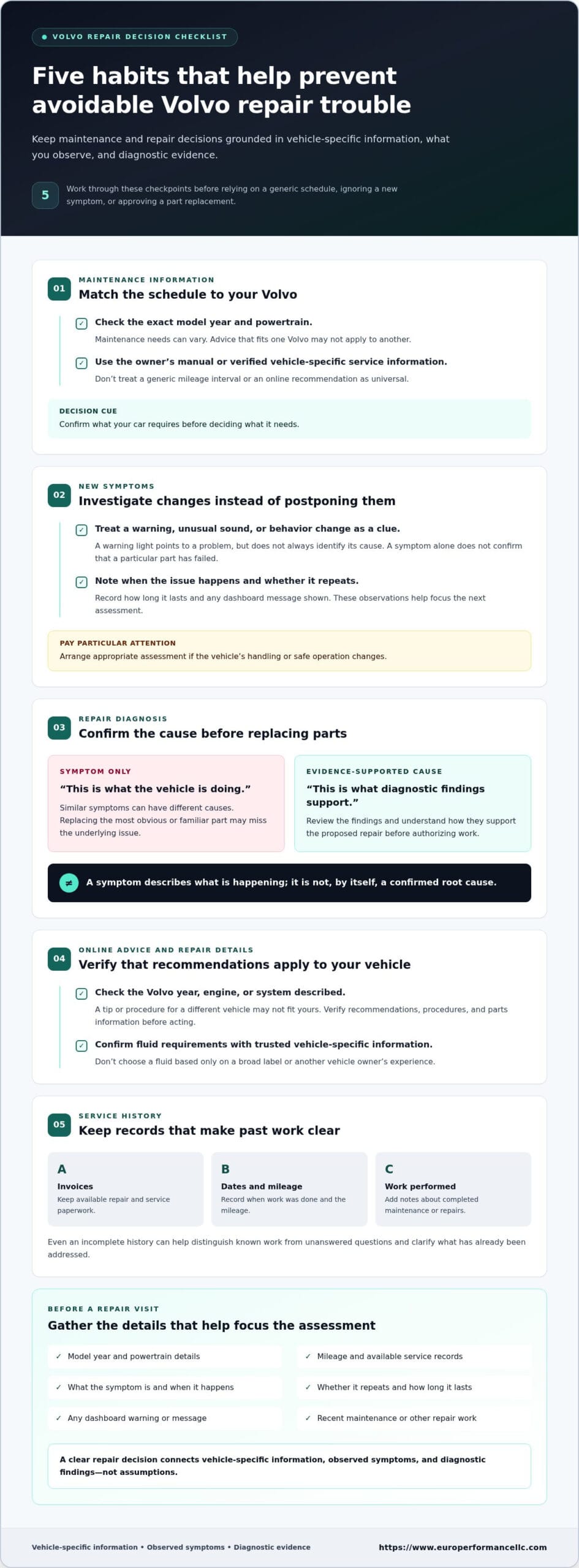
A practical checklist for avoiding common Volvo repair mistakes
A little preparation can make a repair visit more focused and help you understand the decisions that follow. Use this checklist before booking, then refer to it when reviewing the findings and proposed work. You don’t need to diagnose the problem yourself; clear observations and records are enough to give the technician a useful starting point.
Before the appointment: collect useful vehicle details
Write down the exact model year and current mileage, then describe what you’ve noticed in plain language. Include when a noise, warning, or change in performance occurs, how long it lasts, and whether it happens under particular driving conditions. Record any dashboard messages as they appear rather than relying on memory.
- Vehicle details: model year, model, and mileage.
- Symptoms: what changed, when it happens, and how often.
- Recent work: maintenance or repairs that may be relevant.
- Records: available service invoices, dates, and repair notes.
Even an incomplete service history is useful if you distinguish what’s documented from what you’re unsure about. For local owners, expert European auto repair in Belgrade, MT is a relevant resource for organizing maintenance and repair needs around the vehicle’s information.
Before approving work: understand the findings and priorities
Ask for the recommendation to be explained in plain language. What did the inspection or diagnostic process find? How does that finding relate to the symptom? What work is proposed, and what follow-up should you expect? These questions help you understand the repair basis without trying to identify the fault yourself.
Clarify which items affect safe operation and need prompt attention, and which maintenance or repairs can be planned. If the issue may be deferred, ask what to monitor and what change should prompt reassessment. Keep the written estimate and repair findings with the Volvo’s service history so future decisions can account for what was inspected and completed.
This simple routine makes avoiding common volvo repair mistakes more practical: document what you observe, share the available history, and understand the evidence and priorities before authorizing work. For European vehicle maintenance, diagnostics, or repair in Belgrade, Montana, explore European repair expertise at Euro Performance Auto Shop LLC.
Volvo repair support in Belgrade, Montana: choose a disciplined next step
A careful repair decision brings together three things: the Volvo’s service history, maintenance guidance that applies to its model and year, and diagnostic findings that support the recommended work. Keeping these elements connected helps owners avoid guesswork and gives technicians better context for assessing a concern. It also makes it easier to understand which work addresses an active issue and which maintenance can be planned.
What a careful European-vehicle repair process should provide
Vehicle records can show what has already been serviced, while an inspection and diagnostic process help assess the current concern. Modern diagnostic technology supports that work, but the equipment alone doesn’t establish a root cause. Findings should be interpreted alongside the symptoms and vehicle-specific information, then explained in clear terms, including the proposed repair and any maintenance priorities.
At Euro Performance LLC in Belgrade, Montana, ASE-certified technicians provide specialized European vehicle repair, routine and factory scheduled maintenance, and complex diagnostics. The shop uses modern technology and parts from top OE manufacturers. These are useful foundations for a methodical service process, without assuming that every Volvo model has the same requirements or that a particular outcome can be promised.
Plan maintenance and repairs with Euro Performance
Factory scheduled maintenance gives owners a way to follow manufacturer guidance applicable to their vehicle. For a Volvo, use the owner’s manual or verified service information to identify the relevant requirements, and bring available records and a description of current concerns. That context helps connect routine service or complex diagnostic work to the vehicle’s history and the reason for the visit.
Avoiding common volvo repair mistakes doesn’t require owners to diagnose problems themselves. It means choosing a disciplined next step: use accurate service information, share what you know about the vehicle, and seek a clear explanation of findings and priorities. If you’re in Belgrade, Montana, explore European vehicle repair in Belgrade, Montana at Euro Performance LLC.
Make your next Volvo repair decision with confidence
A clear repair decision starts with the right information: maintenance guidance that fits your Volvo, useful service records, and diagnostic findings that support the recommended work. Warning lights and unusual symptoms deserve attention, but they aren’t a diagnosis on their own. Keep notes, ask how findings connect to proposed repairs, and don’t rely on generic advice or parts replacement by guesswork.
That’s the practical approach to avoiding common volvo repair mistakes. For Volvo owners in Belgrade, Montana, Euro Performance LLC provides European vehicle diagnostics and factory scheduled maintenance. Its ASE-certified technicians use modern technology and parts from top OE manufacturers to support careful maintenance and repair decisions.
Explore European vehicle repair at Euro Performance in Belgrade and take a thoughtful next step for your Volvo. With the right records and a disciplined diagnostic process, you can approach service decisions with greater clarity.
Frequently Asked Questions
What are the most common Volvo repair mistakes?
Common mistakes include ignoring the maintenance schedule for your specific model, delaying investigation of a new symptom, and replacing parts without confirming the cause. Owners can also run into trouble by following generic online advice, using unverified fluid specifications, or losing repair records. Avoiding common volvo repair mistakes means matching guidance to your vehicle and relying on inspection findings and diagnostic evidence, rather than assumptions or a warning message alone.
Can I keep driving my Volvo if a warning light comes on?
It depends on the warning and how the vehicle is behaving, so don’t assume every light is safe to ignore. Check your owner’s manual for the meaning and recommended response to the specific message. If the warning accompanies loss of braking or steering, overheating, or another change that affects safe control, stop driving as soon as it’s safe and seek professional assessment. Record the message and any related symptoms.
How do I know whether my Volvo needs a repair or routine maintenance?
Routine maintenance follows the schedule applicable to your Volvo’s model, year, and powertrain. A repair addresses a specific concern, such as a new warning, noise, or change in performance. The two can overlap: a scheduled visit may also reveal an issue that needs further investigation. Check your owner’s manual and service records, then describe symptoms clearly so the technician can distinguish scheduled work from diagnostic needs.
Is it a mistake to use a repair shop that does not specialize in European cars?
Not automatically. The important considerations are whether the shop has the relevant experience, diagnostic process, and information for your particular vehicle and concern. European-vehicle specialization can be useful for model-specific maintenance and complex diagnosis, but no shop category guarantees the right answer by itself. Euro Performance LLC in Belgrade, Montana, specializes in European vehicle repair, with ASE-certified technicians providing maintenance, diagnostics, and repairs.
How can I avoid unnecessary repairs on my Volvo?
Ask how the inspection or diagnostic findings support each recommended repair. A fault code or symptom can guide investigation, but it doesn’t always confirm which part has failed. Review the recommendation, its priority, and any follow-up needed before approving work. Keep estimates and repair records, and use maintenance guidance verified for your exact Volvo. These steps make it easier to distinguish evidence-based work from guesswork.
What should I bring to a Volvo repair appointment?
Bring available service invoices, repair notes, and a record of the Volvo’s current mileage. Write down the symptoms, when they occur, how long they last, and any warning messages displayed. Include recent maintenance or repairs and note changes in performance. You don’t need to identify the cause yourself. Accurate observations and records give the technician context and can help avoid repeating work or overlooking relevant history.
How often should a Volvo be serviced?
Volvo’s general routine maintenance guidance is every 10,000 miles or once a year, but the correct schedule for your car depends on its model, year, powertrain, and driving conditions. Check the owner’s manual or verified vehicle-specific service information rather than relying on a generic interval. Keep a record of completed services and ask a technician to explain which scheduled items apply based on your vehicle’s mileage and history.