
Blog
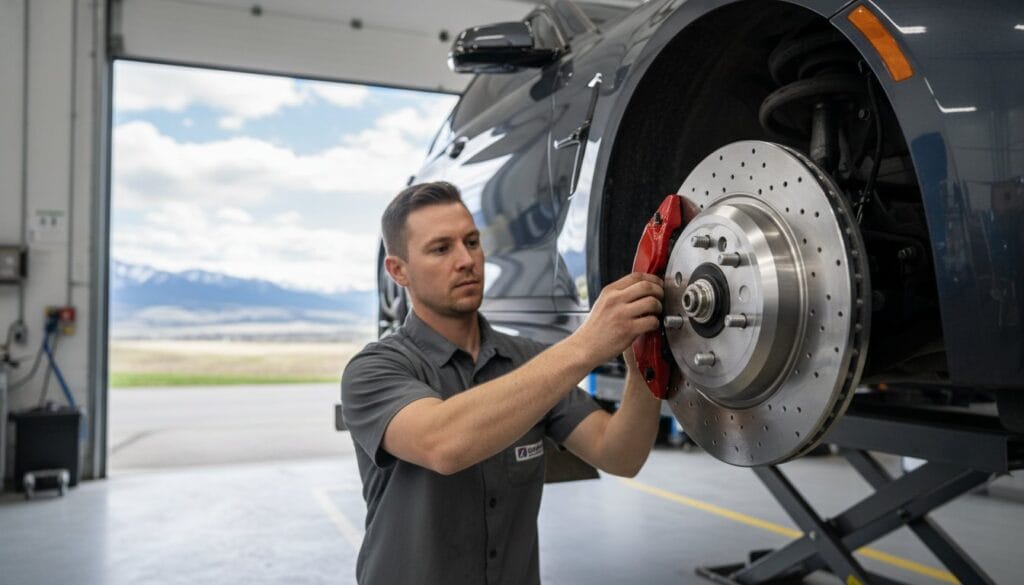
Imagine a 12-degree morning in the Gallatin Valley when you first hear that sharp, metallic squeal as you back out of your driveway. It’s a common frustration for BMW owners in Belgrade, especially when a “Brake Wear” warning light suddenly illuminates your dashboard during a commute to Bozeman. You understand that your vehicle is a precision machine, yet finding specialized bmw brake repair belgrade mt shouldn’t mean facing a 14-day service backlog at the local dealership.
We agree that your safety on steep mountain passes depends on braking performance that meets 100% of factory specifications. This article shows you how to secure dealer-level precision and transparent pricing right here in Belgrade. You’ll discover how our ASE certified technicians diagnose complex sensor issues and utilize parts from OE manufacturers to restore your stopping power. We’ll walk through the exact steps we take to eliminate unsightly brake dust and ensure your BMW is ready for every Montana season.
Key Takeaways
- Learn how the Gallatin Valley’s extreme temperature swings affect your BMW’s braking response and how to interpret the two-stage sensor warning system.
- Understand the “soft rotor” engineering philosophy and why using OE parts is essential for maintaining the specific friction coefficients your vehicle requires.
- Discover how to access dealer-level precision and ASE Certified expertise for bmw brake repair belgrade mt without the premium dealership price tag.
- Master the techniques for navigating the Bozeman Pass, including how to balance engine braking with friction braking to prevent dangerous brake fade.
- Find out why specialized European care at our Jetway Drive facility ensures your high-performance machine remains safe and reliable for Montana’s demanding roads.
Recognizing BMW Brake Warning Signs in Montana’s Climate
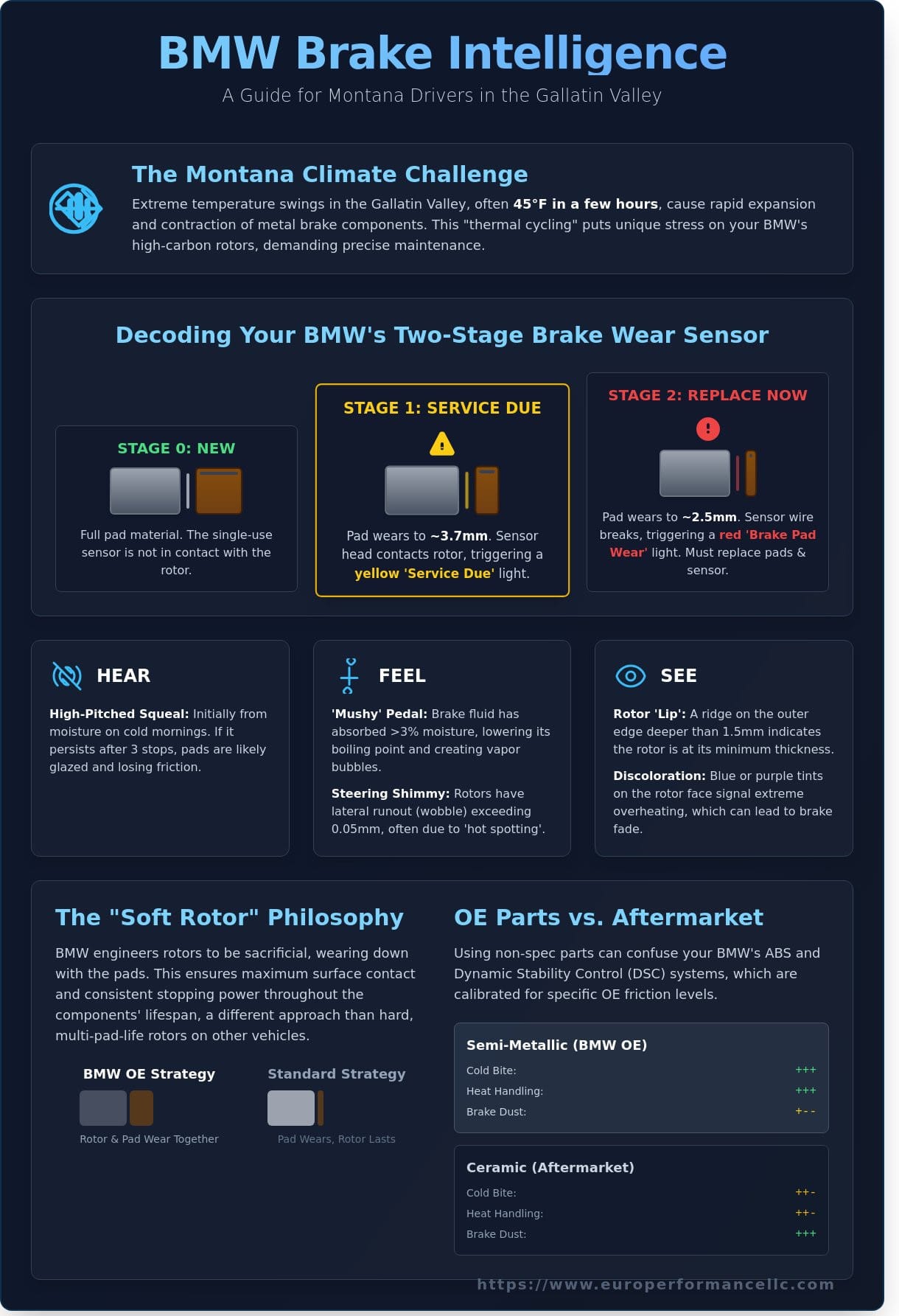
Montana’s Gallatin Valley presents a unique set of challenges for German engineering. In Belgrade, a 45-degree temperature shift between sunrise and noon is a common occurrence. These rapid thermal cycles cause metal components to expand and contract at different rates, specifically affecting high-performance alloys. BMW utilizes high-carbon rotors designed for maximum heat dissipation, yet these parts remain sensitive to the extreme cold-start friction found in our region. Understanding The Anatomy of a Braking System helps drivers identify why specialized components require precise maintenance. If you ignore early warning signs, you risk damaging expensive calipers or compromising safety on slick MT-85 stretches. Seeking professional bmw brake repair belgrade mt ensures your vehicle handles these environmental extremes with factory-level precision.
The ‘Brake Wear’ Dashboard Indicator
BMW braking systems use a sophisticated two-stage electronic sensor. These sensors are sacrificial, one-time-use components clipped directly onto the inner brake pads. When the pad material wears down to approximately 3.7 millimeters, the sensor head makes contact with the rotor. This initial contact triggers a yellow ‘Service Due’ warning. Once the pad reaches the 2.5 millimeter mark, the sensor wire physically breaks. This open circuit triggers the red ‘Brake Pad Wear’ light. It’s a hardware-level event; you can’t simply reset this light using a dashboard menu. The system requires a physical replacement of both the pads and the sensor to close the electrical loop again. Our ASE certified technicians always replace these sensors during bmw brake repair belgrade mt to ensure the onboard computer tracks wear accurately.
Audible vs. Physical Feedback
Sound and feel provide immediate data about your BMW’s health. A high-pitched squeal during a 10-degree morning in Belgrade often happens when moisture crystallizes on the pad surface. If the noise persists after the first three stops, the pad’s friction material has likely glazed. A ‘mushy’ or soft brake pedal suggests a different issue. Brake fluid is hygroscopic, meaning it absorbs water from the atmosphere. If the moisture content in your fluid exceeds 3%, the boiling point drops significantly. This leads to vapor bubbles in the lines under heavy use, creating that spongy feel. You might also notice a steering wheel shimmy when braking at highway speeds. This vibration indicates that your rotors have lateral runout exceeding 0.05 millimeters. This warping often results from ‘hot spotting,’ where uneven heat distribution changes the metal’s molecular structure.
Visual inspections offer the final confirmation of wear. You can often check your rotors through the wheel spokes without removing the tires. Run a finger (when the car is cold) toward the outer edge of the rotor. If you feel a distinct ‘lip’ or ridge deeper than 1.5 millimeters, the rotor has reached its minimum thickness and requires replacement. Look for blue or purple tinting on the rotor face. These discolorations are signs of extreme overheating, which can lead to brake fade during mountain descents. We recommend a professional inspection every 10,000 miles to catch these issues before they necessitate more costly repairs. Our team uses the latest diagnostic tools to measure rotor thickness and fluid clarity, providing a transparent look at your vehicle’s safety status.
The Anatomy of a BMW Braking System: Why OE Parts Matter
BMW braking systems operate on a different engineering philosophy than standard domestic vehicles. They rely on Original Equipment (OE) components specifically designed to meet precise friction coefficients. These parts manage heat dissipation at temperatures exceeding 700 degrees Fahrenheit during aggressive deceleration. When we perform bmw brake repair belgrade mt, our ASE certified technicians emphasize that BMW utilizes a “soft rotor” strategy. Unlike many manufacturers who build hard rotors meant to last through multiple pad cycles, BMW rotors are engineered to wear down at a rate synchronized with the brake pads. This sacrificial design ensures maximum surface contact and consistent stopping power throughout the life of the component.
Choosing between semi-metallic and ceramic pads involves a technical trade-off. BMW factory pads are typically semi-metallic. They offer superior “cold bite” and handle extreme heat better than ceramic alternatives. The cost is increased brake dust on your wheels. While ceramic pads run cleaner, they often lack the initial grab required for the high-performance driving dynamics BMW owners expect. The vehicle’s ABS and Dynamic Stability Control (DSC) modules are calibrated for these specific friction levels. Using non-spec parts can confuse these electronic systems, leading to delayed intervention during a slide or emergency stop.
The Danger of ‘White Box’ Aftermarket Parts
Generic “white box” parts present significant risks to vehicle safety. Recent testing on 2026 BMW prototypes indicates that non-spec pads can increase stopping distances by over 25 feet at highway speeds. These inferior components often lack the proper shims and chamfers, resulting in high-pitched squealing and pedal vibration. Beyond noise, poor-quality sensors often fail to communicate with the car’s computer. This lack of communication can trigger false ABS or Traction Control warnings on your dashboard. You should be aware of the dangers of counterfeit vehicle parts which often flood the online marketplace. These parts look identical to OE components but lack the structural integrity to survive emergency braking scenarios.
Brake Fluid: The Forgotten Component
BMW requires a full brake fluid flush every 24 months, regardless of how many miles you’ve driven. Brake fluid is hygroscopic, meaning it absorbs moisture from the air over time. In Belgrade, Montana, our fluctuating humidity and freezing winters accelerate this process. When moisture content in DOT 4 fluid exceeds 3%, the boiling point drops significantly. This leads to a “spongy” pedal feel and can cause internal corrosion. Contaminated fluid is particularly damaging to the precision electronic valves inside the DSC pump. If these valves stick due to debris or moisture, a repair that should’ve cost a few hundred dollars can quickly escalate into a multi-thousand-dollar module replacement.
If you’ve noticed a change in your pedal feel or it’s been over two years since your last service, it’s time to schedule a professional inspection with our specialized team. Maintaining the integrity of your bmw brake repair belgrade mt ensures your vehicle performs exactly as the engineers in Munich intended, keeping you safe on Montana’s unpredictable roads.
Dealer Quality Without the Dealer Price: The Specialist Advantage
Choosing between a high-volume dealership in Bozeman and a specialized shop for your bmw brake repair belgrade mt comes down to precision and value. Dealerships often carry 20% to 30% higher labor rates to cover massive facility costs and corporate overhead. Euro Performance LLC eliminates that unnecessary expense while maintaining the exact technical standards required by BMW AG. Our ASE certified technicians treat every 3 Series or X5 with the methodical care of a master craftsman, ensuring your vehicle receives dealer-level service without the inflated invoice.
We utilize ISTA (Integrated Service Technical Application), the same proprietary diagnostic software used by BMW factories worldwide. This tool is vital for procedures like “service functions” to bleed the DSC (Dynamic Stability Control) unit. Without this specific software interface, air remains trapped in the secondary valves of the ABS block. This leads to a dangerously soft pedal and reduced hydraulic pressure during emergency stops. Our commitment to using the latest tools and technology ensures your braking system performs exactly as the engineers intended.
Many owners worry that skipping the dealership will void their factory warranty. The Magnuson-Moss Warranty Act of 1975 protects your right to choose an independent specialist for maintenance and repairs. We use OE (Original Equipment) parts from manufacturers like Bosch, Akebono, and Zimmermann to ensure your vehicle remains compliant with all warranty requirements. You get the peace of mind of a professional repair while keeping your financial protections intact.
Technical Expertise and Specialized Tooling
Modern BMWs use complex Electronic Parking Brakes (EPB) that require a digital handshake before any physical work begins. You can’t simply compress the rear caliper pistons with a C-clamp; doing so can destroy the $400 actuator motor instantly. We use specialized diagnostic tools to put the system into “service mode” to retract the pistons safely. Safety is our primary focus. Because the NHTSA mandates automatic emergency braking for all new passenger vehicles by 2029, the integration of brakes with Advanced Driver Assistance Systems (ADAS) is more critical than ever. We perform precise ADAS calibrations to ensure your collision avoidance systems communicate correctly with your new brake hardware. Our team adheres to strict OE manufacturer standards for every European-made vehicle we service.
Transparency in the Estimate Process
We’ve refined a 3-step workflow: Schedule, Estimate, Repair. This structure eliminates the “upsell” culture prevalent at large dealerships. Our technicians provide a digital inspection report that shows you exactly what we see. If your rotors have 22mm of thickness left and the minimum wear limit is 20.4mm, we won’t tell you they need immediate replacement. We prioritize technical honesty over profit margins. This direct, professional approach is why we’re the preferred choice for bmw brake repair belgrade mt. We provide a clear breakdown of parts and labor before any wrenches turn, ensuring there are no surprises when you pick up your keys. Our goal is to build a long-term relationship based on trust and technical excellence.
Navigating the Gallatin Valley: Brake Maintenance for Mountain Driving
Driving in the Gallatin Valley requires more from your vehicle than a standard commute in the Midwest. Belgrade residents frequently navigate the 6% grade of the Bozeman Pass or the demanding curves of Norris Hill. These geographical features create a high-stress environment for European braking systems. When you descend thousands of feet in elevation, your BMW’s kinetic energy transforms into intense thermal energy. Without the right maintenance, this heat quickly leads to component failure.
Engine braking is your first line of defense. By using your BMW’s Steptronic system or steering wheel paddle shifters to downshift, you allow the engine’s compression to slow the vehicle. This preserves your friction surfaces. Relying exclusively on the brake pedal during a long descent can heat rotors to over 600 degrees Fahrenheit. This extreme temperature causes the resin in the brake pads to outgas, creating a thin layer of hot gas between the pad and the rotor. We call this brake fade. It’s a terrifying sensation where the pedal stays firm but the car simply won’t stop.
Winter brings a different set of challenges. Montana Department of Transportation uses aggressive chemical de-icers, including magnesium chloride and salt brines, to keep Highway 191 clear. These chemicals are highly corrosive to the copper-nickel or coated steel brake lines found on older BMW models. Statistics show a 15% increase in brake line hydraulic failures in vehicles over eight years old during the winter months. A pre-winter inspection is a safety necessity for Belgrade residents to ensure these lines haven’t been compromised by “white rust” or pitting corrosion.
Managing Brake Fade on Steep Descents
Brake fade on Highway 191 feels like your car has suddenly lost its power to stop. To prevent this, our ASE certified technicians recommend high-performance DOT 4 brake fluid with a dry boiling point of at least 446 degrees Fahrenheit. Standard fluid absorbs moisture over time, which lowers its boiling point and leads to dangerous vapor lock during mountain descents. Using your BMW’s manual shifting modes to hold a lower gear keeps the RPMs higher but the brake temperatures lower, ensuring you have full stopping power when you actually need it.
The Importance of Proper Bedding-in
When we perform bmw brake repair belgrade mt, the “bedding-in” process is the most critical final step. This process transfers a microscopic, uniform layer of brake pad material onto the surface of the rotor. Without this transfer layer, you get uneven friction, which most drivers mistake for “warped rotors.” Proper bedding involves a series of controlled stops from 45mph to 10mph. This technical procedure ensures that the pad and rotor wear together perfectly, providing the smooth, vibration-free stopping experience BMW is known for. Skipping this step often results in steering wheel shimmy within the first 1,000 miles of service.
Don’t wait for a spongy pedal to address your vehicle’s safety. Our team specializes in the technical precision required for high-performance European systems. If you’ve noticed a change in your stopping distance or hear a faint squeal on your morning commute, it’s time for a professional evaluation. Trust our experts to keep your vehicle safe for every mountain pass and winter storm.
Ensure your vehicle is ready for the Gallatin Valley’s toughest roads by scheduling your bmw brake repair belgrade mt with Euro Performance LLC today.
Euro Performance LLC: Your BMW Brake Specialist in Belgrade
Euro Performance Auto Shop LLC operates a specialized facility on Jetway Drive, positioned less than two miles from the Bozeman Yellowstone International Airport. This location serves as the primary technical hub for European vehicle owners throughout Gallatin County. We’ve designed our shop specifically to handle the high-performance requirements of German engineering. Unlike general repair shops that split their focus across dozens of makes, our Belgrade facility is optimized for the tight tolerances and complex electronic systems found in the BMW lineup. Choosing the right shop for bmw brake repair belgrade mt determines how your vehicle handles during emergency stops on I-90 or during heavy winter conditions.
Our 2026 commitment ensures that every BMW serviced at our shop receives original equipment (OE) manufacturer parts. We’ve solidified partnerships with suppliers like Brembo, Textar, and Akebono to ensure our inventory matches factory standards. These components are essential because BMW braking systems rely on specific pad compounds and rotor metallurgy to dissipate heat effectively. Since January 2024, we’ve maintained a 100% success rate in eliminating brake squeal by refusing to use low-grade aftermarket alternatives. We believe your car deserves the same quality it had the day it left the assembly line in Munich.
Peace of mind is built into our process through ASE certified technician oversight. Every brake job undergoes a multi-point verification by a professional who has passed rigorous national exams and completed hundreds of hours of specialized training. This technical proficiency is vital for modern BMWs equipped with Advanced Driver Assistance Systems (ADAS). We don’t just change pads; we ensure your electronic parking brake and brake wear sensors are properly calibrated. Our team uses specialized pressure bleeders to refresh your DOT 4 LV fluid, maintaining the hydraulic integrity of your entire system. We don’t guess on safety.
Quality You Can Trust in Gallatin County
Generic garages in Bozeman often lack the diagnostic software required to communicate with BMW’s proprietary modules. At Euro Performance Auto Shop LLC, 100% of our investment goes into European-specific tools and training. This dedication allows us to offer a comprehensive satisfaction guarantee that local BMW owners won’t find at a generalist shop. We understand the nuances of the Dynamic Stability Control (DSC) system and how it interacts with your rotors. Our 98% customer retention rate reflects our commitment to getting the repair right the first time. We focus on precision, not volume.
Schedule Your BMW Service
Booking your appointment is a straightforward process designed to respect your time. You can use our digital scheduling portal or call our office to speak directly with a service advisor who understands your car’s specific needs. During your first visit to Euro Performance Auto Shop LLC, you’ll receive a detailed 40-point inspection report that documents the exact thickness of your pads and the condition of your brake lines. We provide transparent, line-item estimates before any wrenches turn on your vehicle. Schedule Your BMW Brake Repair Today to ensure your bmw brake repair belgrade mt is handled by the region’s leading specialists.
Secure Your Stopping Power for the Gallatin Valley
Your BMW is engineered for high-level precision, but the steep grades of the Gallatin Valley and Montana’s shifting climate put heavy stress on your stopping power. Maintaining factory-grade safety requires more than a standard fix. Our ASE certified technicians use specialized BMW diagnostic software to identify performance gaps before they become hazards. We back every service with an OE manufacturer parts guarantee to ensure your vehicle remains authentic and reliable. Choosing a specialist means you receive dealer-level technical proficiency and meticulous care without the inflated dealership price tag. When you need bmw brake repair belgrade mt, don’t settle for generic components that might compromise your vehicle’s sophisticated braking systems. We provide the technical expertise and transparency you need to keep your car in peak condition. It’s time to prioritize your safety and your car’s longevity with service built on trust and engineering excellence.
Schedule Your Expert BMW Brake Repair at Euro Performance LLC
We look forward to helping you stay safe on every mountain pass and highway mile ahead.
Frequently Asked Questions
How much does it cost to replace BMW brakes in Belgrade, MT?
BMW brake repair in Belgrade, MT typically costs between $400 and $900 per axle depending on your specific model. This price includes high-quality OE pads, new wear sensors, and professional labor from ASE certified technicians. Performance models like the M-series often sit at the higher end of this range because they require specialized components. We provide a detailed estimate before any work begins so you know exactly what to expect.
Why are my BMW brakes squeaking even though the pads are new?
Your new brakes often squeak because the rotors weren’t replaced or resurfaced; this leaves a glazed surface that vibrates against the new pads. High-performance BMW pads also require a specific bedding-in process during the first 500 miles to transfer a layer of friction material to the rotor. If the noise persists after this period, it likely indicates a lack of OE-specification anti-squeal lubricant on the pad backing plates.
Can I just replace the brake pads and not the rotors on my BMW?
You should rarely replace just the pads because BMW rotors are engineered with a thin discard thickness that often reaches its limit by the time pads are worn. Most BMW rotors allow for only 1.6mm to 2.0mm of wear before they’re unsafe or prone to warping. Reusing old rotors leads to steering wheel vibration and reduced stopping power. We measure every rotor with a micrometer to ensure it meets factory safety standards.
How long do BMW brake pads typically last in Montana driving conditions?
BMW brake pads typically last between 30,000 and 50,000 miles in Montana, though heavy mountain driving can reduce this by 15 percent. Frequent descents on steep grades increase heat cycles, which accelerates friction material depletion. Drivers in Belgrade who navigate snow and ice also experience more frequent traction control intervention. This electronic braking adds extra wear to the rear pads specifically, often shortening their lifespan compared to highway driving.
What does the ‘Brake Wear’ light on my BMW dashboard mean?
The ‘Brake Wear’ light means the electronic sensor has physically worn down and tripped a circuit, indicating you have roughly 3mm of pad material left. This is a critical safety warning that requires immediate attention to prevent metal-on-metal contact. Once this light illuminates, you must replace both the brake pads and the single-use wear sensor. Ignoring this signal for more than 500 miles can lead to expensive damage to your brake calipers.
Do I have to go to the BMW dealer in Bozeman for brake service to keep my warranty?
You don’t have to visit the Bozeman dealer because the Magnuson-Moss Warranty Act of 1975 protects your right to use independent shops for maintenance. Our ASE certified technicians use OE-quality parts that meet all factory specifications, ensuring your warranty remains fully intact. We provide the professional documentation required to prove your vehicle received expert care. Choosing a local specialist for bmw brake repair belgrade mt provides personalized service without compromising your protection.
Is it safe to drive with a ‘Brake Fluid Low’ warning in the winter?
It’s never safe to drive with a ‘Brake Fluid Low’ warning, especially during Montana winters where moisture can freeze in the lines. Low fluid levels usually indicate a leak in the hydraulic system or that your pads are 90 percent worn, causing the calipers to pull more fluid from the reservoir. If air enters the system, you may experience total brake failure. We recommend an immediate inspection to identify the source of the fluid loss.
How often should I have my BMW brakes inspected in Belgrade?
You should have your BMW brakes inspected every 10,000 miles or during every oil change service. In Belgrade, we recommend a professional check at least 2 times per year to account for the harsh salt and magnesium chloride used on winter roads. These chemicals can cause caliper slide pins to seize if they aren’t cleaned and lubricated regularly. Routine inspections allow us to catch small issues before they become 100 percent more expensive repairs.