
Blog
Did you know that in the Kalispell area alone, the Montana Department of Transportation applied over 2.5 million gallons of liquid de-icing brine in a single winter season? While these chemical agents keep our highways passable, they create a highly corrosive environment for the high-precision components of your BMW, Audi, or Mercedes-Benz. Finding specialized european car care tips for montana drivers is essential because our “severe service” climate demands more than standard maintenance. The combination of extreme thermal shock and magnesium chloride requires a technical approach to preserve the sophisticated engineering of your vehicle.
We understand the concern that comes with driving through remote mountain passes or parking in sub-zero temperatures. You want the peace of mind that your engine will start reliably and that road salts won’t silently corrode your investment. This guide provides the specific maintenance strategies you need to protect your vehicle’s performance and long-term resale value. You will learn about specialized cold-weather fluid requirements, how to neutralize chemical corrosion, and the essential maintenance steps required to master Montana’s unique driving conditions.
Key Takeaways
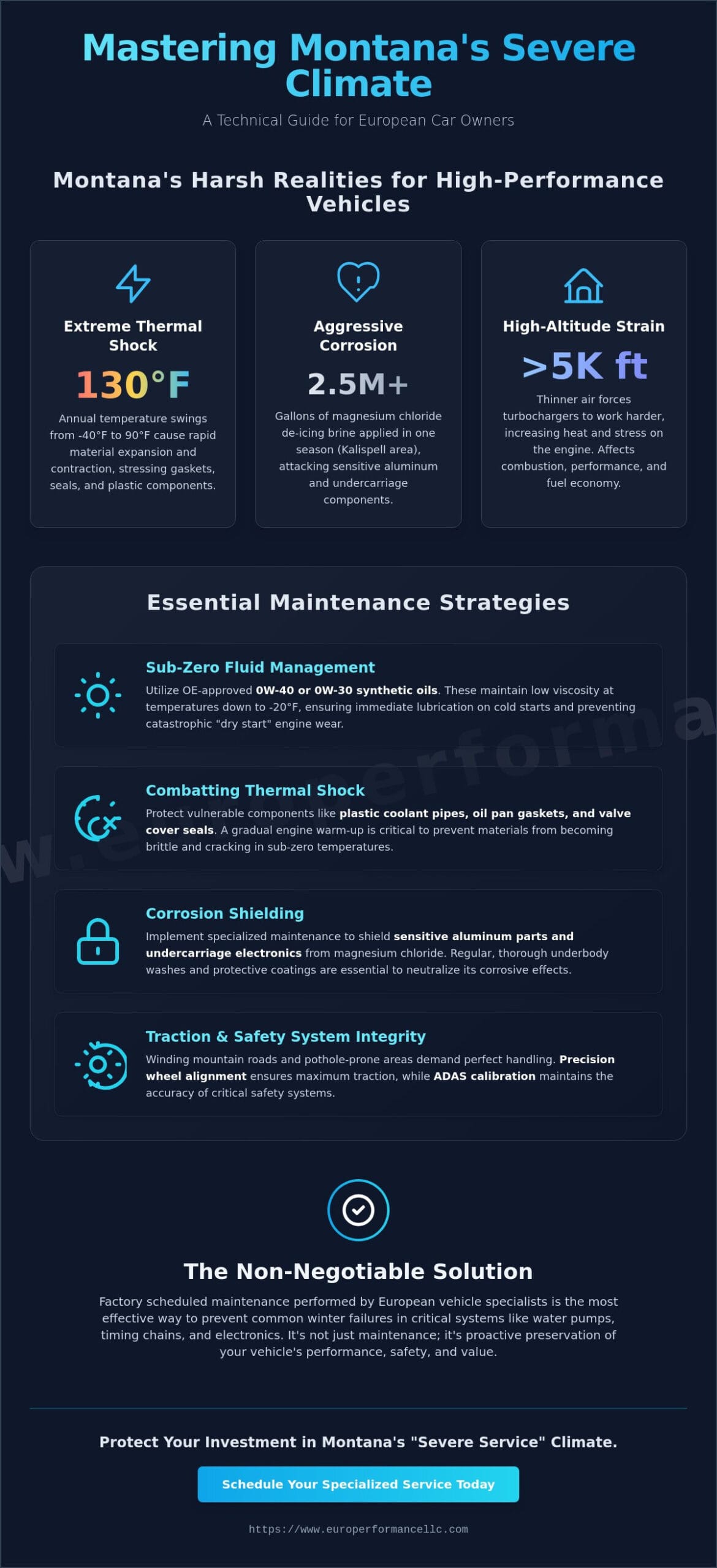
- Understand how to protect engine seals and gaskets from the “thermal shock” caused by Montana’s 130-degree annual temperature fluctuations.
- Implement critical european car care tips for montana drivers by using OE-approved synthetic fluids designed to maintain proper viscosity at temperatures as low as -20°F.
- Learn why precision wheel alignment and ADAS calibration are vital for maintaining control and safety system accuracy on winding mountain roads and through pothole-prone areas.
- Discover specialized maintenance techniques to shield sensitive aluminum components from the aggressive corrosive effects of magnesium chloride road brine.
- Recognize why factory scheduled maintenance performed by European specialists is the most effective way to prevent common winter failures in water pumps and timing systems.
Navigating Montana’s Extreme Climate in a European Vehicle
Montana drivers face environmental challenges that would baffle many automotive engineers in Europe. The state’s 130-degree annual temperature range, swinging from -40°F in the dead of winter to 90°F in the summer, puts immense stress on precision-engineered vehicles. For those living in Belgrade or Bozeman, these “severe service” conditions are the daily reality, not the exception. Low humidity levels in the Mountain West also accelerate the degradation of rubber suspension bushings, leading to premature squeaks and compromised handling. Following specific european car care tips for montana drivers keeps your engine running smoothly despite these environmental pressures.
To better understand how these conditions impact your vehicle’s electrical health and general winter readiness, watch this helpful video:
The Impact of Thermal Shock on European Gaskets
Thermal shock occurs when engine materials expand and contract at vastly different rates. European engines frequently use a sophisticated mix of aluminum alloys and high-grade plastics to save weight and improve efficiency. In many BMW models, the plastic coolant pipes are particularly vulnerable to this phenomenon. After a spirited climb over a mountain pass, the engine is hot. If you shut it down immediately in sub-zero air, the rapid cooling can cause these plastic components to become brittle and crack. Audi and Mercedes-Benz owners should also be vigilant regarding oil pan gaskets and valve cover seals. These components are most likely to fail during a cold start when the rubber is frozen and lacks flexibility. A gradual warm-up period is a critical safety directive to allow these high-performance alloys to expand evenly.
Altitude and Your Turbocharged Engine
Driving through the Rockies changes the fundamental physics of combustion. At the summit of Bozeman Pass, the air is significantly thinner than it is at sea level. Your turbocharger must work much harder, spinning at higher RPMs to compress enough oxygen to maintain requested boost levels. This increased workload generates significant internal heat. We recommend a thorough check of intercooler efficiency before tackling summer mountain passes to ensure your intake air stays dense. Because the engine operates under higher load to compensate for the altitude, it’s wise to shorten spark plug replacement intervals. Fouled plugs or a weak spark will cause noticeable performance drops and fuel economy loss more quickly at 5,000 feet than they would at sea level. For more information on specific service timelines, you can refer to our Factory Scheduled Maintenance: A Complete Guide.
Essential Fluid and Filtration Management for Sub-Zero Performance
High-precision European engines are designed with tight tolerances that demand specific fluid viscosities to function correctly. When temperatures drop to -20°F or lower, standard fluids can thicken, leading to catastrophic internal wear during the first few seconds of operation. Mastering european car care tips for montana drivers starts with a meticulous approach to fluid management. This ensures that every component, from the turbochargers mentioned previously to the smallest solenoid, receives immediate lubrication and protection. Proper fluid choices act as the first line of defense against the thermal stresses of the Mountain West.
Selecting the Right Oil for a Montana Winter
The “W” in oil ratings stands for winter. In Belgrade and Bozeman, a 0W-40 or 0W-30 synthetic oil is often essential. The “0” indicates the oil’s ability to flow at extremely low temperatures, preventing the “dry start” that ruins engine bearings. We utilize only OE-approved synthetics that meet the stringent standards of manufacturers like BMW, Porsche, and Mercedes-Benz. You can learn more about these requirements through our Expert Oil Change Services in Bozeman, MT. Additionally, avoid generic oil filters. High-pressure cold starts can cause cheap paper filters to collapse or bypass, allowing unfiltered oil to circulate through your high-value engine.
Coolant and Anti-Freeze: Beyond Just Temperature
European manufacturers use specific chemical formulations, often identified by colors like blue, pink, or violet. You must never mix these with generic “all-vehicle” green coolants. Doing so creates a chemical reaction that forms a thick gel, clogging the narrow passages of your radiator and heater core. For Montana’s climate, we often recommend a 60/40 coolant-to-water ratio to provide protection down to -52°F. It is also vital to test the pH level periodically. Over time, coolant becomes acidic, leading to radiator electrolysis. This process eats away at aluminum components from the inside out, causing leaks that are expensive to repair.
Brake fluid is hygroscopic, meaning it naturally absorbs moisture from the air. During Montana’s heavy spring runoff, the increased humidity can saturate your brake fluid. This lowers the boiling point and causes internal corrosion in ABS modules. Similarly, do not overlook your transmission and differential fluids. The constant gear-hunting required for mountain driving generates significant heat, even in winter. Fresh, high-quality gear oil ensures your driveline remains reliable when climbing steep grades. If you are unsure about your vehicle’s current fluid health, scheduling Specialized European Auto Repair is the most reliable way to verify your winter readiness.
Maximizing Traction and Safety: Alignment, ADAS, and Driveline Care
Montana’s mountain passes and the notorious pothole season around Bozeman present a constant threat to your vehicle’s geometry. European cars are engineered with precise suspension settings to provide superior handling; however, this precision makes them highly sensitive to impacts. A single encounter with a frost heave can knock your vehicle out of factory specification. Integrating a professional wheel alignment into your seasonal european car care tips for montana drivers is a proactive way to ensure your car remains safe and predictable on icy surfaces.
Precision Alignment for Mountain Roads
Winding canyon roads demand constant steering input. If your alignment is even slightly off, your tires will scrub against the pavement. This leads to rapid, uneven wear that can ruin a set of premium tires in just one season. Beyond tire longevity, proper alignment reduces rolling resistance. This is vital for maintaining fuel economy during long highway hauls across the state. Finding a specialist who understands factory-specific tolerances is essential for these high-performance systems. For more details, see our guide on Choosing the Right Alignment Shop.
Montana winters place extreme stress on advanced all-wheel-drive systems like Audi’s Quattro, BMW’s xDrive, and Volkswagen’s 4Motion. These systems work overtime to manage torque on slick roads, engaging and disengaging clutches to find grip. We recommend regular inspections of drive shafts and CV boots during every service. If a rubber CV boot cracks in sub-zero temperatures, the specialized grease inside can escape. This allows road salt and grit to enter the joint, leading to an expensive failure. Catching a small tear before the deep freeze can save thousands in repair costs.
ADAS Calibration in Winter Environments
Modern European vehicles use Advanced Driver Assistance Systems (ADAS) to help you stay in your lane and avoid collisions. These systems rely on cameras and radar sensors that are calibrated based on the car’s thrust angle. If your wheel alignment is off, your safety systems may “see” the road incorrectly, leading to erratic lane-keep assist behavior. Additionally, Montana’s gravel-heavy winter roads often lead to cracked windshields. If you replace your glass, you must perform a professional recalibration of the cameras mounted behind it. You can learn why this is a technical necessity in our article What is ADAS Calibration. Keeping your car’s exterior sensors free of snow and ice buildup is another vital safety directive for winter travel.
Protecting Your Investment from Road Salt and Corrosion
Montana’s Department of Transportation utilizes a liquid de-icing agent composed of magnesium and sodium chlorides. While effective for maintaining safety on I-90 or MT-85, these chemicals are devastating to the high-grade aluminum and specialized alloys found in German and Italian vehicles. Standard car washes often fail to reach the intricate recesses where these brines accumulate. Effective european car care tips for montana drivers must prioritize chemical neutralization over simple rinsing. Road brine is a liquid salt solution designed to stick to surfaces, and its ability to penetrate electrical harnesses and porous aluminum makes it far more aggressive than traditional rock salt.
The “Hidden” Corrosion Zones
Audi and Volkswagen models often feature wheel well liners that, while excellent for noise reduction, act as sponges for salt-laden slush. This trapped moisture sits against the chassis, slowly compromising the factory finish. For owners of luxury SUVs like the Mercedes-Benz GLE, the air suspension system requires specific attention. Magnesium chloride can degrade the rubber bellows and corrode the brass fittings of the air lines, leading to expensive leaks. We also recommend a thorough cleaning of the radiator and condenser fins every spring. Salt buildup here restricts airflow and can lead to the “thermal shock” issues discussed in previous sections. Catching these deposits early prevents the cooling system from working overtime during the summer months.
Preventative Underbody Care
European manufacturers are known for superior rust-resistance due to extensive galvanization processes. However, these defenses aren’t invincible against Montana’s high-volume chemical applications. During a professional inspection, we look for compromised factory under-coatings where gravel has chipped the protective layer. Even a small breach allows salt to migrate beneath the coating, causing “spiderweb” corrosion that remains hidden from view. Electrical sensors and connectors are also high-risk areas. These should be cleaned using specialized “dry” contact cleaners rather than high-pressure water, which can force brine deeper into the connector pins. Protecting your vehicle’s structural integrity requires a methodical, technical approach that goes beyond the capabilities of a local drive-through wash. If you haven’t had your undercarriage inspected since the last snow, scheduling Specialized European Auto Repair is the most effective way to halt corrosion before it takes hold.
Why Specialized Factory Scheduled Maintenance is Non-Negotiable
Precision-engineered European vehicles require a level of technical oversight that generic repair shops simply cannot provide. While a standard oil change facility focuses on speed, they often overlook the subtle early warning signs of component failure. A weeping water pump or a hairline crack in a timing belt might go unnoticed during a 15-minute service, yet these issues lead to catastrophic breakdowns on remote Montana highways. Relying on ASE-certified technicians who specialize in marques like BMW and Porsche ensures that your vehicle is evaluated by professionals who understand these specific engineering nuances. For a detailed breakdown of what your vehicle requires, refer to our Factory Scheduled Maintenance: A Complete Guide.
Adhering to a rigorous service schedule also plays a critical role in maintaining high resale value. In the competitive Montana import market, savvy buyers look for a documented history of specialized care. They want proof that the vehicle has been protected against the thermal shock and chemical corrosion discussed throughout this guide. Proactively implementing these european car care tips for montana drivers transforms maintenance from an expense into an investment in your vehicle’s longevity.
The Belgrade Alternative to Big Dealerships
Euro Performance Auto Shop LLC offers a personalized, climate-aware alternative to regional dealerships. We understand the “severe service” demands of our local environment and adjust our maintenance strategies accordingly. This includes the exclusive use of Original Equipment (OE) parts, which are designed to withstand the extreme temperature fluctuations of the Gallatin Valley. Our facility utilizes advanced diagnostics to identify “ghost” electrical issues. These are often triggered by the voltage drops common in sub-zero weather, and they require specialized software to accurately diagnose and clear. We provide the technical precision of a dealership with the transparency and methodical approach of a specialized boutique.
Scheduling Your Season-End Inspection
The most effective way to stay ahead of Montana’s climate is to schedule a comprehensive “Montana Health Check” twice a year. We recommend these inspections during the transitional periods of Spring and Fall. During a Fall inspection, we focus on battery cold-cranking amps, heater core efficiency, and fluid freeze points. In the Spring, our priority shifts to neutralizing road brine deposits and inspecting the suspension for pothole damage. You can expect a transparent, process-oriented explanation of your vehicle’s status after every visit. Don’t wait for a warning light to appear during a blizzard. Schedule your specialized European maintenance at Euro Performance Auto Shop LLC today.
Secure Your European Performance for Every Montana Season
Mastering the unique demands of our environment requires more than just a standard oil change. It demands a technical understanding of how sub-zero temperatures affect synthetic fluids and how Montana’s road brine interacts with precision aluminum components. By prioritizing specialized maintenance and seasonal inspections, you protect both the safety of your passengers and the long-term resale value of your vehicle. These proactive steps ensure that your car’s sophisticated systems remain reliable when you need them most.
Implementing these european car care tips for montana drivers is the most reliable way to ensure your vehicle remains a high-performing asset through every mountain pass and winter storm. Our ASE Certified Technicians utilize advanced ADAS calibration technology and specialized diagnostic equipment to provide the meticulous care your BMW, Audi, Mercedes, or VW deserves. We invite you to experience the precision of a master craftsman in every service we perform.
Book Your European Specialist Service in Belgrade and enjoy the peace of mind that comes with expert automotive stewardship. Drive with confidence knowing your vehicle is prepared for whatever the Rockies have in store.
Frequently Asked Questions
Do European cars really need special oil for Montana winters?
Yes. European manufacturers specify OE-approved synthetic oils with specific cold-start flow characteristics. In Montana, where temperatures can drop to -40°F, using a 0W-rated oil is essential to prevent internal engine wear during the first few seconds of operation. These high-performance lubricants ensure that oil reaches critical components like turbochargers and camshafts immediately, even when the engine is completely frozen.
How often should I get an alignment if I drive on Montana dirt roads?
We recommend a professional wheel alignment at least twice a year for vehicles frequently driven on unpaved surfaces. Dirt roads and frost heaves in the Gallatin Valley create constant vibration and impact that can easily displace factory settings. Regular checks are a vital part of european car care tips for montana drivers because they prevent premature tire wear and ensure your safety systems remain correctly calibrated for mountain driving.
Will road salt ruin my Audi or BMW’s aluminum frame?
While aluminum does not rust like steel, the magnesium chloride road brine used by the Montana Department of Transportation causes severe pitting and oxidation. This chemical reaction weakens structural components and degrades the aesthetic value of your vehicle. Neutralizing these chemicals through specialized underbody cleaning is essential to prevent the salt solution from eating into the porous aluminum surfaces of your frame and suspension.
Can I use regular antifreeze in my Mercedes-Benz?
No. Mercedes-Benz and other European marques require specific chemical formulations to prevent internal corrosion and electrolysis. Mixing regular green antifreeze with specialized European fluids can cause a chemical reaction that gels the coolant. This gel eventually clogs the narrow passages of your radiator and heater core, leading to engine overheating and expensive cooling system repairs.
Why does my “Check Engine” light come on when it gets extremely cold?
Extreme cold often triggers sensors due to voltage drops in the battery or changes in air density. However, it can also signal a more serious issue like a failing thermostat or a vacuum leak in a brittle plastic hose. You should have a specialized technician perform a diagnostic scan to identify the specific fault code rather than assuming it is just a temporary cold-weather glitch.
How much does a pre-purchase inspection cost for a used European car in Montana?
The cost of a pre-purchase inspection depends on the complexity of the vehicle and the depth of the diagnostic testing required. A thorough inspection at a specialized facility includes an underbody corrosion check, a scan for hidden electrical faults, and a review of the factory scheduled maintenance history. This process ensures the vehicle is prepared for local conditions and helps you avoid inheriting expensive mechanical issues.
What is the most important winter car care tip for a BMW driver?
Maintaining a healthy battery and using the correct 0W-weight synthetic oil are the most critical factors for BMW owners. BMW engines rely on high-precision solenoids and sensors that are extremely sensitive to voltage fluctuations. Ensuring your battery is tested for cold-cranking amps before the first deep freeze prevents most common winter starting failures and protects the vehicle’s sophisticated electronic modules.
Is it safe to drive my European SUV in deep Montana snow?
Yes, provided you have appropriate traction devices and your all-wheel-drive system is properly maintained. European SUVs like the Audi Q7 or BMW X5 are highly capable, but their performance depends on the health of CV boots and differential fluids. Always check road conditions through the Montana Department of Transportation 511 app and ensure your tires meet the legal requirements for winter travel.