
Blog

A vehicle inspection and MSU driving approval are separate processes, so there is no single document packet for both. For a European car inspection as an out-of-state MSU student, have the vehicle’s identifying details and available maintenance records ready. University or registration paperwork depends on the specific process.
It’s easy to confuse a mechanic’s assessment of a vehicle with paperwork for campus driving or vehicle registration. Identifying which process you need helps you prepare the right documents without mistaking routine service records for official application forms.
This article explains how to identify the inspection you need, what to gather for the appointment, and where a European-vehicle repair shop fits in. You’ll be able to distinguish inspection preparation from university or registration requirements and know what information to have on hand.
Key Takeaways
- Separate a mechanic’s inspection from university driving approval or vehicle-registration paperwork; each process has its own purpose and documents.
- Michigan’s no-fault insurance requirements are stated in MCL 500.3101 and its sub-parts, according to the Michigan Legislature.
- For tuition residency, a dependent student’s eligibility is assessed differently from a non-dependent student’s; age and supporting documentation matter.
- Review the applicable state-status pathway before preparing an application, since qualifying routes may depend on education, employment, or other circumstances.
- Organize vehicle details and maintenance records for an inspection, then turn to Euro Performance Auto Shop LLC for specialized European auto repair when the car needs technical assessment or service.
How can an out-of-state student get a European car inspected near MSU?
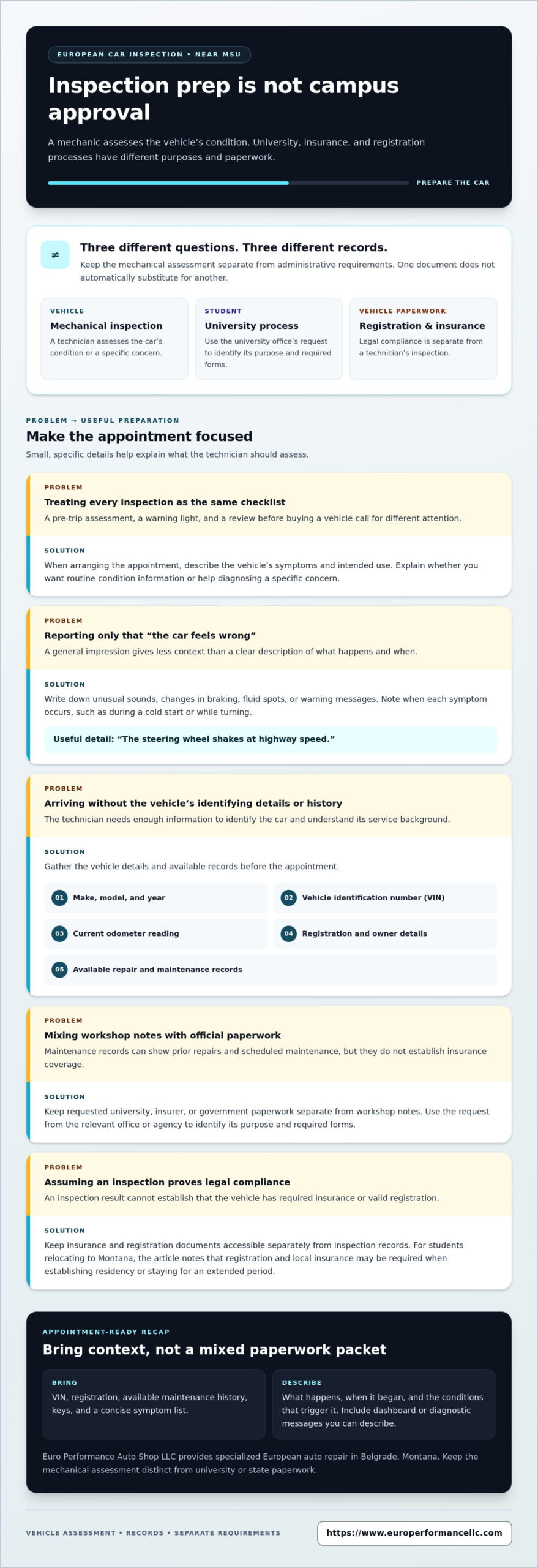
A mechanical inspection is a technician’s assessment of a vehicle’s condition, not an MSU application review. If you’re a student near Montana State University in Bozeman, first decide what you need the inspection to address. A pre-trip assessment, a warning light, and a review before buying a vehicle each call for different attention. Describe the vehicle’s symptoms and intended use when arranging an appointment at Euro Performance Auto Shop LLC. This helps focus the assessment on relevant systems rather than treating every inspection as the same checklist.
A document packet for an inspection contains information that helps identify the car and its service history. Before the appointment, gather the registration, vehicle identification number (VIN), owner details, and available maintenance records. The VIN identifies the specific vehicle, while service records can show prior repairs and scheduled maintenance. If a dashboard warning appears, note when it started and whether it returns after restarting the car. These details give the technician useful context.
Prepare the vehicle and records
A pre-inspection check is a brief review of details that may help the technician assess the vehicle. Before driving to an appointment near Bozeman, note unusual sounds, changes in braking, fluid spots, or warning messages. Record when each symptom occurs, such as during a cold start or while turning. Keep your notes factual: “The steering wheel shakes at highway speed” is more useful than “the car feels wrong.” Don’t attempt a repair just to hide a warning.
Use this sequence to prepare:
- Record the make, model, year, VIN, and current odometer reading.
- Collect registration and available repair or maintenance records.
- List each symptom, when it began, and the conditions that trigger it.
- Bring the keys and any dashboard or diagnostic messages you can describe.
These items support a mechanical evaluation, but they aren’t automatically official application requirements. If a university office, insurer, or government agency requested paperwork, use that request to identify its purpose and required forms. A maintenance record, for example, can document past service, but it does not establish insurance coverage. Keep requested paperwork separate from workshop notes so each record goes to the right place.
Keep local registration and insurance rules distinct
State vehicle registration and auto-insurance compliance are legal requirements, not a mechanical inspection. According to Montana vehicle statutes, keeping your vehicle properly registered and insured is required for all resident and out-of-state drivers operating vehicles within the state. These regulations concern legal compliance and financial responsibility; they do not describe a technician’s inspection checklist. The distinction matters for an out-of-state student whose vehicle may be used across different jurisdictions. An inspection result and proof of insurance serve different purposes, so don’t treat one as a substitute for the other.
For students relocating to Montana for school, state regulations generally require individuals to register their vehicles and obtain local insurance if establishing residency or staying for an extended period. Keep a record of where and when the vehicle is driven if extended state use is part of your plans. This is a local regulatory rule and should not be mistaken for a rule governing a mechanical diagnostic test performed at Euro Performance Auto Shop LLC in Belgrade, Montana.
Driving without required auto insurance or valid registration can carry financial and legal consequences, including standard state traffic fines. A mechanical inspection cannot establish that the vehicle has the required legal coverage. Keep insurance and registration documents accessible separately from your Euro Performance Auto Shop LLC inspection records, especially when travelling between states. The state where the car is driven, the length of use there, and the vehicle’s condition are separate issues that call for separate documentation.
For an efficient European car inspection near MSU in Bozeman, prepare the VIN, registration, maintenance history, and a concise list of symptoms for Euro Performance Auto Shop LLC. Explain whether you need routine condition information or help diagnosing a specific concern. If your plans include updating your vehicle registration or insurance policy, handle those questions separately under the applicable state rules. Separating the mechanical assessment from administrative paperwork keeps the appointment focused and clarifies what each document proves.
Dependent student
A dependent student is a student MSU presumes dependent for residency purposes if the student is 24 years of age or younger. This classification concerns tuition residency, not whether a European vehicle can receive a mechanical inspection. A student arranging an inspection near Montana State University in Bozeman should keep the vehicle appointment separate from any residency application connected with Michigan State University. The shared abbreviation, MSU, can otherwise make two different processes appear connected.
Age is a starting point in this residency definition, not a complete description of a student’s family or financial circumstances. For example, a student who is 24 falls within the stated presumed-dependent group. A student who is 25 does not fall within that particular age-based presumption. The age threshold alone doesn’t establish every eligibility detail or determine a vehicle’s condition. Keep the question being answered clear: tuition classification concerns the student, while inspection concerns the car.
Dependency may matter because a student’s residency application can rely on information about a parent or another person. Before completing paperwork, identify whose circumstances the application asks you to document. Don’t assume an out-of-state driver’s license, vehicle registration, or insurance card establishes tuition residency. Those records relate to driving or vehicle use and don’t, by themselves, explain the student’s dependency status under MSU residency rules.
Before submitting anything, sort records by purpose. Keep tuition-residency documents separate from vehicle records. If a form asks about a parent, don’t substitute the vehicle owner’s information unless the form requests it. If an inspection appointment asks for the car’s VIN or service history, those details belong with the vehicle, not the residency application. Separating the records helps prevent paperwork mix-ups.
Use the application’s wording to guide what you gather. A document supports a claim only when it addresses the fact the application asks about. For example, a student may need to organize records explaining the relationship or circumstances named on the residency form. A service invoice can describe past vehicle work, but it doesn’t prove family dependency. Similarly, a parent’s address in a car record doesn’t automatically establish the student’s tuition classification.
Before sending a residency application, compare each requested item with the student’s situation. Keep copies of completed forms and supporting records together, and note whom each record concerns. If a question refers to the student’s age, use the student’s age, not a parent’s. If it concerns a vehicle, use the vehicle’s details. These checks make the packet easier to understand and help prevent unrelated documents from being treated as evidence.
- Identify whether the paperwork concerns tuition residency or a vehicle inspection.
- For MSU residency, note that the stated dependent presumption applies at 24 years of age or younger.
- Match each supporting document to the person and issue named on the form.
- Keep vehicle records, such as registration and service history, separate from residency materials.
A student’s age can clarify which dependent-student rule applies, but it doesn’t replace the rest of the application process. Read each question carefully and organize evidence around the specific claim it supports. For a Bozeman inspection, prepare vehicle information for the technician. For Michigan State University residency paperwork, prepare the student-related records requested by the application. Keeping these tasks separate helps an out-of-state student avoid confusing car documents with evidence of tuition status.
Before sending the application, consider whether a benefit category is relevant to the student’s circumstances. MSU’s in-state tuition eligibility rules include qualifying users of Chapter 35 Survivors and Dependents Educational Assistance benefits under Public Law 117-68. The rule refers to qualifying users, so the benefit name alone should not be treated as confirmation that an individual qualifies. Read the application instructions and identify what evidence, if any, they request for this category. Keep related records with tuition-residency materials rather than vehicle paperwork, and use the form’s questions to determine how the information should be presented. If the student is uncertain about eligibility or supporting documentation, seek clarification through the appropriate MSU residency channel before submitting.
State status
State status is a student’s classification for tuition purposes, not a vehicle-inspection result. At Michigan State University (MSU), tuition residency guidelines are independent of state residency rules for taxes, voting, or driving. An out-of-state student’s car documents therefore don’t, by themselves, establish tuition eligibility. First identify whether your question concerns Michigan State University tuition or a vehicle driven near Montana State University in Bozeman. The abbreviation “MSU” can refer to either campus.
A domicile route is a set of circumstances that may support a request for Michigan in-state tuition. For a non-dependent student, MSU lists a twelve-month period without enrollment in academic courses at any two-year or four-year degree-granting institution as one route to Michigan domicile eligibility. This route concerns academic enrollment, not how long a car has been registered or insured. Map your enrollment history across the relevant period before preparing an application.
Michigan high school attendance is another route described in the residency rules. A student relying on this route must have attended an accredited Michigan high school for at least three years. The student must also start at MSU within forty (40) months of high school graduation or receipt of a GED. These are distinct conditions: school attendance addresses the education history, while the forty-month window connects graduation or GED receipt to the start at MSU.
Military-related circumstances can also affect classification. MSU’s regulations identify Foreign Service active duty lasting more than 30 days as a basis for in-state classification for qualifying students. They also identify VA educational assistance under Chapter 30 while attending MSU. These routes depend on the qualifying circumstance described, rather than simply living in Michigan or owning a vehicle there.
A migrant-worker route is based on specific Michigan employment patterns. One criterion is employment in Michigan for at least two months each year for three of the five years before the proposed in-state tuition status. Another is employment in Michigan for at least three months each year for two of the five years before the proposed status. Organize work records by year and duration so they can be matched to the route you’re using.
Temporary visa status affects eligibility. MSU does not consider people holding temporary F, H, J, K, L, Parolee, TN, or TD visas eligible for in-state tuition as Michigan residents. Distinguish this tuition classification from permission to drive or register a vehicle. A driver’s license or insurance document addresses vehicle use, while a tuition application concerns the student’s eligibility under the university’s residency criteria.
Application timing and format are practical parts of the process. MSU requires students seeking reclassification to submit their application and documentation at least 30 days before the first day of classes for the semester. The application for in-state fee status must be submitted in PDF format by email for review. Prepare the documents around the eligibility route you’re claiming, then submit them together in the required format and within the stated deadline.
Use this preparation sequence:
- Identify the specific eligibility route, such as Michigan schooling, qualifying employment, or a military-related basis.
- Organize records that directly support that route, including enrollment or employment history where relevant.
- Separate tuition-residency documents from vehicle registration, insurance, and inspection records.
- Submit the PDF application and supporting documentation by email at least 30 days before the semester begins.
Keep the two decisions separate: tuition state status concerns the student’s eligibility, while a mechanical inspection concerns the vehicle’s condition. For a European car needing service, plan your European vehicle’s next service step.
A vehicle owner staying in Michigan for 90 days must register the vehicle in Michigan under the quoted Michigan Vehicle Code requirement. This is a vehicle-registration obligation tied to the stated stay, not a tuition classification rule. It can matter when deciding what must be done for a vehicle, but it does not replace the separate review of a student’s tuition circumstances.
Keep the two questions distinct: vehicle registration relates to the vehicle, while in-state tuition depends on the applicable MSU residency route. Michigan vehicle registration is not proof of tuition eligibility.
Euro Performance Auto Shop LLC: Specialized European Auto Repair
Euro Performance Auto Shop LLC can help when a vehicle assessment identifies a repair or maintenance concern. Its specialized European auto repair service addresses technical needs for European-made vehicles, while Factory Scheduled Maintenance aligns service with the vehicle’s maintenance needs. If an assessment points to alignment or driver-assistance system concerns, Advanced Wheel Alignment & ADAS Calibration addresses those service needs.
Bring the inspection findings and describe the symptoms you noticed, such as a warning light, vibration, or unusual handling. That context helps connect the reported issue with the appropriate repair or maintenance work. For European vehicle service in Montana, contact Euro Performance Auto Shop LLC.
Make Your Next Vehicle Step a Deliberate One
Use an inspection as the starting point for a clear maintenance plan, not simply as a document to file away. If you’re arranging a European car inspection as an out-of-state MSU student, keep the vehicle’s mechanical needs separate from campus or residency paperwork. This distinction helps you decide what needs attention next, whether it’s a concern found during an assessment or scheduled vehicle maintenance.
Euro Performance Auto Shop LLC offers specialized European auto repair, Factory Scheduled Maintenance, and Advanced Wheel Alignment & ADAS Calibration. These services can address repair needs, planned maintenance, or alignment and driver-assistance system concerns identified during an inspection. Share the symptoms you’ve noticed and relevant vehicle records so the discussion can focus on the car’s needs.
Contact Euro Performance Auto Shop LLC to discuss European vehicle service. A thoughtful next step can help you move forward with a clearer understanding of your car’s care.
Frequently Asked Questions
What does “European car inspection” mean for an out-of-state student at MSU?
A European car inspection is a mechanical assessment of the vehicle, not an MSU application or tuition-residency review. If you’re an out-of-state student seeking an inspection near MSU, first identify its purpose: investigating a warning light, checking a concern before a long drive, or reviewing the car’s condition. For example, note when a dashboard warning appears and describe any related change in handling. Inspection findings concern the vehicle, not the student’s state status.