
Blog

The odometer on an Audi ticking past 100,000 miles can feel like a countdown to expensive repairs. It’s a common concern for both current owners and those considering a pre-owned model, leading to the critical question: how many miles do Audi’s last before they become a financial liability? Many drivers worry that German engineering comes with an unavoidable expiration date, turning a dream car into a money pit once the warranty is a distant memory. The reality, however, is far more optimistic when you have the right knowledge.
As European vehicle specialists, our ASE-certified technicians know that an Audi’s longevity isn’t a matter of luck-it’s a matter of precise, informed maintenance. In this expert guide, we provide a clear, honest answer on your Audi’s potential lifespan. You will discover the essential maintenance secrets that can help your vehicle reach 200,000 miles and beyond, learn what common issues to watch for, and gain the confidence to make smart decisions about long-term ownership. It’s time to replace uncertainty with a reliable roadmap for your vehicle’s future.
The Straight Answer: What Is the Lifespan of an Audi?
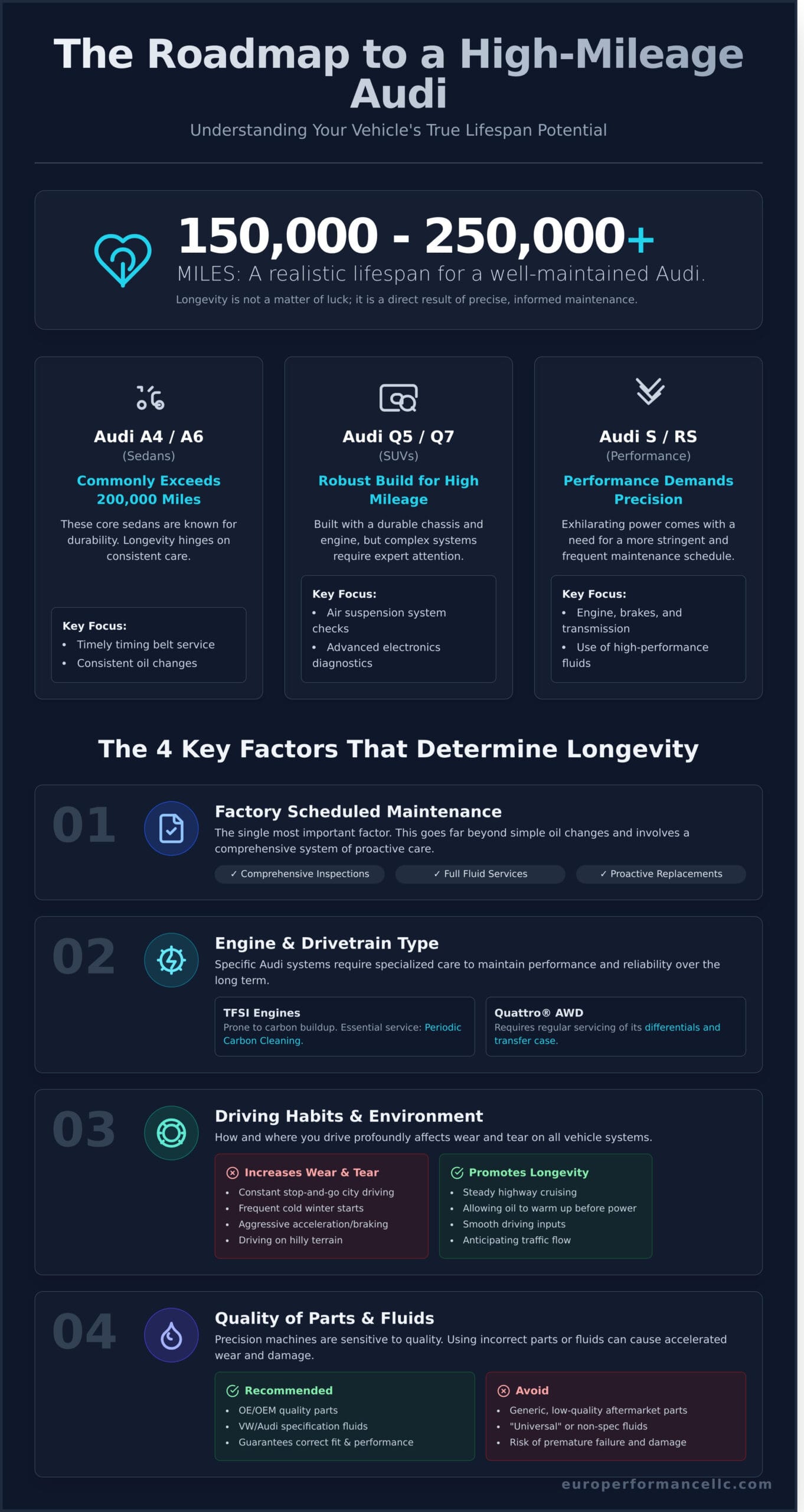
When prospective owners ask, “how many miles do Audi’s last?” the most straightforward answer is that a well-maintained Audi can reliably travel between 150,000 to 250,000 miles. Some can even surpass this range. As a brand known for its commitment to “Vorsprung durch Technik” (Advancement through Technology), Audi builds vehicles with a high degree of engineering precision. The company’s long and storied Audi AG corporate history is a testament to this focus on quality. However, reaching that upper mileage threshold is not a matter of luck; it is a direct result of diligent maintenance, the specific model, and your driving habits.
To better understand the factors influencing an Audi’s longevity, watch this helpful overview:
Much like its German counterparts, BMW and Mercedes-Benz, an Audi is a high-performance machine that demands precise care. It is not a vehicle you can simply drive with minimal attention and expect to last. Proactive maintenance is the single most important factor in determining its lifespan. Adhering to-and sometimes exceeding-the manufacturer’s recommended service schedule is crucial for keeping its complex systems operating in perfect harmony.
Mileage You Can Expect from Popular Audi Models
While overall brand quality is high, potential longevity can vary slightly by model. Here are a few common examples:
- Audi A4/A6: These core sedans are known for their durability. With consistent oil changes and timely attention to key components like the timing belt, it is very common for them to exceed 200,000 miles.
- Audi Q5/Q7: As robust SUVs, their chassis and engines are built to last. However, owners must pay close attention to more complex systems, such as the air suspension and advanced electronics, to avoid costly future repairs.
- Audi S/RS Models: These high-performance variants deliver exhilarating power, but that performance comes at a cost. They require more stringent and frequent maintenance schedules, especially concerning the engine, brakes, and transmission, to ensure a long life.
Setting Realistic Expectations
A modern Audi is far more than just an engine and four wheels. Its longevity depends on the health of its entire ecosystem, including the transmission, Quattro all-wheel-drive system, advanced electronics, and chassis components. Answering the question of how many miles do Audi’s last involves looking at the vehicle as a complete system. The good news is that with the right professional service partner, reaching high mileage is an achievable goal, not a rare exception.
The 4 Key Factors That Determine How Long Your Audi Will Last
While Audi is renowned for its engineering, the ultimate longevity of your vehicle is not predetermined. When owners ask us, “how many miles do Audi’s last?”, our answer always points back to four critical areas that are largely within the owner’s control. These factors have a direct and significant impact on whether your Audi reaches 100,000 miles with issues or cruises past 200,000 miles with reliability.
1. Adherence to Factory Scheduled Maintenance
This is the single most important factor in your Audi’s lifespan. Following the manufacturer’s maintenance schedule goes far beyond simple oil changes. It involves a comprehensive system of inspections, fluid services (for the transmission, coolant, and brakes), and component replacements at specific intervals. A specialist shop uses manufacturer-grade diagnostic tools to communicate with your Audi’s complex computer systems, identifying potential issues before they become catastrophic failures. This proactive approach also ensures that any service bulletins or items noted in official NHTSA safety ratings and recalls are properly addressed.
2. Engine and Drivetrain Type
Not all Audis are created equal, and their specific systems require specialized care. For example, many modern Audis use TFSI (Turbocharged Fuel Stratified Injection) engines, which are susceptible to carbon buildup on the intake valves over time. A periodic carbon cleaning service is essential for maintaining power and efficiency. Likewise, the legendary Quattro all-wheel-drive system requires regular servicing of its differentials and transfer case to ensure it performs correctly and reliably for years to come. The needs of a high-torque TDI diesel engine will also differ from those of a high-revving gasoline counterpart.
3. Driving Habits and Environment
How and where you drive profoundly affects wear and tear. Constant stop-and-go city driving is much harder on the brakes, transmission, and engine components than steady highway cruising. Here in Montana, the environment plays a major role; cold winter starts place significant stress on the engine and battery, while our hilly terrain demands more from the braking and Quattro systems. For turbocharged engines, it’s crucial to allow the engine oil to warm up to operating temperature before demanding full power to ensure proper lubrication and longevity.
4. Quality of Parts and Fluids
Audis are precision-engineered machines that are highly sensitive to the quality of the parts and fluids used. Using generic, aftermarket parts can lead to improper fitment, premature failure, and even damage to surrounding components. It is critical to use Original Equipment (OE) or high-quality OEM parts that meet Audi’s exact specifications. The same is true for fluids; using an oil that doesn’t meet the specific VW/Audi spec, for instance, can cause accelerated engine wear. Our ASE-certified technicians use only high-quality OE parts to guarantee the performance and reliability your vehicle was designed to deliver.
The Non-Negotiable Maintenance for a High-Mileage Audi
Reaching 200,000 miles or more in an Audi is not a matter of luck; it is the direct result of proactive, specialized maintenance. While many models earn favorable J.D. Power reliability ratings for their initial years, the key question of how many miles do Audi’s last is ultimately answered by the care they receive after crossing the 80,000-mile mark. The factory-scheduled maintenance plan is a great start, but true longevity requires a more intensive approach focused on systems prone to age-related wear. A professional shop specializing in European vehicles will have the diagnostic tools and expertise to address these critical items before they become catastrophic failures.
Engine & Timing System Services
The heart of your Audi requires precise and preventative care. The single most critical service is the timing belt or timing chain service. Most Audi engines are “interference” designs, meaning a failed belt or chain will cause the pistons to strike the valves, resulting in catastrophic engine damage. Beyond that, modern TFSI (direct-injection) engines are susceptible to carbon buildup on the intake valves, which can restrict airflow and reduce performance. We also recommend diligent monitoring for oil consumption and regular checks of the PCV (Positive Crankcase Ventilation) system, a common failure point that can lead to oil leaks and other issues.
Transmission & Drivetrain Care
An Audi’s sophisticated drivetrain demands specialized fluid services. Whether your vehicle has a DSG/S-Tronic dual-clutch or a traditional Tiptronic automatic, the transmission fluid and filter must be changed at regular intervals-far more frequently than the “lifetime” fluid myth suggests. For Quattro all-wheel-drive models, this extends to servicing the front and rear differentials and the center transfer case. Our ASE-certified technicians also inspect CV joint boots and driveshafts for tears or wear, preventing costly axle failures down the road.
Suspension, Brakes, and Fluids
Maintaining the refined ride and safety of a high-mileage Audi means paying close attention to the chassis and its supporting systems. Key services include:
- Control Arm Bushing Inspection: These rubber components degrade over time, leading to poor handling, clunking noises, and uneven tire wear. They are a common wear item on most Audi platforms.
- Brake Fluid Flush: Brake fluid is hygroscopic, meaning it absorbs moisture from the air. This lowers its boiling point and can corrode internal components. A full flush every two years is essential for safety and performance.
- Coolant and Power Steering System Checks: We inspect hoses for brittleness, check for leaks, and ensure fluid integrity to prevent overheating or a sudden loss of steering assist.
Addressing these specific areas with high-quality OE parts and expert service is the most effective strategy for ensuring your Audi delivers the performance and reliability you expect for years to come.
Common Problems in Audis Over 100,000 Miles
As an Audi surpasses the 100,000-mile mark, its engineering precision is met with the realities of wear and tear. Acknowledging potential issues is not a cause for alarm; rather, it is the key to proactive ownership. These are not deterrents but known maintenance points that a specialist armed with the right diagnostic tools can manage effectively. Understanding what to look for is a crucial part of knowing how many miles do Audi’s last when properly cared for.
Proactive inspection by an expert technician can identify these common issues before they escalate into more significant repairs, ensuring your vehicle’s longevity and performance.
Engine and Performance Issues
The heart of your Audi is its engine, and several components predictably require attention in higher-mileage vehicles to maintain their signature performance.
- Oil Leaks: A common source of leaks are valve cover gaskets and oil filter housing gaskets. Symptom: The smell of burning oil or small drips on your garage floor. Solution: These rubber seals become brittle over time and require replacement by a qualified technician to prevent oil loss and other engine damage.
- Water Pump & Thermostat Failures: These are critical components of the cooling system. Symptom: Engine overheating warnings or fluctuating temperature gauges. Solution: The plastic components can degrade. We often recommend replacing them proactively, sometimes during a timing belt service, to prevent catastrophic engine failure.
- Ignition Coils & Spark Plugs: These are essential for efficient combustion. Symptom: A rough idle, engine misfires, or a flashing check engine light. Solution: This is a standard wear-and-tear replacement that restores power and fuel economy.
Electronic and Interior Component Failures
Modern Audis are complex electronic systems. Over time, some of these sophisticated components may require service.
- MMI Infotainment System: Your Audi’s central command center can experience glitches. Symptom: A frozen or blank screen, or unresponsive controls. Solution: This often requires a professional diagnostic scan to determine if a software update or a hardware replacement is needed.
- Window Regulators: The mechanism that moves your window up and down can fail. Symptom: A window that is stuck, slow, or makes grinding noises. Solution: This typically involves replacing the regulator assembly inside the door panel.
- Dashboard Warnings: Illuminated ABS or airbag lights indicate a fault. Symptom: Persistent warning lights on the instrument cluster. Solution: These warnings should never be ignored as they relate to critical safety systems. A diagnostic check is required to pinpoint the faulty sensor or module.
What to Do If You Notice These Symptoms
Ignoring unusual noises, warning lights, or performance changes is the quickest way to turn a manageable repair into a major expense. The complex systems in your Audi require precise diagnostic equipment to identify the root cause of a problem accurately. Early and expert diagnosis not only saves you money but also ensures your vehicle remains safe and reliable on the road.
If your high-mileage Audi is showing any of these signs, don’t wait for the problem to worsen. The true answer to how many miles do Audi’s last is directly tied to the quality and timeliness of its service. If your Audi shows these signs, schedule a diagnostic check with our expert technicians today.
Buying a Used High-Mileage Audi? Here’s What to Check
A high-mileage Audi can represent excellent value, offering premium engineering and performance for an attractive price. However, a low sticker price can easily hide the potential for significant future repair bills. To ensure you’re making a sound investment, a thorough evaluation is not just recommended-it’s essential. A detailed inspection is the best way to understand the true condition of the vehicle and get an accurate answer to how many miles do Audi’s last for that specific car.
The Pre-Purchase Inspection (PPI) is a Must
Before you commit to a purchase, the single best investment you can make is a professional Pre-Purchase Inspection (PPI) from a European vehicle specialist. A comprehensive PPI goes far beyond a simple test drive. Our ASE-certified technicians perform a detailed, multi-point inspection, including a diagnostic computer scan, a thorough check of the engine and transmission, and an evaluation of the suspension and brake systems on a vehicle lift. This process uncovers hidden issues that are impossible to spot otherwise.
Key Areas to Scrutinize
While a professional PPI is critical, you can perform an initial check yourself to spot obvious red flags. Pay close attention to these four key areas:
- Service Records: Insist on seeing a complete, documented maintenance history. Consistent oil changes and timely service for major items like the timing belt are signs of a well-cared-for vehicle. Gaps in the records are a serious concern.
- Engine Bay: Look for active oil or coolant leaks, especially around the valve cover and radiator. A clean engine bay is a good sign, but an engine that looks too clean may have been steam-cleaned to hide problems.
- Test Drive: Turn the radio off and listen carefully. Note any clunking or rattling noises from the suspension over bumps. Pay attention to the transmission-shifts should be smooth and decisive, without hesitation or jerking.
- Electronics: Modern Audis are electronically complex. Methodically test every button, switch, and function on the MMI infotainment system, from the navigation to the climate controls and power seats.
Get an Expert Opinion in the Bozeman Area
This checklist is a great starting point, but it cannot replace the trained eye of a specialist. Before you finalize the purchase of a used Audi in the Bozeman or Belgrade area, bring it to our team at Euro Performance LLC. A professional inspection is the only way to truly know how many miles do Audi’s last when you’re looking at a specific car. We can accurately identify potential issues, from developing oil leaks to pending electronic module failures, and provide a clear estimate for future repair costs. This information gives you powerful negotiating leverage and the confidence to make the right choice.
For total peace of mind, let our experts verify the health of your potential purchase. Schedule a Pre-Purchase Inspection with us today.
Maximizing Your Audi’s Mileage: The Final Word
Ultimately, an Audi’s potential to reach 200,000 miles and beyond is not a matter of chance, but a direct result of diligent care. As we’ve detailed, consistent factory-scheduled maintenance and proactively addressing common high-mileage issues are the pillars of longevity. The answer to how many miles do Audi’s last truly depends on the owner’s commitment to professional upkeep. Protecting that investment requires specialized expertise.
At Euro Performance, our ASE Certified Technicians specialize in high-performance European vehicles. We combine hands-on expertise with advanced diagnostic tools for accurate troubleshooting and use only high-quality OE/OEM parts for every repair. This ensures your vehicle receives the precise care it was engineered for. Ready to give your Audi the expert attention it deserves? Schedule your Audi service with our expert technicians today.
With the right service partner, you can confidently enjoy the peak performance and luxury of your Audi for many miles to come.
Frequently Asked Questions
Are Audis really expensive to maintain compared to other cars?
Audis generally have higher maintenance costs than non-luxury domestic or Asian brands. This is attributed to their precision engineering, which requires specialized diagnostic equipment, specific high-grade synthetic oils, and Original Equipment (OE) quality parts to maintain peak performance. While individual services may cost more, adhering to a professional maintenance schedule is a crucial investment in the vehicle’s longevity and reliability, ensuring it performs as designed for years to come.
Which Audi models and engines are generally considered the most reliable?
Certain powertrains have earned an excellent reputation for durability. The 3.0L supercharged V6 (3.0T) engine, found in models like the S4, A6, and Q7, is widely regarded for its robust performance. Additionally, later generations of the A4 and Q5 with the 2.0T engine have proven to be very dependable with proper maintenance. A comprehensive pre-purchase inspection by a European vehicle specialist is always the best way to assess an individual car’s condition.
How often should I change the oil in my Audi?
While the manufacturer’s service indicator may suggest intervals of 10,000 miles, our expert technicians recommend a more proactive approach for optimal engine health. We advise a full synthetic oil and filter service every 5,000 to 7,500 miles, especially for turbocharged engines or vehicles driven in demanding conditions. This preventative measure helps prevent sludge buildup and ensures critical components remain protected, maximizing the life of your engine.
Is it worth repairing an Audi with over 150,000 miles?
This decision depends entirely on the vehicle’s overall condition, service history, and the nature of the required repair. A well-maintained Audi can provide many more years of reliable service, making a cost-effective repair a wise investment. The answer to how many miles do Audis last often hinges on this choice. A thorough diagnostic evaluation from an ASE-certified technician will provide a clear picture of the vehicle’s health, empowering you to make an informed financial decision.
Can I take my Audi to any mechanic for service?
While you can, we strongly advise seeking out a specialist. Modern Audis are complex machines with advanced electronic systems that require brand-specific diagnostic tools and expertise for accurate service and repair. A general mechanic may lack the necessary equipment and training, potentially leading to misdiagnosis or the use of improper parts. Choosing a shop that specializes in European vehicles ensures your Audi receives the precise, expert care it was engineered for.
Does using a specialist shop like Euro Performance void my warranty?
Absolutely not. The Magnuson-Moss Warranty Act gives you the right to have your vehicle serviced at any qualified independent repair shop without voiding your factory warranty. The key is to ensure the shop uses high-quality OE-equivalent parts and meticulously follows Audi’s prescribed maintenance schedule. A reputable European specialist will document all work properly, providing you with the records needed to keep your warranty fully intact and giving you complete peace of mind.