
Blog
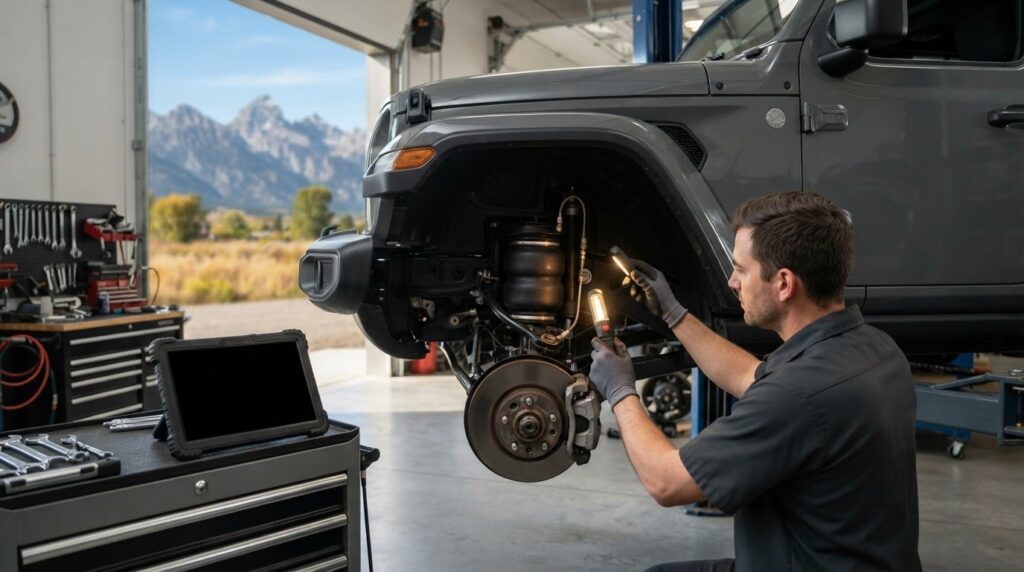
Replacing a Discovery 3’s air suspension with traditional coil springs is possible, but the conversion may affect ride comfort and off-road capability. A Land Rover Discovery 3 air suspension fault fix in Belgrade should start by identifying the cause, since a leak, valve block issue, compressor problem, or electrical fault can call for different repairs.
It’s understandable to consider coil springs when air suspension problems keep returning, but replacing the system is not automatically the best solution. This guide explains how to check air springs and valve blocks for leaks, what affects repair costs, and how to weigh the trade-offs of a coil conversion.
You’ll also find practical ways to interpret warning signs and decide what to address before driving further. The goal is to help you compare options and understand both the fault and what each repair would change.
Key Takeaways
- Inspect air springs for damage or wear, and treat overnight suspension drop as a clue to investigate the valve block or compressor.
- Compare repairing the failed component with a coil-spring conversion, weighing the change to ride comfort and off-road capability.
- Use diagnostic findings and repair scope to understand what drives the cost, rather than assuming every suspension fault needs the same fix.
- After a repair, account for system setup: a replacement suspension ECU must be configured to the vehicle.
Testing air springs and valve blocks for leaks
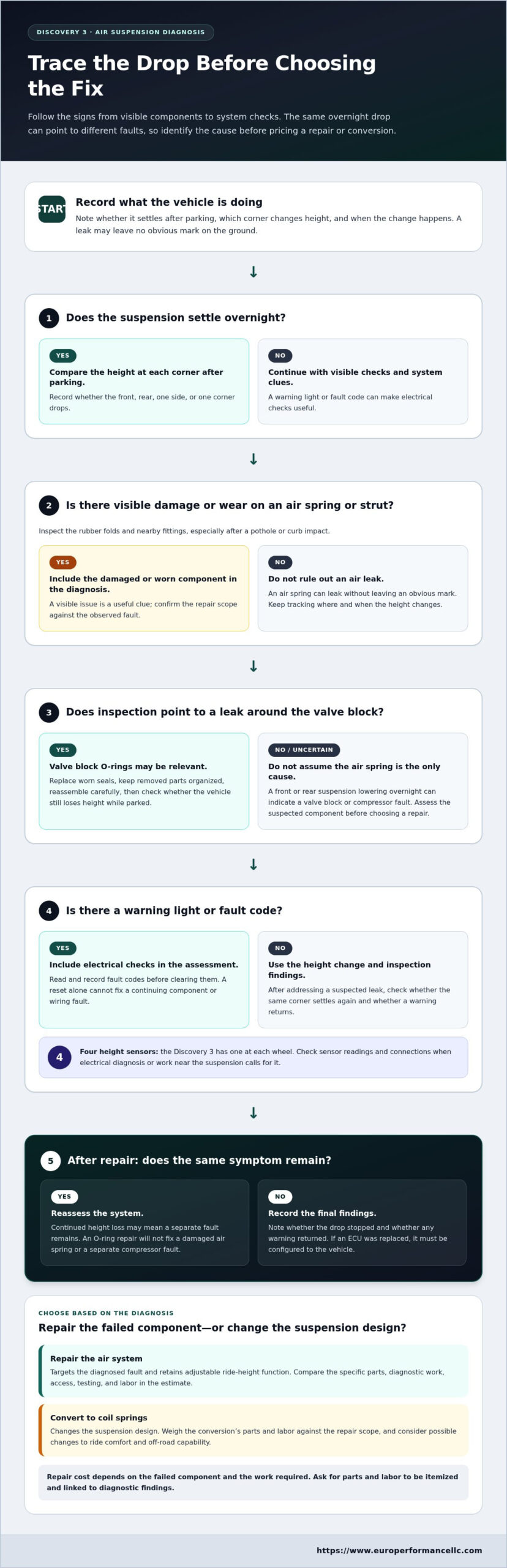
Work from visible air-system components toward electrical causes. A Discovery 3 that settles overnight may have an air leak, valve block fault, or compressor problem. For a Land Rover Discovery 3 air suspension fault fix in Belgrade, start by recording which corner changes height and when.
- Inspect each air spring and strut for visible damage or wear. Check the rubber folds and nearby fittings, especially after hitting a pothole or curb. Compare the vehicle’s stance after parking and note which corner drops. An air spring can leak without leaving an obvious mark on the ground, so record where and when the height changes.
Identify Valve Block Faults
Compare the vehicle’s height at each corner after parking, then note whether the front, rear, or one side drops. A front or rear suspension that lowers overnight can indicate a faulty valve block or compressor, so don’t assume the air spring is the only cause. A warning light or fault code can make electrical checks a useful part of assessing the suspension system. The Discovery 3 has four height sensors, one at each wheel.
Replace Valve Block O-Rings
Address valve block O-rings only if inspection points to a leak around the block. Identify the sealing points and keep removed components organized so each seal returns to the correct position. Replace worn O-rings, reassemble the block carefully, and check whether the vehicle still loses height while parked. An O-ring repair will not fix a damaged air spring or a separate compressor fault, so reassess the system if the vehicle continues to drop.
- Recheck the suspension after addressing the suspected leak. Note whether the same corner settles again and whether a warning returns; these observations help distinguish a persistent air leak from an electrical fault. A valve block fault may involve its seals or operation, while a compressor issue can also contribute to suspension problems. If you need a Land Rover Discovery 3 air suspension fault fixed in Belgrade, isolate the faulty component before choosing a repair.
Air suspension repair costs
Discovery 3 repair costs depend on which component failed and how much work the diagnosis identifies. Compare the required repair scope, not just the part name.
- Get the fault diagnosed before pricing parts. A leaking air spring, a valve block fault, and a compressor problem involve different components and labor. Ask for the cause and proposed repair to be explained separately. This makes it easier to compare a targeted fix with replacing multiple components, and helps avoid paying for parts that have not been identified as faulty.
- Ask for parts and labor to be itemized in the estimate. Replacing a leaking air spring, renewing valve block O-rings, and addressing a compressor fault are different repairs. The total also depends on access, testing, and whether the initial repair resolves the symptom. A useful written estimate links each recommended part and task to a specific diagnostic finding.
- Compare a coil-spring conversion with a repair as two different scopes of work. A conversion changes the suspension design, while repairing the air system retains its adjustable ride-height function. Weigh the conversion’s parts and labor against the work needed to restore the existing system. Also consider how coil springs may affect ride comfort and off-road capability, not just the initial expense.
- Use the diagnosis to decide what deserves attention first. If testing points to one leaking air spring, a full-system replacement may not be necessary; if several faults are present, the estimate should explain each one. Repair price depends on the case and is provided after a quote request; key factors include the failed component, parts, diagnostic work, and labor. For European-vehicle repair, specialized European auto repair is a relevant next step.
How do you reset or calibrate Discovery 3 air suspension after a repair?
Clearing a warning is not the same as correcting the fault. A replacement suspension ECU must be configured for the vehicle before the system can operate correctly.
- Confirm the mechanical repair is complete before attempting a reset. Check that the replacement component is fitted correctly and that the original symptom has stopped. For example, if a corner still settles after an air-system repair, investigate the continuing drop rather than treating a cleared warning as proof the fault is fixed. Record any warning messages that remain.
- Read the suspension system’s fault codes with suitable diagnostic equipment. Save the codes before clearing them, as they can help connect a warning to a specific system issue. If a warning returns after clearing, use the new code and the vehicle’s behavior to guide further diagnosis. A reset alone cannot fix a continuing component or wiring fault.
- Check the height readings and sensor connections after work near the suspension. The Discovery 3 has four height sensors, one at each wheel. Compare the displayed readings and inspect affected wiring or connectors if one corner appears out of position. Don’t adjust ride-height settings to mask a fault; first establish whether the sensors report the vehicle’s actual position consistently.
- Configure a replacement suspension ECU to the vehicle, rather than treating installation as a simple reset. The ECU must be configured for that Discovery 3. After configuration, use diagnostic equipment to assess system operation and any required calibration. Follow the equipment’s vehicle-specific prompts, then check for returning codes and confirm that the suspension responds as expected through its available height settings.
- Document the final diagnostic results, including cleared and returning codes, sensor readings, and completed ECU configuration. This gives the next technician a clear starting point if the warning reappears. If the system still behaves incorrectly, investigate the relevant sensors, wiring, air components, and ECU setup instead of repeatedly clearing the same fault.
Is it safe to drive a Discovery 3 with an air suspension fault?
Decide based on the vehicle’s stance, handling, and warning behavior, not just whether it still moves. The Discovery 3’s air suspension supports ride comfort, off-road handling, and adjustable ride height, so a fault can affect how the vehicle behaves.
- Check whether the Discovery 3 sits level before moving it. If one corner is visibly low, or the body changes height while parked, avoid treating the vehicle as ready for a normal journey. A low or uneven stance can indicate that the suspension isn’t maintaining its expected position. Note which corner sits lower and whether the condition changes after startup.
- Pay attention to steering and alignment symptoms. A faulty valve block may affect alignment and cause the vehicle to pull to one side. If the Discovery 3 pulls, feels unsettled, or changes direction unexpectedly, stop in a safe place and arrange an inspection rather than continuing at speed.
- Watch the dashboard and how the suspension responds to the controls. A warning light, repeated height change, or failure to respond can help describe the fault during diagnosis. Don’t rely on restarting the engine to judge whether it is safe to drive. An intermittent warning can disappear temporarily while the underlying issue remains.
- Check tire wear as another possible warning sign. A faulty compressor could contribute to premature or uneven wear, so look for clear differences in tread across the vehicle. Treat unusual wear alongside a suspension warning as a reason to investigate the system and alignment, not as proof that a particular part has failed.
- Choose the next step according to the symptoms. If the vehicle sits unevenly, pulls to one side, or shows a persistent suspension warning, avoid unnecessary driving and arrange an assessment. For a Discovery 3 with these symptoms, request specialized European auto repair to help identify the fault before normal use continues.
Euro Performance Auto Shop LLC: Specialized European Auto Repair
Euro Performance Auto Shop LLC provides specialized European auto repair for Discovery 3 owners facing persistent suspension warnings, uneven ride height, or handling changes. Its ASE certified technicians use diagnostic expertise to assess complex vehicle faults and identify what needs attention. If a suspension issue affects how the vehicle tracks, wheel alignment can also be relevant after the underlying problem is addressed.
Share the symptoms, warning messages, and any diagnostic codes during the assessment. This information can help distinguish a continuing fault from one that needs further diagnosis, so the next repair step is based on the vehicle’s condition.
Contact Euro Performance Auto Shop LLC to discuss your Discovery 3, or visit the shop’s website.
Choose a Clear Next Step for Your Discovery 3
The most useful next step is a focused assessment that turns your symptoms into a repair plan. Keep a simple record of when the warning appears, how the vehicle sits, and whether its behavior changes after restarting. These details can help make the initial discussion more precise and keep attention on the fault affecting your Discovery 3.
For a Land Rover Discovery 3 air suspension fault fix in Belgrade, Euro Performance Auto Shop LLC can support your next step with specialized European auto repair. If the suspension issue has affected how the vehicle tracks, wheel alignment can also be considered. Factory scheduled maintenance helps address the vehicle’s other service needs as you plan ahead.
Share the symptoms you’ve observed and discuss the appropriate service for your vehicle. Contact Euro Performance Auto Shop LLC to take the next step with confidence.
Frequently Asked Questions
What Causes Suspension Fault on Discovery 3?
Common causes include air leaks, valve-block faults, compressor problems, and electrical issues affecting height sensors or wiring. A Discovery 3 that loses height while parked points attention toward air-system integrity, while a warning with inconsistent height readings calls for electrical diagnosis. Corrosion at a height-sensor wiring connection is another reported fault pattern, so inspect connectors rather than replacing suspension parts by guesswork.
What are common Land Rover Discovery 3 air suspension fault symptoms and causes?
Symptoms can include uneven ride height, warning messages, slow or inconsistent height changes, or vehicle pull. One reported owner of a 2009 Discovery 3 described intermittent brake warnings alongside suspension lowering and code U0416-86. Restarting temporarily cleared that reported fault for about a week. Treat this as an example, not a diagnosis: symptoms can overlap, so record them alongside stored codes.
How do you diagnose a Discovery 3 air suspension fault with a diagnostic scanner?
Use a scanner that communicates with Discovery 3 control systems to retrieve diagnostic trouble codes, or DTCs. Codes identify recorded faults but don’t automatically name every failed part. Save them before clearing, then review suspension data, including signals from each of the four height sensors. Compare readings, inspect the indicated circuit or component, address the underlying issue, and rescan to see whether the fault returns.
How much does a Discovery 3 air suspension compressor cost in Belgrade?
A compressor replacement has no single fixed cost because the total depends on the diagnosed fault, parts, labor, and related repairs. In Belgrade, the price depends on the case and is given after a quote request. Diagnosis should distinguish a failed compressor from an air leak or valve-block fault. Replacing the compressor alone won’t address a separate leak elsewhere in the suspension system.
What does it cost to repair or replace Discovery 3 air suspension struts in Belgrade?
Strut repair or replacement costs depend on which component has failed and the work needed to complete the repair. The quote factors include parts, labor, diagnostic work, and whether related components also need attention. In Belgrade, the price depends on the case and is given after a quote request. A useful estimate separates the proposed parts and tasks, linking each to a diagnostic finding.
Which garages in Belgrade specialize in Land Rover Discovery 3 air suspension repairs?
Euro Performance Auto Shop LLC in Belgrade, Montana, provides specialized European auto repair for European vehicles, including Land Rover. For a Discovery 3 suspension concern, share the vehicle’s model year, warning messages, stored codes, and any changes in ride height. These details help frame the diagnostic discussion and clarify whether the reported issue involves suspension components or related electrical systems.