
Blog
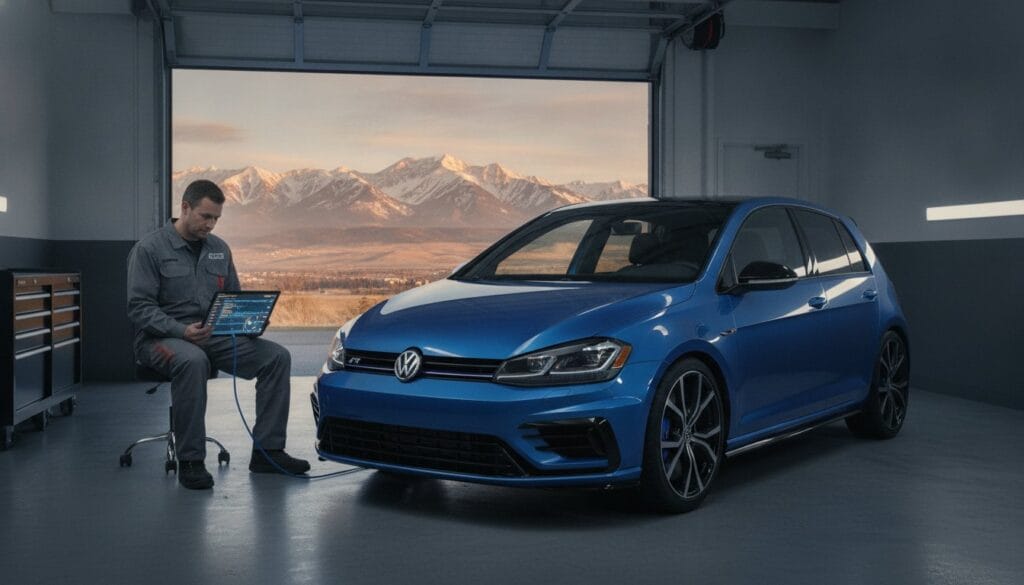
Driving a stock Volkswagen up the Bozeman Pass shouldn’t feel like a struggle against the altitude. While German engineering is world-class, factory settings are often a compromise designed for sea-level commutes rather than the demanding inclines of the Northern Rockies. You likely appreciate the precision of your VW, but you’ve probably noticed that thin mountain air and sub-zero winter mornings can lead to frustrating turbo lag and a lack of passing power when you need it most. It’s a common frustration for local drivers who want the performance they were promised without compromising the long-term health of their engine.
This article explores how professional performance tuning for vw bozeman can bridge the gap between factory limitations and Montana’s rugged reality. We’ll show you how specialized European tuning optimizes power delivery and fuel efficiency while maintaining the strict reliability standards your vehicle requires. You’ll discover how a methodical, technical approach to ECU calibration can provide smoother acceleration and dependable high-altitude performance, ensuring your Volkswagen is fully equipped for every mountain adventure. From improving throttle response to stabilizing power in cold climates, we’ll outline the path to unlocking your car’s true potential.
Key Takeaways
- Learn why professional calibration of the Engine Control Unit (ECU) provides a safer and more reliable power increase than generic, off-the-shelf software flashes.
- Identify the specific tuning stage that matches your driving needs, whether you seek a software-only upgrade or significant gains through supporting hardware.
- Discover how specialized performance tuning for vw bozeman addresses high-altitude air density and cold climate demands to prevent turbocharger over-speeding.
- Understand the critical role of pre-tuning inspections and baseline diagnostics in verifying your Volkswagen’s mechanical integrity before performance optimization.
- Master the maintenance protocols required for tuned European vehicles, including why high-quality specialized oils and 5,000-mile service intervals are necessary.
What is VW Performance Tuning and Why Does it Matter?
VW performance tuning is the technical process of optimizing the digital brain of your vehicle. At its core, it involves recalibrating the Engine Control Unit (ECU) to better manage how your car processes fuel, air, and ignition. Many owners assume their car leaves the factory at its peak potential, but manufacturers actually build in significant headroom. This is because they must account for global variables like low-quality fuel in certain regions or extreme mechanical neglect in others. By pursuing a professional engine tuning strategy, you can reclaim this untapped performance and tailor it to your specific environment.
When considering performance tuning for vw bozeman, it’s vital to distinguish between generic off-the-shelf flashes and professional European calibration. A generic flash is a one-size-fits-all software file designed for a broad range of cars across various climates. In contrast, professional calibration takes into account the specific health and atmospheric requirements of your local area. This precision results in increased torque for mountain climbs, sharper throttle response for highway merging, and potential fuel savings. By optimizing the air-fuel ratio, the engine often operates more efficiently during steady-state cruising.
To better understand the fundamentals of these modifications, watch this helpful video guide:
The Core Components: ECU and TCU Tuning
The ECU controls vital engine parameters such as boost pressure and ignition timing. Adjusting these maps allows the engine to produce more power safely. However, the Engine Control Unit is only half the story. For Volkswagens equipped with a Direct-Shift Gearbox, TCU (Transmission Control Unit) tuning is equally important. It optimizes shift points for faster gear changes and increases the clamping force of the clutches. These two systems must work in harmony. If the engine produces more torque than the transmission is programmed to handle, the driving experience will feel disjointed and sluggish.
Performance vs. Reliability: Finding the Sweet Spot
A common myth suggests that tuning inevitably shortens an engine’s lifespan. This isn’t true when the calibration is handled by experts who understand mechanical limits. Reliability is maintained by staying within the safe tolerances of the turbocharger and internal components. We always emphasize the use of OE-quality components for any supporting hardware like intercoolers or downpipes. Before any software is uploaded, a comprehensive diagnostic check is essential. This ensures your vehicle is mechanically sound, as tuning an engine with underlying faults like vacuum leaks or worn spark plugs will only amplify those issues. High-quality performance tuning for vw bozeman focuses on longevity just as much as it does on power.
Stage 1, 2, and 3: Understanding the Tuning Ladder
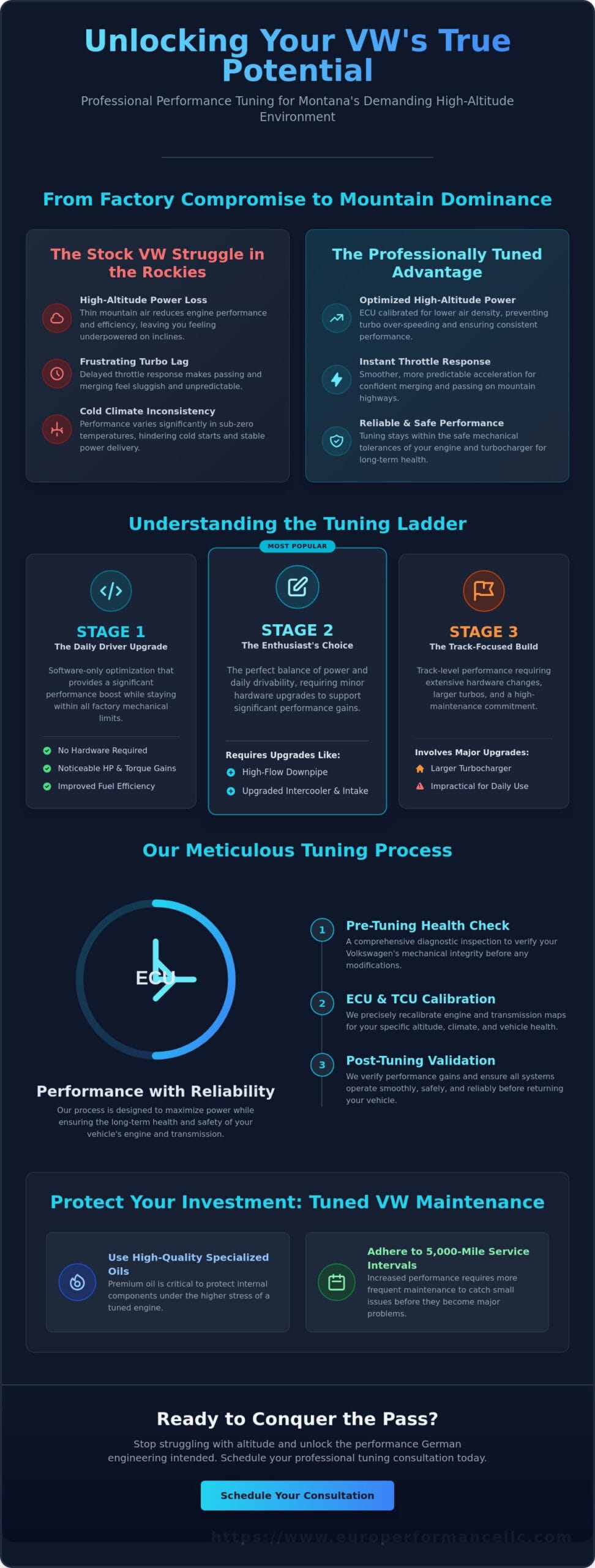
Choosing the right level of modification is easier when you view the process as a ladder. Most owners seeking performance tuning for vw bozeman start with Stage 1. This is a software-only optimization that requires no physical hardware changes. It’s the ideal entry point for a daily driver. It provides a noticeable increase in horsepower and torque while keeping the vehicle within its factory mechanical tolerances. For those who want more, Stage 2 introduces minor hardware modifications like high-flow downpipes and upgraded intercoolers. This stage offers significant gains, particularly for overtaking on mountain roads. Stage 3 is reserved for track-level performance, involving larger turbochargers and extensive fuel system upgrades. While impressive, Stage 3 often requires a level of maintenance that most Bozeman commuters find impractical.
Hardware Essentials for Performance Gains
Even a basic software tune benefits from hardware that helps the engine breathe. High-flow air intakes reduce restriction, allowing the turbocharger to draw in air more efficiently. This is especially helpful at our elevation. Upgraded intercoolers are another critical component. They maintain consistent power by cooling the intake air, preventing the “heat soak” that often occurs during long, steep climbs in the summer. We also recommend specialized European spark plugs and high-output ignition coils. These components ensure a strong, consistent spark under higher boost pressures, preventing the misfires that can plague poorly executed tunes. Because Cold Weather and Fuel Economy are closely linked, ensuring your hardware is optimized for Bozeman’s climate is essential for maintaining efficiency.
Why Specialized European Knowledge is Non-Negotiable
Volkswagen uses proprietary software systems that are notoriously complex. Generic “box” tuners often bypass critical safety protocols, which can trigger limp mode or permanent engine codes. Professional calibration requires ASE-certified technicians who understand these Euro-specific tolerances. They ensure that your car’s safety sensors remain active and that the tune respects the mechanical limits of the DSG transmission and engine internals. If you are ready to see what your car can really do, you might consider consulting with a specialist who understands these intricate German systems. Precision is the difference between a car that feels faster and one that remains reliable for years to come.
Tuning for Montana: High Altitude and Cold Climate Optimization
Bozeman’s elevation of approximately 4,800 feet presents a unique engineering challenge for forced-induction engines. At this altitude, the air is significantly thinner than at sea level. When air density drops, the turbocharger must work harder and spin faster to compress enough oxygen to meet the requested boost targets. A generic software flash might request a boost level that is safe in coastal regions but causes the turbo to over-spin at our elevation. This leads to excessive wear and potential turbocharger failure. Professional performance tuning for vw bozeman includes “thin air” compensation maps. These adjustments ensure the turbo operates within its mechanical efficiency range, providing reliable power without risking the integrity of the hardware.
The necessity for these localized calibrations is even recognized at a regulatory level. There are specific federal regulations on high-altitude vehicle adjustments that underscore the importance of altitude-specific engine management. Beyond elevation, Montana’s sub-zero winter mornings require precise fuel-trim adjustments. Cold-start optimization ensures that fuel atomizes correctly in freezing temperatures. This prevents cylinder washing and ensures your engine reaches its operating temperature safely and efficiently. A well-tuned Volkswagen should be as dependable on a negative twenty-degree morning as it is on a mild spring day.
Managing Heat Soak in the Gallatin Valley
Heat soak occurs when the intake air temperature rises beyond the cooling capacity of the intercooler. This is common during long, steep climbs through the Gallatin Canyon or when stuck in summer traffic. When the air gets too hot, the ECU reduces power to prevent engine damage. For Bozeman drivers, an upgraded intercooler is a performance part that doubles as a reliability upgrade. It allows for consistent power delivery by maintaining lower intake temperatures. We also recommend monitoring oil temperatures during high-load scenarios. High-quality synthetic oils are vital for managing the thermal stress of mountain driving.
Fuel Quality and Octane Considerations
Fuel availability is another critical factor in the tuning process. Most premium pumps in the Bozeman area offer 91 octane, while some performance maps from other regions are designed for 93 octane. Running a high-octane map on lower-grade fuel can cause pre-detonation, also known as “knock.” This can lead to catastrophic engine failure over time. A professional tune is calibrated specifically for the 91 octane fuel found at local stations. This ensures the ignition timing is optimized for the fuel you actually use, providing a safe and powerful driving experience without the risk of internal damage.
The Euro Performance Tuning Process: Step-by-Step
A methodical approach ensures that performance tuning for vw bozeman is both a safe and effective investment. We don’t simply plug in a laptop and upload a file. The process is a structured sequence of technical evaluations designed to protect your engine while maximizing output. This disciplined workflow allows us to identify potential issues before they become expensive failures, ensuring the final result is a car that feels factory-refined but significantly more powerful.
- Step 1: Comprehensive Pre-Tuning Inspection. We verify the mechanical integrity of the engine, looking for boost leaks, worn spark plugs, or aging sensors.
- Step 2: Baseline Diagnostics. Our technicians log real-time data to establish how the engine is currently performing under its factory software.
- Step 3: Software Installation. We apply the specific performance map calibrated for your hardware and the local Bozeman climate.
- Step 4: Post-Tuning Road Test. This involves a series of controlled drives to verify that power delivery is smooth and all safety parameters are met.
- Step 5: Follow-up Maintenance Schedule. We provide a revised service plan, as tuned vehicles require more frequent oil changes and spark plug inspections.
The Importance of the Health Check
We maintain a strict policy: we never tune a car that has an existing check engine light. Performance software increases the stress on mechanical components, so the foundation must be perfect. We pay close attention to common Volkswagen weak points, such as the diverter valve and the PCV (Positive Crankcase Ventilation) system. If these parts are leaking, you won’t see the full benefit of the tune. Safety also extends to the chassis. We inspect tire condition and verify your wheel alignment to ensure the car handles the increased torque predictably on the road.
Advanced Diagnostics and Data Logging
Our process utilizes factory-level diagnostic tools to monitor critical engine metrics during the tuning phase. We look specifically at “knock” detection and air-fuel ratios to ensure the engine is operating safely under higher boost pressures. We also verify that the turbocharger is meeting its targets without over-spinning, which is crucial at our high altitude. Once the process is complete, we provide you with a digital health report. This document offers transparency into your vehicle’s condition and the improvements made. If you are ready to begin the transformation of your vehicle, contact our specialized team to schedule your initial diagnostic health check.
Maintaining Your Tuned VW for Longevity
Standard factory intervals are calculated for vehicles operating under average conditions. When you invest in performance tuning for vw bozeman, your engine produces more heat and higher cylinder pressures. This added stress means that following the manufacturer’s 10,000-mile oil change interval is no longer sufficient. We recommend a strict 5,000-mile rule. Using specialized, high-grade synthetic oil is essential to protect the turbocharger bearings and prevent internal wear. Think of Factory Scheduled Maintenance as your bare minimum baseline, not the final word on vehicle health.
Increased power also places a higher demand on your braking system. While your Volkswagen might accelerate faster, it also generates more kinetic energy that must be dissipated as heat during deceleration. We monitor brake pad thickness and rotor condition closely during every service. If you’ve opted for a higher-stage build, upgrading to high-performance brake fluid with a higher boiling point is a prudent safety measure for mountain driving. Reliability is built on the details of preventative care.
Shortened Service Intervals for Tuned Engines
Spark plugs in a tuned engine operate in a much harsher environment. We typically recommend replacing them every 15,000 to 20,000 miles, which is nearly twice as often as the factory suggestion. We also check the gap and heat range to prevent pre-ignition. Similarly, the DSG transmission handles increased torque through the clutches. Frequent fluid changes are necessary to keep the transmission shifting smoothly and to prevent overheating. Drive belts and cooling hoses should also be inspected at every oil change, as they are subject to increased thermal stress during long climbs.
Why Euro Performance LLC is Your Bozeman VW Expert
Our approach to performance tuning for vw bozeman is rooted in technical precision and mechanical honesty. We utilize components from original equipment manufacturers to ensure your Volkswagen retains its European engineering standards. Our ASE-certified technicians understand the specific tolerances of German engines, allowing us to provide expert advice that generic shops simply cannot match. We prioritize transparency, recommending only the modifications and maintenance steps that your specific vehicle can safely handle. We’re committed to helping you enjoy every mile of the Montana road with confidence.
Ready to feel the difference? Schedule your VW performance consultation today!
Transform Your Driving Experience in the Gallatin Valley
Realizing the full potential of your Volkswagen requires more than just a software upload. It demands a technical understanding of Bozeman’s high-altitude environment and a commitment to precision maintenance. By following a structured tuning ladder and prioritizing altitude-specific calibrations, you can enjoy a vehicle that is both powerful and reliable. Professional performance tuning for vw bozeman ensures that every modification respects the mechanical limits of your engine while providing the torque needed for Montana’s mountain passes.
At Euro Performance LLC, our ASE Certified Technicians use specialized European diagnostic tools and OE manufacturer parts to deliver factory-refined results. Conveniently located in Belgrade, we serve the entire Gallatin Valley with a focus on technical transparency and engineering excellence. We understand the specific needs of German engineering and provide the meticulous care your vehicle deserves. Your Volkswagen was built for performance, and we’re here to help you unlock it safely. Optimize Your VW’s Performance at Euro Performance LLC today and feel the difference on every mountain road.
Frequently Asked Questions
Will performance tuning void my VW’s factory warranty?
Performance tuning can lead to the denial of warranty claims on specific engine or drivetrain components if the manufacturer determines the modification caused the failure. Dealerships often utilize diagnostic tools that detect “TD1” codes, which signal that the factory software has been altered. While the Magnuson-Moss Warranty Act protects consumers from blanket denials, it’s important to understand that the engine and transmission warranty will likely be affected by software changes.
How much horsepower can I expect from a Stage 1 tune on my GTI or Jetta?
A Stage 1 tune typically offers an increase of 40 to 80 horsepower and 50 to 100 lb-ft of torque, depending on your engine’s specific generation. These gains are achieved solely through software optimization of boost pressure and ignition timing. This level of modification provides a significant boost in passing power without requiring any physical hardware changes, making it a popular choice for daily drivers in the Gallatin Valley.
Does performance tuning affect gas mileage for daily driving?
Performance tuning often improves fuel efficiency during steady-state highway cruising because the engine operates more efficiently. By optimizing the air-fuel ratio and ignition timing, many drivers see a slight increase in miles per gallon under normal conditions. However, if you frequently utilize the additional power under heavy acceleration, your fuel consumption will naturally increase to match the higher air and fuel demands.
Is tuning safe for high-mileage Volkswagens?
Tuning is safe for high-mileage vehicles only if they are in excellent mechanical health. Before performing any performance tuning for vw bozeman, we conduct a rigorous pre-tuning inspection to verify the integrity of the turbocharger, fuel system, and cooling components. If your engine shows signs of excessive wear or underlying leaks, we’ll recommend addressing those maintenance items before proceeding with any software upgrades.
Do I need to use premium fuel after my VW is tuned?
Yes, premium fuel is a strict requirement for almost all performance tunes to prevent engine knock. Performance maps are designed to run on higher octane levels, typically 91 or 93. Because Bozeman stations primarily offer 91 octane, we calibrate our tunes specifically for this grade. Using lower-octane fuel on a performance map can lead to pre-detonation, which risks serious internal engine damage over time.
What is the difference between a ‘chip’ and an ECU remap?
A ‘chip’ refers to an outdated method where a physical microchip was replaced or soldered onto the engine’s circuit board. In contrast, an ECU remap is a modern software update performed through the vehicle’s OBD-II port. This digital approach is far more precise and allows us to adjust hundreds of different parameters within the factory computer without needing to open the hardware casing.
How long does the tuning process typically take at your Belgrade shop?
The entire tuning process generally takes four to six hours to complete. This timeframe includes the essential pre-tuning health check, the software installation itself, and a series of post-tuning road tests with data logging. We take this methodical approach to ensure the calibration is performing correctly and that your vehicle remains reliable for Montana’s demanding driving conditions.
Can I return my car to the stock settings if I decide to sell it?
Yes, your vehicle can be flashed back to its original factory software at any time. We maintain records of the original file, allowing us to restore the stock parameters if you decide to sell the car or return a leased vehicle. This process is straightforward and ensures the car operates exactly as it did when it first left the Volkswagen factory floor.