
Blog

Your Audi represents a pinnacle of German engineering, a blend of performance and luxury that deserves the highest standard of care. Yet, ensuring it receives that care can feel overwhelming. Navigating complex service intervals, deciphering technical terms like ‘DSG service,’ and facing steep dealership costs can create uncertainty. This is where a clear, expert-driven approach to Audi car maintenance becomes essential, not just for preventing costly repairs, but for preserving the exhilarating driving experience you invested in.
This comprehensive guide is designed to empower you with that clarity and confidence. We will break down your Audi’s specific maintenance schedule, explain critical services in plain language, and identify common issues before they become major problems. By the end, you’ll have a reliable roadmap to properly care for your vehicle, prolong its life, and ensure it continues to perform at its peak for years to come.
Key Takeaways
- Understand the critical differences between Audi’s Minor and Standard Maintenance intervals to protect your vehicle’s performance and warranty.
- Discover why specialized systems like Quattro all-wheel drive and S tronic transmissions demand expert service that goes beyond a basic oil change.
- A proactive approach to audi car maintenance helps you prevent common, costly issues related to timing chains, oil consumption, and carbon buildup.
- Learn the key factors to weigh when choosing between a dealership and a qualified independent specialist for your service needs.
Decoding Your Audi’s Factory Scheduled Maintenance Plan
Your Audi is a masterpiece of German engineering, and maintaining its peak performance requires precision and diligence. Adhering to the manufacturer’s recommended service schedule is the single most effective way to ensure its longevity, safety, and reliability. This Factory Scheduled Maintenance Plan isn’t just a suggestion; it’s a meticulously designed roadmap for proactive care, addressing wear and tear before it becomes a significant issue. Following this schedule is the foundation of expert audi car maintenance.
For a deeper look at proactive habits that complement scheduled service, our technicians recommend this helpful video:
Your vehicle’s on-board computer uses a Service Interval Display to alert you when maintenance is due, but understanding the core services at each milestone is key. Audi’s plan is structured around progressive service intervals, each building upon the last.
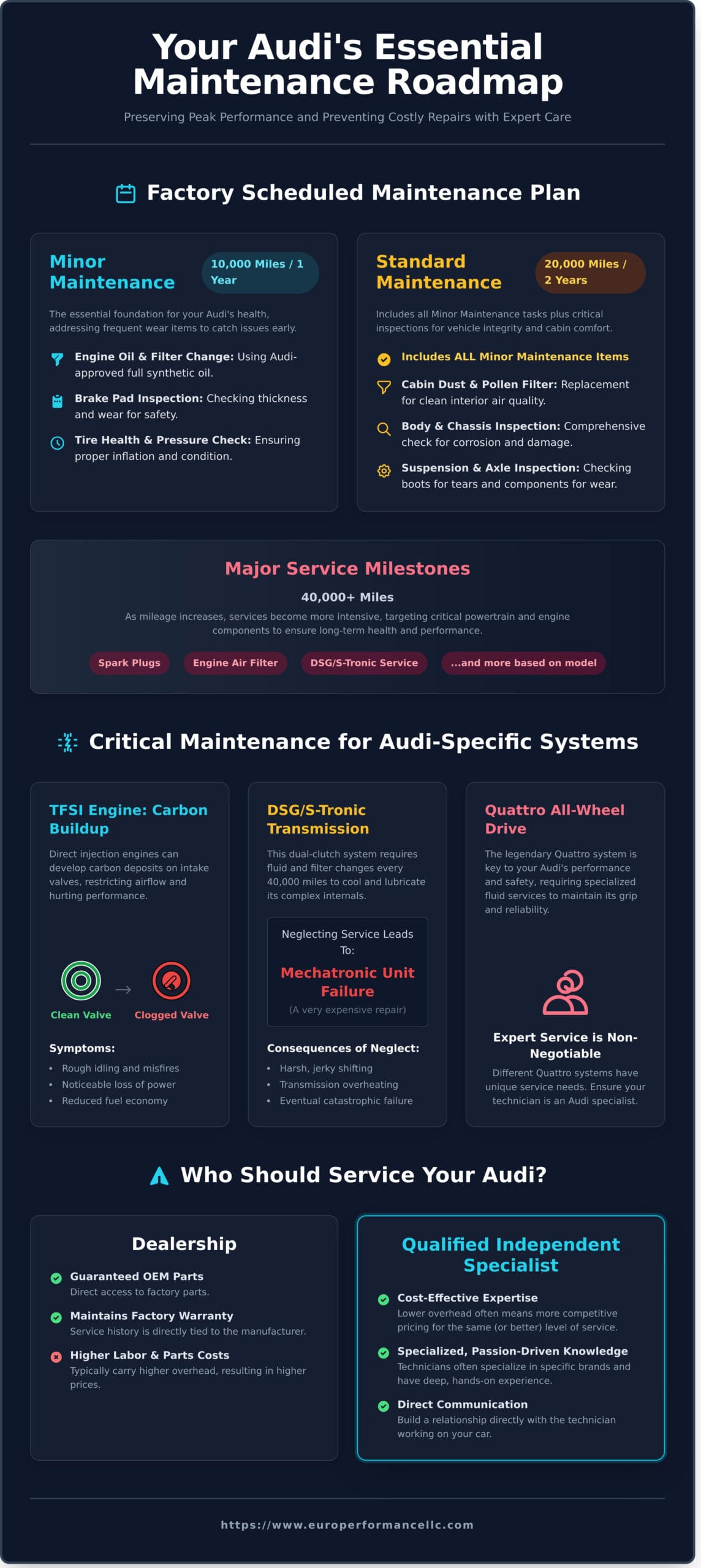
Minor Maintenance (Every 10,000 Miles or 1 Year)
This essential check-up is designed to address frequent wear items and catch potential issues early. It forms the baseline for all subsequent services.
- Engine oil and filter change with Audi-approved synthetic oil
- Brake pad thickness inspection
- Tire health and pressure check
- Wiper blade and windshield washer system check
Standard Maintenance (Every 20,000 Miles or 2 Years)
This service includes all tasks from the Minor Maintenance visit plus several crucial additions to maintain cabin comfort and vehicle integrity.
- Replacement of the cabin dust and pollen filter
- Comprehensive body and chassis inspection for corrosion
- Inspection of suspension components and axle boots
- Panoramic sunroof drain cleaning (if equipped)
Major Service Milestones (40,000+ Miles)
As your Audi accumulates mileage, more intensive services are required to maintain core systems. At 40,000 miles, for example, services often include all previous checks plus critical replacements that preserve engine efficiency and powertrain health, such as spark plugs, engine air filters, and, on certain models, transmission fluid service.
Remember, the factory schedule represents the minimum care required. Driving conditions and personal habits can influence your vehicle’s needs. Our ASE certified technicians can provide expert recommendations to ensure your Audi receives the precise care it deserves.
Beyond the Basics: Critical Maintenance for Audi-Specific Systems
An Audi is not just a car; it’s a precisely engineered machine with sophisticated systems that demand expert knowledge. While routine oil changes are essential, a comprehensive audi car maintenance plan goes much deeper to address the unique needs of its advanced technology. Proactive care of these components is the key to preserving the performance you love and preventing catastrophic, costly failures down the road. Adhering to manufacturer guidelines for critical maintenance for vehicle safety and performance is a non-negotiable aspect of ownership, and our ASE certified technicians have the specialized training to do it right.
Engine Care: TFSI Carbon Buildup and Timing Chains
Audi’s TFSI (Turbo Fuel Stratified Injection) engines are renowned for their efficiency and power. However, this direct-injection design can lead to carbon buildup on the intake valves. Over time, this restricts airflow and can cause:
- Rough idling and misfires
- Noticeable loss of power and acceleration
- Reduced fuel economy
Using top-tier fuel and performing timely, high-quality oil changes can slow this process, but periodic inspection is crucial. We also inspect the timing chain and tensioner, a known wear item, to prevent severe engine damage.
Transmission Service: The Critical DSG/S-Tronic Fluid Change
Unlike traditional automatic transmissions that sometimes claim to have “lifetime fluid,” Audi’s dual-clutch DSG/S-Tronic transmissions require fluid and filter changes, typically every 40,000 miles. This service is vital because the fluid cools and lubricates the intricate clutch packs and mechatronic unit. Neglecting it leads to harsh shifting, overheating, and eventual failure of the expensive mechatronic unit, turning a routine service into a major repair.
Quattro All-Wheel Drive System Maintenance
The legendary Quattro system is a cornerstone of the Audi experience, but not all Quattro systems are the same. Whether your vehicle has a Torsen-based system (common in A4, A6, A8 models) or a Haldex-based system (found in the A3, S3, and TT), proper fluid service is essential for reliable traction. This includes periodic fluid changes for the center and rear differentials. For Haldex systems, servicing the specific fluid and filter is a critical part of audi car maintenance that ensures the AWD engages correctly when you need it most.
Common Audi Problems and How Preventative Maintenance Helps You Avoid Them
Owning an Audi is an investment in German engineering and performance. To protect that investment, a proactive approach to service is far more effective than a reactive one. Understanding common issues is the first step toward preventing them. A consistent audi car maintenance schedule, like the one detailed in this comprehensive Audi maintenance guide from J.D. Power, is your best defense against unexpected and costly repairs. Here, we address known concerns and explain how our expert service provides the solution.
Issue 1: Oil Consumption in TFSI Engines
- Problem: Certain 2.0T TFSI engines, particularly from earlier generations, are known for consuming more oil than average due to their specific piston ring design.
- Symptom: The most direct indicator is the low oil level warning light illuminating on your dashboard between scheduled oil changes.
- Solution: Using the precise, OEM-specification synthetic oil is critical to managing consumption. We also advise owners to manually check their oil level monthly. During our services, we not only perform an oil change with the correct fluids but also inspect for any related leaks or signs of excessive use.
Issue 2: Water Pump and Thermostat Failures
- Problem: Key cooling system components, including the water pump and thermostat housing, are often made from high-strength plastic. Over thousands of heat cycles, these parts can become brittle and fail.
- Symptom: Watch for puddles of pink or purple G12/G13 coolant under your car, a sweet smell from the engine bay, or your temperature gauge climbing higher than normal.
- Solution: Preventative replacement is the most reliable strategy. During major services like a timing belt replacement, it is both practical and cost-effective to replace the water pump and thermostat, preventing a sudden failure that could lead to engine overheating.
Issue 3: Electrical Gremlins and Sensor Faults
- Problem: Modern Audis feature a complex network of sensors and control modules. Over time, components like ignition coils, wheel speed sensors, or MAF sensors can fail, disrupting vehicle performance.
- Symptom: A flashing check engine light, rough idling, misfires, or warning lights for the ABS or traction control systems often point to an electrical fault.
- Solution: Our ASE certified technicians use advanced, dealer-level diagnostic equipment to accurately read fault codes and pinpoint the exact source of the problem. This expert approach to your audi car maintenance saves you time and money by ensuring we fix the right part the first time.
By staying ahead of these common issues with a structured service plan, you ensure your Audi delivers the reliability and performance you expect. Trust our team to provide the expert care your vehicle deserves. Schedule your appointment with us today.
Dealership vs. Independent Specialist: Who Should You Trust With Your Audi?
Choosing where to service your vehicle is one of the most important decisions you’ll make as an Audi owner. It’s a choice between the dealership and a dedicated independent shop, and understanding the distinct advantages of each is key to your long-term satisfaction. A common concern is the vehicle’s warranty; rest assured, you have the right to have your routine audi car maintenance performed at a qualified independent shop without voiding your factory warranty.
The Case for an Independent Audi Specialist
Independent European auto specialists offer a compelling combination of expertise, value, and personalized attention. Because we focus exclusively on brands like Audi, our technicians develop deep, hands-on knowledge of their specific engineering and common issues. This expertise is often paired with more accessible labor rates than a dealership. We use high-quality Original Equipment (OE) parts-the same components used on the assembly line-to ensure performance without the dealership price tag. Meet our ASE-certified European car specialists.
When the Dealership Makes Sense
While an independent shop is ideal for most maintenance and repairs, there are specific situations where visiting an official Audi dealership is necessary. The most common reasons are for repairs covered under your vehicle’s original factory warranty and for addressing official safety recalls. Dealerships have a direct line to the manufacturer for these specific services and can access the very latest factory technical service bulletins (TSBs) as soon as they are released.
Key Questions to Ask Any Auto Shop
Whether you choose a dealership or an independent, you should feel confident in your technician’s ability. Empower yourself by asking the right questions before committing to any service. Here is a practical checklist to help you vet any potential service center:
- Do you specialize in European cars, and specifically, do you have extensive experience with Audi models?
- What kind of parts do you typically use: genuine OEM (Original Equipment Manufacturer), OE (Original Equipment), or aftermarket?
- Do you have the specific VAG (Volkswagen Auto Group) diagnostic tools and software required for modern Audi vehicles?
- Are your technicians ASE-certified or do they hold other relevant certifications for German auto repair?
The answers to these questions will reveal a shop’s commitment to quality and their suitability for handling your sophisticated audi car maintenance needs.
Trust Your Audi’s Performance to Proven Experts
Your Audi is a masterpiece of German engineering, and maintaining its peak performance requires more than just basic service. As we’ve explored, adhering to the factory schedule, understanding the unique needs of systems like Quattro all-wheel drive, and choosing a qualified specialist are all critical components of a comprehensive audi car maintenance strategy. Proactive care is the key to avoiding common issues and preserving the exceptional driving experience you invested in.
When your vehicle deserves specialized attention, you need a team you can trust. At Euro Performance, our team of ASE Certified Technicians specializes in European vehicles. We are committed to using only high-quality OE manufacturer parts to ensure every service meets the exacting standards your Audi requires. Don’t leave your vehicle’s longevity to chance. Schedule your expert Audi service in Belgrade, MT today.
Give your vehicle the professional care it deserves and drive with complete confidence for years to come.
Frequently Asked Questions About Audi Maintenance
Will taking my Audi to an independent shop void my factory warranty?
No, servicing your Audi at a qualified independent shop will not void your factory warranty. The Magnuson-Moss Warranty Act protects your right to choose your service provider. Our ASE certified technicians use parts that meet or exceed Original Equipment (OE) specifications and meticulously follow Audi’s prescribed maintenance schedules. This ensures your warranty remains fully intact while providing a high-quality, reliable alternative to the dealership for all your service needs.
How much does Audi maintenance actually cost compared to other brands?
Audi maintenance costs are generally higher than non-luxury brands due to the vehicle’s precision engineering, specialized components, and advanced technology. The use of high-performance synthetic oils, specific fluids, and parts from OE manufacturers contributes to this cost. However, adhering to a consistent service schedule with a specialized shop can prevent more expensive, unexpected repairs down the line, ultimately protecting the value and performance of your investment. We provide detailed estimates for full transparency.
What kind of engine oil is best for my Audi?
Your Audi requires a high-quality, full synthetic engine oil that meets the specific Volkswagen Auto Group (VAG) specification for your engine model. Common specifications include VW 502 00, VW 504 00, or VW 508 00. Using the incorrect oil can lead to premature engine wear and potential damage. Our technicians will always use the precise oil formulation recommended by Audi for your vehicle’s year and model to ensure optimal performance and engine longevity.
How often should I change the oil in my Audi if I don’t drive 10,000 miles a year?
Even if you do not reach the 10,000-mile interval, we strongly recommend changing your Audi’s engine oil and filter at least once every 12 months. Engine oil degrades over time due to oxidation and moisture contamination, regardless of mileage. This annual service is a critical part of a proactive Audi car maintenance plan, protecting vital engine components from corrosion and sludge buildup, ensuring your vehicle remains reliable and performs as designed.
What does the ‘Service Due!’ light on my dashboard mean?
The ‘Service Due!’ indicator is a pre-set reminder from Audi’s maintenance computer that your vehicle is approaching a scheduled service interval, such as an oil change or a more comprehensive inspection. It is not an alert for a system malfunction like the Check Engine light. We recommend scheduling an appointment promptly to perform the required services. Our technicians will complete the necessary work and reset the indicator, keeping your vehicle on its proper service schedule.
Can I perform any Audi maintenance tasks myself at home?
While owners can certainly perform basic checks like monitoring tire pressure, washer fluid, and engine oil levels between services, most Audi maintenance tasks require specialized tools and diagnostic equipment. Due to the complexity of modern Audi systems, from electronic sensors to specific torque procedures, we recommend entrusting all routine services and repairs to our ASE certified technicians. This ensures the work is completed correctly, safely, and without risking damage to sensitive vehicle components.