
Blog
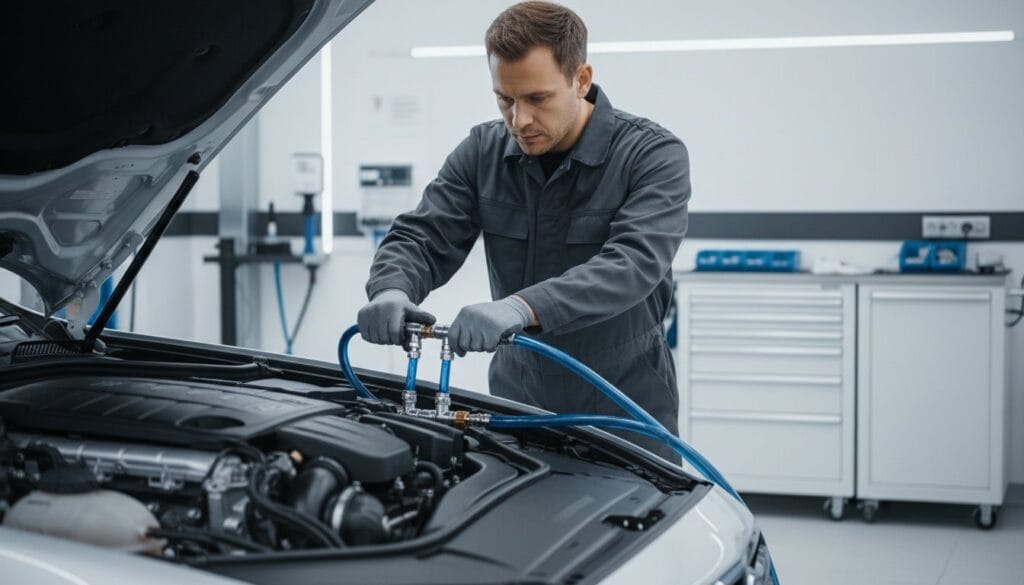
Is your temperature gauge creeping into the red zone? Or perhaps a technician recommended a service, leaving you to wonder if a coolant flush is truly necessary or just a costly upsell. These are valid concerns for any vehicle owner, particularly those driving precision-engineered European models where proper maintenance is paramount. Your engine’s cooling system is its most vital defense against catastrophic heat damage, and keeping it in optimal condition is non-negotiable for ensuring long-term performance and reliability. Neglecting this system can lead to expensive repairs and unexpected breakdowns.
In this complete guide, our expert technicians provide the clarity you need to make an informed decision. We will explain exactly what a professional coolant flush entails, highlight the critical difference between a flush and a simple fluid drain, and detail the definitive signs that your vehicle is due for this service. By the end, you will understand the process, feel confident in your maintenance choices, and be equipped to protect your engine for the road ahead.
Key Takeaways
- Recognize the critical warning signs that your engine’s cooling system requires immediate attention and learn the recommended service intervals.
- Understand the difference between a simple drain-and-fill and a professional coolant flush to ensure all damaging contaminants are removed from your system.
- Discover why precision-engineered European vehicles (BMW, Audi, Mercedes) demand specific coolant formulas and expert service to prevent costly damage.
- Learn how this essential maintenance protects your investment by preventing catastrophic engine overheating and expensive future repairs.
What is Engine Coolant and Why is a Flush Necessary?
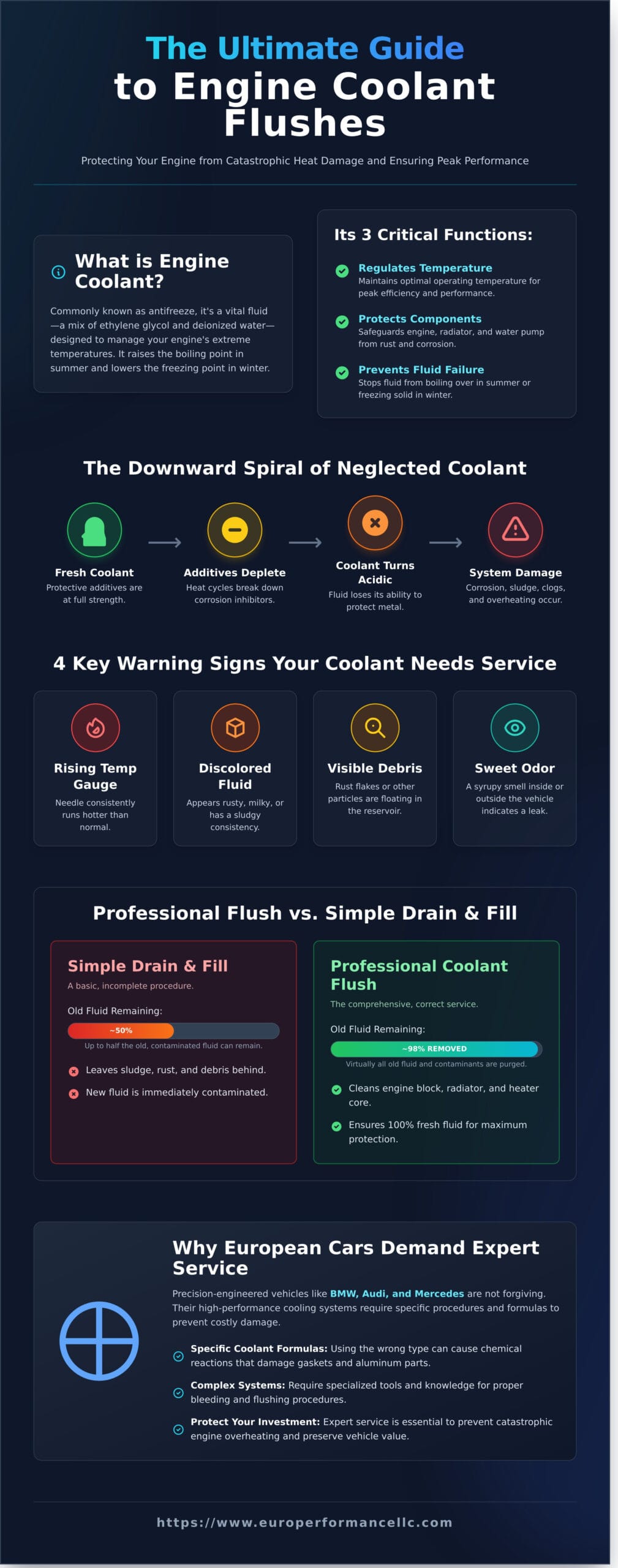
Engine coolant, commonly known as antifreeze, is a meticulously engineered fluid that circulates through your vehicle’s engine to manage extreme temperatures. To understand its fundamental role, it’s helpful to review what engine coolant is: a balanced mixture of an alcohol-based concentrate (typically ethylene glycol) and deionized water. This formula gives the fluid its two primary jobs: it raises the boiling point to prevent overheating in summer and lowers the freezing point to stop freeze-ups in winter.
For a detailed visual explanation of the cooling system and the flush process, this video provides excellent insights:
Beyond temperature regulation, fresh coolant contains a vital package of additives, including powerful corrosion inhibitors. These additives form a protective barrier on the internal metal surfaces of your engine and radiator. Over time and through countless heat cycles, these essential additives break down. As they deplete, the coolant becomes acidic and loses its ability to protect metal. This degraded fluid begins to eat away at components, leading to rust, scale, and sludge. This is precisely why a preventative coolant flush is so critical for long-term engine health.
The Critical Functions of Your Car’s Cooling System
A properly maintained cooling system is the unsung hero of your vehicle’s performance and longevity. It performs several essential tasks simultaneously:
- Regulates Engine Temperature: It maintains the optimal operating temperature for peak performance, fuel efficiency, and low emissions.
- Protects Key Components: It safeguards the engine block, cylinder heads, radiator, and water pump from damaging rust and corrosion.
- Prevents Fluid Failure: It ensures the fluid doesn’t boil over in summer heat or turn to destructive ice during a harsh Montana winter.
What Happens When Coolant Goes Bad?
Neglecting your coolant can lead to a cascade of expensive and potentially catastrophic problems. When the fluid degrades, it stops protecting and starts damaging your engine:
- It loses its anti-corrosive properties, allowing the acidic fluid to eat away at metal parts like gaskets and aluminum components.
- It forms sludge and scale deposits that can clog the narrow passages in the radiator and heater core, restricting flow.
- Its ability to transfer heat diminishes, significantly increasing the risk of your engine overheating, especially under load.
- This internal damage can lead to premature water pump failure or even a leaking head gasket-two of the most serious engine repairs.
Signs You Need a Coolant Flush & Recommended Service Intervals
Your vehicle’s cooling system is engineered for longevity, but it requires periodic maintenance to perform correctly. Proactively servicing your coolant is far more effective than reacting to an overheating engine. Fortunately, your vehicle provides distinct warning signs when attention is needed, and your manufacturer provides a clear schedule to follow for preventive care.
Key Warning Signs of Old or Contaminated Coolant
Old or contaminated coolant loses its ability to transfer heat effectively and protect against internal corrosion. Ignoring these symptoms can lead to significant engine damage. If you notice any of the following signs, it is crucial to have your system inspected by a certified technician.
- Rising Temperature Gauge: Your car’s temperature needle consistently creeps higher than its normal operating position, especially in traffic or while under load.
- Discolored or Thick Coolant: Healthy coolant is brightly colored (e.g., pink, blue, or green) and translucent. If the fluid in your reservoir appears rusty, milky, or has a sludgy consistency, it is contaminated.
- Visible Debris: You see rust flakes, sediment, or other particles floating in the coolant reservoir. These contaminants can clog the radiator and heater core, restricting flow.
- Sweet, Syrupy Odor: Antifreeze has a distinct sweet smell. If you notice this aroma inside or outside your vehicle, it often points to a leak in the cooling system that requires immediate attention.
Following Your Manufacturer’s Recommended Schedule
The most reliable guide for maintenance is always your vehicle’s owner’s manual. While a general recommendation for a coolant flush is often cited as every 30,000 to 50,000 miles (or every 3-5 years), specific requirements for high-performance and European vehicles can vary significantly based on the coolant technology used.
Modern vehicles often use long-life coolants with advanced Organic Acid Technology (OAT), which have much longer service intervals than the conventional coolants found in older cars. Using the exact fluid type specified by the manufacturer is non-negotiable for system health. While it can be useful to understand the procedure, and reputable sources like Haynes Manuals offer guides on how to perform a coolant flush, using the wrong fluid can cause severe internal corrosion.
Finally, remember that driving conditions directly impact service intervals. If you frequently tow, drive in extreme climates, or spend significant time in stop-and-go city traffic, your cooling system is under greater stress. For vehicles operated under these severe conditions, we recommend shortening the service interval to ensure optimal protection and performance.
Professional Flush vs. DIY: What’s the Difference?
When considering engine maintenance, many vehicle owners confuse a simple “drain and fill” with a professional coolant flush. While the former may seem like a straightforward DIY task, it is a fundamentally incomplete service. A drain and fill, performed by opening the radiator’s drain plug, typically removes only 50-60% of the old, contaminated fluid, leaving a significant amount of depleted antifreeze and harmful deposits circulating through your engine and heater core.
A professional service performed by expert technicians ensures the comprehensive cleaning and protection your vehicle’s cooling system requires. The difference in methodology and results is critical for long-term engine health and performance.
The Professional Coolant Flush Process
Our ASE certified technicians utilize specialized equipment and a methodical process to restore your cooling system to factory specifications. This service is far more than a simple fluid swap; it is a complete system renewal. The key steps include:
- System Inspection: We begin with a thorough visual inspection of all hoses, clamps, the radiator, and the pressure cap to identify any leaks, wear, or potential points of failure before the service begins.
- Power Flushing: We connect a professional-grade flushing machine that uses pressure to force all of the old coolant and loose debris out of the entire system, including the engine block, radiator, and heater core.
- System Cleaning: A specialized cleaning solution is circulated through the system to dissolve and remove stubborn scale, sludge, and rust deposits that a simple drain would leave behind.
- OEM-Specified Refill: The system is then completely refilled with the precise type and mixture of antifreeze specified by your vehicle’s manufacturer, ensuring optimal protection and compatibility.
Common Risks of a DIY Coolant Change
Attempting this service at home without the proper tools and knowledge can lead to significant and costly problems. The most common pitfalls include:
- Air Pockets: Failing to properly bleed the system after a refill can trap air pockets, which create hot spots and can lead to severe engine overheating and damage to components like the head gasket.
- Incorrect Coolant: Using a universal or incorrect type of coolant in a modern European vehicle can cause chemical reactions that corrode internal engine components, clog passageways, and lead to catastrophic failure.
- Hazardous Waste Disposal: Used antifreeze is highly toxic to people, pets, and the environment. It must be captured completely and disposed of according to strict local and federal regulations, which can be difficult for a home mechanic.
Why European Cars (BMW, Audi, Mercedes) Demand Expert Coolant Service
While a coolant flush is a standard maintenance item for any vehicle, the process for European models like BMW, Audi, and Mercedes-Benz is far from standard. These vehicles feature complex, precision-engineered cooling systems designed for high performance and efficiency. They operate under tighter tolerances and often utilize a mix of materials, including specialized plastics and alloys, that are highly sensitive to fluid chemistry. Entrusting this critical service to a non-specialist can lead to premature component failure and costly engine damage.
The intricate design of these systems means there is no margin for error. From the specific type of coolant required to the specialized tools needed to bleed air from the system, every step demands expert knowledge and meticulous execution. This is why a professional coolant flush performed by technicians who specialize in European vehicles is not just recommended-it’s essential for protecting your investment.
The Right Coolant is Non-Negotiable
Unlike many domestic vehicles, European cars do not use a “one-size-fits-all” coolant. Using an incorrect or “universal” antifreeze can have catastrophic consequences. Manufacturers specify formulas with unique additive packages to protect the specific metals and plastics in their systems. Key examples include:
- Volkswagen/Audi: G12, G13, and G14 series coolants (OAT/HOAT formulas).
- BMW/Mercedes-Benz: G48 coolant (a specific HOAT formula).
Mixing these incompatible coolants or using the wrong type can cause the fluid to gel, creating a thick sludge that clogs the radiator, heater core, and narrow passages within the engine block, leading to severe overheating.
Specialized Bleeding Procedures and Tools
Properly refilling the cooling system is just as critical as using the right fluid. Due to their complex routing, European cooling systems are notoriously difficult to bleed of air. Trapped air pockets create hotspots that can cause overheating and damage to the engine or water pump. Our ASE-certified technicians use specialized vacuum-fill tools to ensure a bubble-free refill every time.
Furthermore, many modern BMWs feature electronic water pumps that cannot be bled manually. They require a diagnostic computer to activate a specific, automated bleeding procedure. Attempting a coolant service without this equipment will almost certainly result in an improperly bled system. Ensure it’s done right. Schedule your European car service today.
Understanding the Cost and Value of a Professional Coolant Flush
When considering vehicle maintenance, it’s natural to ask if a particular service is truly worth the expense. For a professional coolant flush, the answer is an unequivocal yes. This service should not be viewed as a cost, but as a critical investment in your vehicle’s long-term health, performance, and reliability. Neglecting this maintenance can lead to component failure and engine damage, with repair bills that far exceed the price of this preventative procedure.
What Are You Paying For?
The price of a professional service reflects the quality, expertise, and equipment required to protect your engine correctly. Unlike a simple drain-and-fill, a comprehensive flush is a meticulous process. When you trust your vehicle to our specialists, the cost includes:
- The Expertise: Service performed by an ASE-certified technician who understands the specific cooling system requirements of high-performance and European vehicles.
- The Correct Antifreeze: The cost of several gallons of high-quality, OEM-approved antifreeze formulated with the precise additives your engine needs.
- Specialized Equipment: Use of professional-grade flushing machines and vacuum-filling tools to ensure every bit of old, contaminated fluid is removed and no air pockets are left in the system.
- Safe Disposal: The fee for the environmentally responsible disposal of used antifreeze, which is a hazardous material.
An Investment in Your Vehicle’s Longevity and Reliability
The value of a coolant flush becomes clear when you compare its cost to the price of inaction. A proactive flush is a small, predictable expense. In contrast, an overheating event caused by degraded coolant can lead to catastrophic failures. The cost of replacing a warped head gasket or a corroded radiator can easily run into thousands of dollars—a financial burden that is almost always preventable. This principle of proactive maintenance applies to all major vehicle systems, which is why it’s also wise to explore Diesel Engine Repair to avoid other costly issues down the road.
Beyond preventing disaster, this service maintains your vehicle’s peak performance, optimizes fuel efficiency, and preserves its resale value. It provides the invaluable peace of mind that comes from knowing your engine is protected, whether you’re navigating summer heat or winter cold. To ensure your vehicle receives the meticulous care it deserves, get a transparent estimate for your vehicle at Euro Performance.
Entrust Your Engine’s Health to the Experts
As we’ve covered, your vehicle’s cooling system is vital for engine longevity and performance. A routine flush is not merely about replacing old fluid; it’s a comprehensive service that removes harmful contaminants and prevents costly corrosion and overheating. This is especially true for precision-engineered European vehicles like BMW, Audi, and Mercedes-Benz, which have strict requirements that a generic service simply cannot meet.
To ensure the health and reliability of your vehicle, a professional coolant flush is a non-negotiable investment. At Euro Performance, our ASE Certified Technicians utilize specialized equipment and only the correct, OE-specified coolants required by your vehicle’s manufacturer. We don’t guess-we guarantee precision service that protects your engine for the road ahead.
Don’t wait for a warning light to appear. Schedule your professional coolant service with our European car specialists in Belgrade, MT. Give your vehicle the expert care it deserves and drive with complete confidence.
Frequently Asked Questions About Coolant Flushes
Can I just add water to my coolant?
While adding a small amount of distilled water in an emergency is acceptable, we strongly advise against it as a long-term solution. Coolant is a precise mixture of antifreeze and water, formulated with crucial anti-corrosion additives. Using only water dilutes these protections, raising the freezing point and lowering the boiling point. This can lead to engine damage, rust, and scale buildup, particularly in the complex cooling systems of modern European vehicles. Always use the manufacturer-specified coolant.
What’s the difference between green, orange, and blue antifreeze?
The color indicates the type of corrosion inhibitor technology used. Traditional green coolants use Inorganic Additive Technology (IAT). Orange coolants typically use Organic Acid Technology (OAT) for longer life. Blue, pink, or violet coolants are often Hybrid Organic Acid Technology (HOAT) formulations, common in European vehicles. It is critical to use the specific type recommended by your vehicle’s manufacturer, as mixing them can cause gelling, blockages, and significant damage to your cooling system.
Is a radiator flush the same as a coolant flush?
While the terms are often used interchangeably, a professional coolant flush is more comprehensive than simply draining the radiator. A radiator drain-and-fill only removes about 50-60% of the old fluid. Our service involves using specialized equipment to push cleaning agents and then new fluid through the entire system-including the engine block, heater core, and hoses. This ensures all old, contaminated fluid and debris are completely removed for optimal system protection and performance.
How long does a professional coolant flush take?
A professional coolant flush performed by our ASE-certified technicians typically takes between 60 to 90 minutes. This timeframe allows for a complete and meticulous service, which includes a system pressure test for leaks, the flushing process itself, refilling with the correct OE-specified coolant, and properly bleeding any air from the system. This ensures the cooling system functions correctly and reliably, providing you with peace of mind on the road.
Will a coolant flush fix my car’s overheating problem?
A coolant flush can resolve overheating if the cause is old, degraded coolant or minor blockages in the system. However, overheating is often a symptom of other issues, such as a failing thermostat, a water pump malfunction, a radiator fan failure, or a system leak. Our expert technicians will first perform a thorough diagnosis to accurately identify the root cause. While a flush is vital maintenance, it is not a universal solution for all overheating problems.
What happens if I never flush my coolant?
Neglecting to flush your coolant allows the protective additives to break down, turning the fluid acidic. This leads to corrosion, rust, and scale buildup throughout the cooling system. Over time, this debris can clog the radiator and heater core, and damage the water pump. The ultimate consequences can be severe and costly, including thermostat failure, major leaks, and catastrophic engine damage due to overheating. Regular flushing is essential preventative maintenance for your vehicle’s health.