
Blog
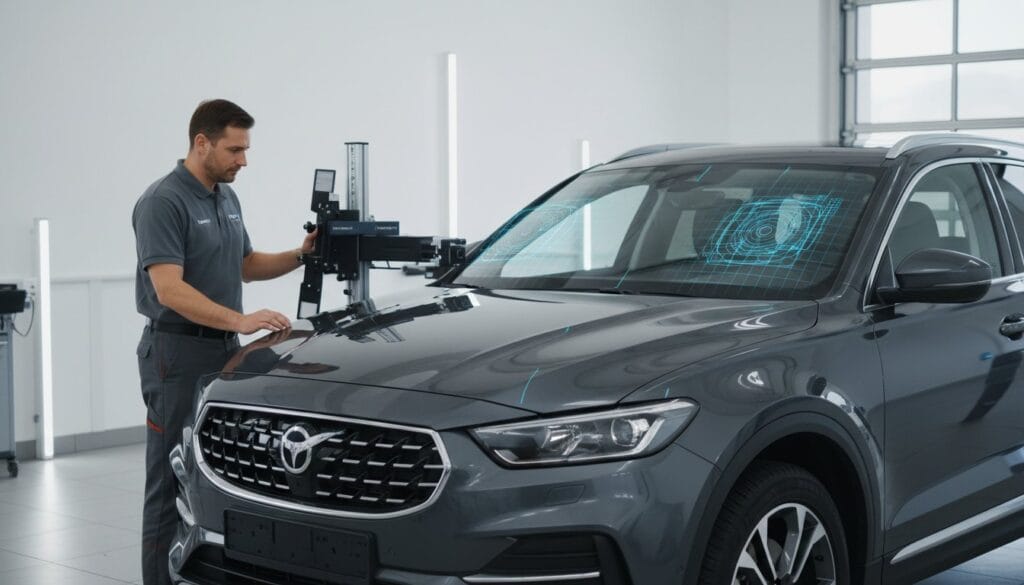
Has a recent windshield replacement left a mysterious warning light on your dashboard? Or perhaps your service advisor recommended an ‘ADAS calibration,’ leaving you wondering if it’s a critical safety procedure or simply an expensive upsell. Your vehicle’s advanced safety features-like lane-keeping assist and automatic emergency braking-depend on a network of precisely aimed cameras and sensors. When that alignment is disturbed, even slightly, their reliability is compromised. This is where the essential process of adas calibration comes in, ensuring every component of your car’s safety net is functioning exactly as the manufacturer intended.
In this guide, our expert technicians will demystify this vital procedure. You will learn what ADAS calibration is, understand the common events that make it necessary-from minor collisions to wheel alignments-and see why professional service is the only way to guarantee your vehicle’s advanced features are protecting you and your family. We’ll provide the clear, straightforward information you need to make confident, informed decisions about your car’s safety systems.
Key Takeaways
- Learn how Advanced Driver-Assistance Systems (ADAS) function as your vehicle’s critical “digital eyes” and why their precision is non-negotiable for safety.
- Recognize the common service events, like a windshield replacement or wheel alignment, that make professional adas calibration an essential procedure.
- Understand the serious safety risks of improper calibration, which can lead to the failure of features like automatic emergency braking and lane-keep assist.
- Discover why the complexity of modern vehicle sensors demands expert technicians and specialized equipment to guarantee your safety systems perform reliably.
What is ADAS? Understanding Your Car’s Invisible Co-Pilot
In today’s sophisticated European vehicles, you are never driving completely alone. You have an invisible co-pilot: the Advanced Driver-Assistance System, or ADAS. Think of ADAS as an extra set of highly vigilant eyes on the road, a suite of technologies engineered to increase driver safety and reduce the potential for human error. These Advanced driver-assistance systems use an intricate network of sensors to monitor your vehicle’s surroundings, providing crucial alerts and even taking automated action to prevent collisions.
To better understand how these complex systems function, watch this helpful overview:
Just as video is a great medium for explaining complex visual systems, audio formats like podcasts are also growing in popularity for expert discussions. This has led to the rise of specialized on-location recording services, with mobilepodcasting.com being a prime example of bringing professional-grade equipment directly to the source.
Common ADAS Features in Your European Vehicle
Many of these safety features have become standard on premium vehicles and will likely feel familiar. They are designed for precision and seamless integration into your driving experience, and include:
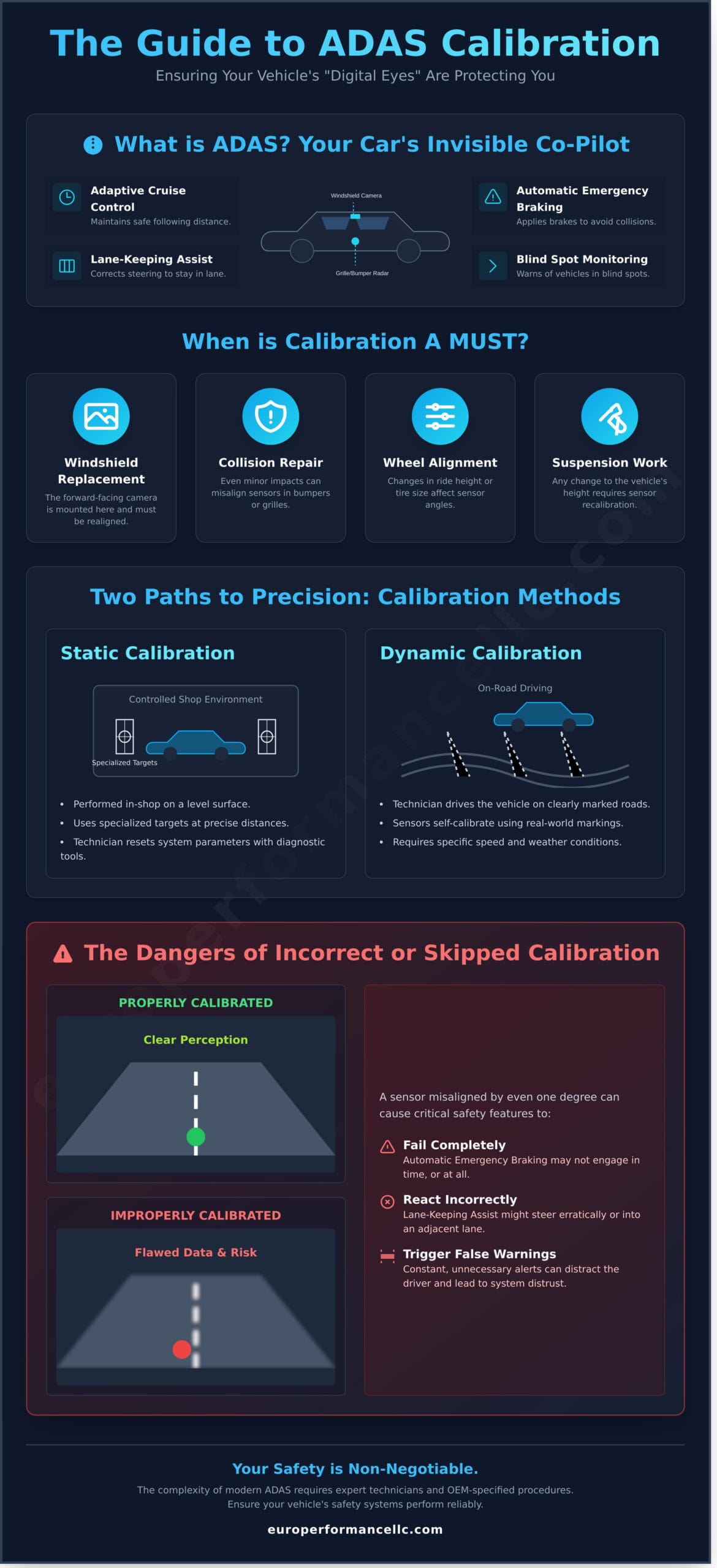
- Adaptive Cruise Control (ACC): Automatically adjusts your vehicle’s speed to maintain a safe, pre-set following distance from the car ahead.
- Lane-Keeping Assist (LKA): Provides gentle steering corrections to help keep your vehicle safely centered within its lane markings.
- Automatic Emergency Braking (AEB): Detects potential frontal collisions with other vehicles or pedestrians and can apply the brakes to mitigate or avoid an impact.
- Blind Spot Monitoring and Rear Cross-Traffic Alert: Warns you of vehicles in your blind spots or approaching from the side while you are reversing.
How ADAS Works: The Role of Cameras, Radar, and Sensors
The remarkable effectiveness of ADAS relies on the accuracy of the data it receives. Your vehicle gathers this information through a network of specialized sensors that constantly monitor the driving environment. The primary components include a forward-facing camera mounted on the windshield, which “sees” lane markings and traffic signs, and radar sensors often hidden in the grille or bumpers that detect the position and speed of other objects.
This constant stream of data allows the system to make split-second safety decisions. For these decisions to be accurate, every sensor must be perfectly aligned-a task accomplished through precise adas calibration. This process ensures the entire safety network functions exactly as its engineers intended, which is why professional adas calibration is a critical requirement after many common repairs.
Defining ADAS Calibration: Aligning Your Car’s Digital Eyes
At its core, ADAS calibration is the professional process of precisely aligning the cameras and sensors that your vehicle’s safety systems rely on. Think of it like focusing a high-end camera lens or having an optometrist perfectly adjust a new pair of prescription glasses. If the focus is even slightly off, the resulting image is useless. Similarly, for your vehicle’s ADAS to function correctly, its sensors must “see” the world with pinpoint accuracy, measuring distances, angles, and lane markings exactly as the manufacturer intended.
When these digital eyes are misaligned-even by a single degree-the computer receives flawed data. This can cause safety features like automatic emergency braking or lane-keeping assist to react too late, too early, or not at all. A proper adas calibration ensures that your car’s perception of the road matches reality, which is fundamental to its ability to protect you.
Static vs. Dynamic Calibration: Two Paths to Precision
To restore this essential alignment, our ASE certified technicians use one of two manufacturer-specified methods. The required procedure is not a matter of choice; it is dictated by your vehicle’s engineering.
- Static Calibration: This process is performed in our controlled shop environment. The vehicle is parked on a perfectly level surface, and specialized targets are placed at exact, measured distances. Our technicians then use advanced diagnostic tools to reset the system’s parameters to these precise targets.
- Dynamic Calibration: This method requires one of our technicians to drive the vehicle on clearly marked roads. During the drive, the diagnostic tool is connected to the vehicle, allowing the ADAS sensors to self-calibrate by reading real-world road markings and conditions.
Why OEM Procedures are Non-Negotiable for European Cars
The precision engineering of European brands like BMW, Audi, and Mercedes-Benz extends deep into their electronic safety systems. These vehicles have strict, model-specific calibration requirements that leave no room for error. Following the Original Equipment Manufacturer (OEM) procedure is not just a best practice; it is the only way to guarantee the system will function as designed. Attempting shortcuts or using generic processes can lead to catastrophic system failure, a risk detailed in technical studies such as SAE International’s report on Sensor Calibration for Automotive Aftermarket ADAS. Restoring these sophisticated systems requires brand-specific equipment and expert training, ensuring your vehicle’s safety features remain reliable and effective.
When is ADAS Calibration Absolutely Necessary?
Many drivers assume that Advanced Driver Assistance Systems only need attention after a significant accident. However, several common, real-world scenarios can disrupt the precise alignment of these systems, making a professional adas calibration essential for your safety. Understanding these triggers ensures your vehicle’s protective features function exactly as intended.
After Windshield Replacement
Your vehicle’s forward-facing camera, critical for features like lane-keeping assist and automatic braking, is typically mounted directly to the windshield. When the glass is replaced, the camera’s position and angle inevitably change. Even a millimeter of deviation can cause the system to misinterpret road conditions, making post-replacement calibration a vital step for safety.
Following a Wheel Alignment or Suspension Work
Any service that alters your vehicle’s ride height or the angle of its wheels-such as a four-wheel alignment or suspension repair-directly impacts how ADAS sensors perceive the road. Your car’s computer relies on this precise data to function correctly. Calibration synchronizes the ADAS with the new vehicle geometry, restoring the system’s accuracy and reliability.
After a Collision, Even a Minor One
Modern bumpers, grilles, and side mirrors often conceal sensitive radar and sonar sensors. A seemingly minor parking lot bump or fender bender can easily knock these components out of alignment without causing visible damage. Restoring your vehicle’s safety net requires a thorough adas calibration to ensure these hidden sensors are aimed and functioning perfectly.
When a Sensor or Related Part is Replaced
If a faulty camera, radar sensor, or related control module is replaced, the new component must be calibrated. This process integrates the new part into the vehicle’s complex network, ensuring it communicates correctly with other systems. A dashboard warning light is often the clearest indicator that a system component needs professional service and recalibration.
Ignoring these common triggers can lead to system malfunctions when you need them most. If your vehicle has experienced any of these events, it is critical to have its systems professionally assessed. For the precise calibration required by high-performance European vehicles, trust our ASE-certified technicians.
The Dangers of Incorrect or Skipped ADAS Calibration
The advanced safety systems in your European vehicle are designed to be a crucial layer of protection, but they are only as reliable as their last calibration. An improper or skipped adas calibration doesn’t just mean a feature might not work-it can actively create dangerous situations on the road, compromising the safety of you, your passengers, and everyone around you.
When the sensors, cameras, and radar units that govern these systems are even slightly misaligned, they feed incorrect information to the vehicle’s computer. This can lead to two primary types of critical failures.
Safety Features That Fail to Activate
The most alarming risk is when a life-saving feature fails to engage during an emergency. Imagine a scenario where a vehicle ahead stops suddenly. Your Automatic Emergency Braking system, relying on a misaligned camera, may not detect the obstacle in time to apply the brakes. Similarly, a Lane Keeping Assist system might fail to recognize lane markings, allowing your vehicle to drift without correction. In these moments, a feature designed as a safety net becomes a dangerous liability.
Incorrect System Activation
Equally hazardous are systems that activate when they shouldn’t. This can lead to “phantom braking,” where the vehicle brakes sharply and unexpectedly for a non-existent threat, creating a high risk of a rear-end collision. In another scenario, a miscalibrated lane-assist system could incorrectly interpret the road’s position and steer the vehicle toward the shoulder or, even worse, into oncoming traffic. These malfunctions don’t just fail to prevent an accident; they can directly cause one.
Why You Need a Specialist with the Right Equipment
Given these serious risks, it’s clear that this is not a task for a general mechanic. A professional ADAS service requires a specific, controlled environment and specialized tools, including:
- A perfectly level and clean workshop floor to ensure precise measurements.
- Manufacturer-specific targets placed at exact distances and heights.
- Advanced diagnostic scan tools to communicate with and reset the vehicle’s computers.
This level of specialization highlights the growing need for continuous education in the automotive industry. For workshops and technicians looking to expand their capabilities in areas like ADAS and EV technology, it’s valuable to discover K-Tech Auto Solution, a provider of advanced automotive equipment and training courses.
Only a specialist can guarantee that these intricate systems are restored to precise OEM standards. Our ASE-certified technicians have the dedicated training and equipment to perform this service with the meticulousness your European vehicle demands. Trust Belgrade’s European vehicle experts with your ADAS service.
Your Vehicle’s Safety Depends on Precision Calibration
Your vehicle’s Advanced Driver Assistance Systems are more than just convenient features-they are your digital co-pilot, actively working to keep you safe on the road. As we’ve discussed, events as common as a windshield replacement or a wheel alignment can compromise the precision of these systems. Ignoring the need for recalibration isn’t a risk worth taking, as it can lead to system malfunctions when you need them most. This is why professional adas calibration is not just a recommendation; it is an essential service for maintaining your car’s integrity and your peace of mind.
At Euro Performance LLC, our ASE Certified Technicians specialize in servicing high-performance European vehicles like BMW, Audi, and Mercedes. Using state-of-the-art diagnostic and calibration equipment, we ensure your vehicle’s safety systems function exactly as the manufacturer intended. Don’t leave your safety to chance. Schedule Your Expert ADAS Calibration in Belgrade, MT today.
Drive with the confidence that comes from knowing your vehicle is in expert hands.
Frequently Asked Questions About ADAS Calibration
How long does a typical ADAS calibration service take?
The duration of an ADAS calibration varies depending on the vehicle’s make and model and the specific systems requiring adjustment. A static calibration, performed in a controlled workshop environment, can take from 30 minutes to a few hours. A dynamic calibration requires a road test under specific conditions, which may take longer. Our ASE certified technicians will provide a more accurate time estimate after assessing your specific vehicle’s needs to ensure a precise and reliable result.
Is ADAS calibration covered by my auto insurance policy?
In most cases, ADAS calibration is covered by an insurance policy if it is a necessary component of a covered repair, such as a windshield replacement, collision repair, or suspension work. However, individual policies can differ significantly. We strongly advise contacting your insurance provider directly to confirm your specific coverage details. Our team can provide all the necessary technical documentation for your claim, outlining why the calibration was essential for your vehicle’s safety.
Can I still drive my car if an ADAS warning light is on?
While your vehicle may be mechanically operable, we strongly recommend you do not continue to drive with an active ADAS warning light. This light indicates that one or more critical safety systems-like automatic emergency braking or blind-spot monitoring-are disabled or malfunctioning. Continuing to drive compromises your vehicle’s built-in safety features, increasing the risk of an accident. For your safety, schedule a diagnostic service with a qualified professional immediately.
What is the average cost of ADAS calibration?
The cost of an adas calibration can range from approximately $150 to over $1,000. This price is influenced by several key factors, including the make and model of your vehicle, the number of systems requiring calibration, and whether a static or dynamic procedure is needed. A simple forward-facing camera recalibration will cost less than a comprehensive service involving radar, lidar, and multiple cameras. We provide a detailed estimate after a thorough vehicle assessment.
Why can’t just any auto shop perform an ADAS calibration?
ADAS calibration demands a level of precision that requires specialized equipment and training. The process involves manufacturer-specific diagnostic tools, laser-guided targets, and a perfectly level service area to meet strict OE specifications. Technicians must undergo extensive training to understand the complex sensor networks in modern European vehicles. An incorrect calibration from an unequipped shop can render your safety systems unreliable or completely ineffective, posing a significant safety risk.
Does a small chip or crack in my windshield affect ADAS?
Yes, even a minor chip or crack in your windshield can significantly interfere with ADAS functions. The system’s forward-facing camera is typically mounted on the windshield, and any imperfection in its direct line of sight can distort its perception of the road. This distortion can lead to inaccurate readings for critical features like lane-keeping assist and collision avoidance. This is why any windshield replacement on an ADAS-equipped vehicle must be followed by a professional recalibration.