
Blog

A performance exhaust isn’t just a hollow tube of metal; it’s a precision instrument that dictates the very soul of your vehicle’s engine. If you’re seeking bmw performance tuning bozeman enthusiasts rely on, you already know that the “Ultimate Driving Machine” deserves more than a generic muffler shop’s guesswork. You want a deeper, more aggressive note that commands respect without the headache of cabin drone or raspy tones. It’s about finding that perfect balance between raw power and refined European acoustics.
We understand the anxiety that comes with modifying a sophisticated German vehicle, from triggering persistent check engine lights to the fear of Montana’s road salt corroding low-grade components. This guide explains how specialized exhaust engineering transforms your BMW’s performance while maintaining its longevity. You’ll discover why precision sensor integration is vital for modern engine management and how professional installation ensures you stay within the state’s 95-decibel noise limit. We’ll also cover the critical role of material quality and technical calibration in protecting your investment against the local climate.
Key Takeaways
- Understand how optimizing scavenging and backpressure directly influences your BMW’s torque curve for measurable performance gains.
- Compare the different types of exhaust systems available for bmw performance tuning bozeman to find the right balance between acoustic profile and horsepower increases.
- Learn why specialized knowledge of European electronic valve systems is essential to prevent fitment errors and maintain factory-level sensor integration.
- Discover the technical methods used to manage O2 sensors and catalytic efficiency to ensure your performance upgrades don’t trigger check engine lights.
- Identify the importance of using OE-manufacturer components and high-grade materials that withstand Montana’s specific environmental challenges.
Why Performance Exhaust Engineering Matters for Your BMW
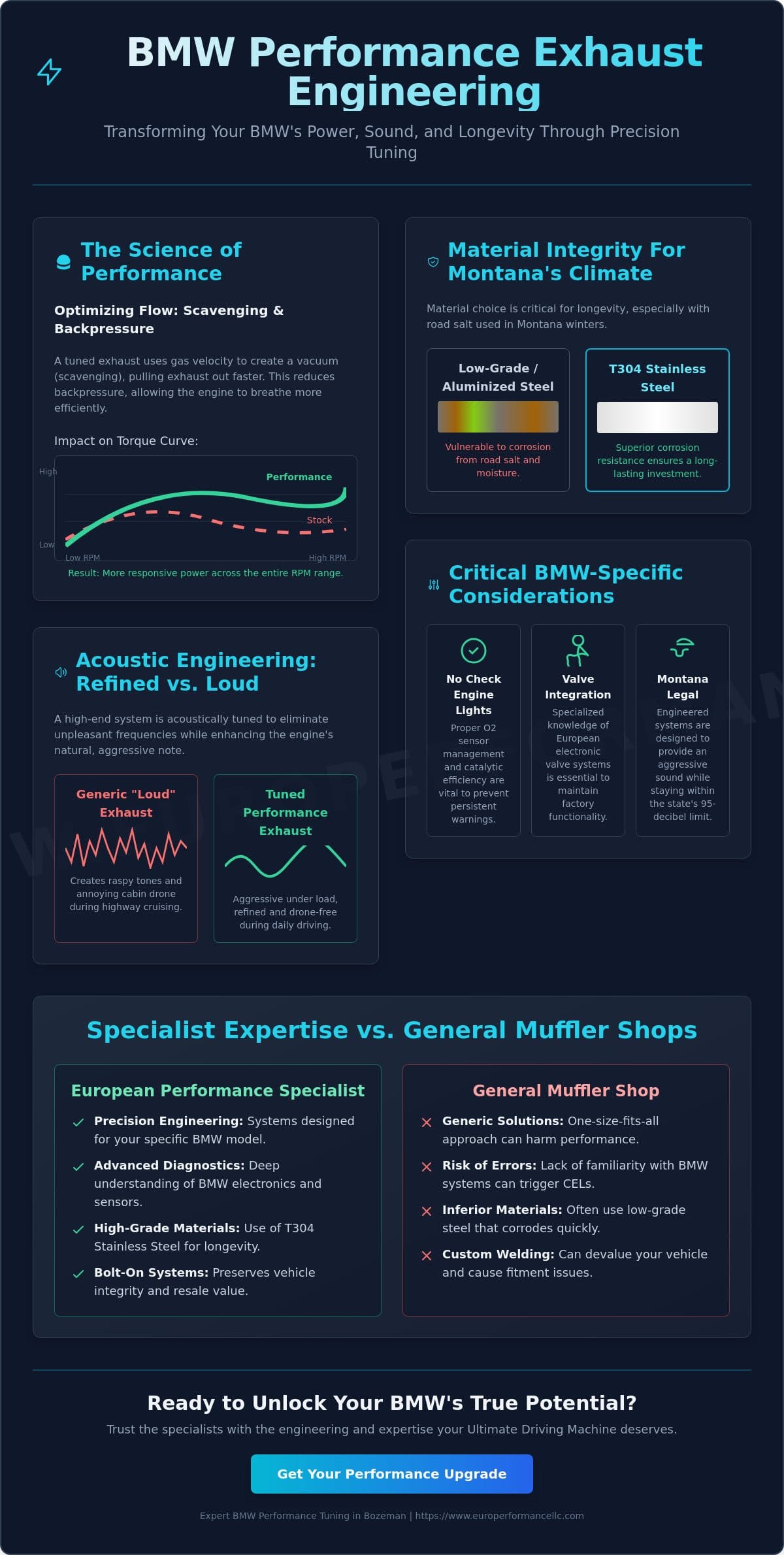
Performance exhaust engineering is frequently misunderstood as a simple quest for higher decibels. For owners seeking bmw performance tuning bozeman services, the reality is far more technical. A well-engineered system acts as a precision-tuned extension of the engine’s combustion cycle. It optimizes the flow of spent gases to improve volumetric efficiency. By applying the principles of tuned exhausts, engineers manipulate pressure waves to assist in pulling fresh air and fuel into the cylinder. This process significantly alters the BMW torque curve, providing a more responsive feel across the entire RPM range. Reducing restrictive backpressure allows the turbocharger to reach its target boost levels faster, resulting in a more immediate power delivery that you can feel during acceleration.
Selecting the right components ensures that your vehicle remains a pleasure to drive in Montana’s varied conditions. High-quality systems utilize T304 stainless steel, which is essential for resisting the corrosive effects of road salt during local winters. This material choice reflects a commitment to longevity that general muffler shops often overlook. It’s a methodical approach that prioritizes the vehicle’s long-term health alongside its performance gains.
To better understand how these components are integrated, watch this helpful video:
The Science of Exhaust Scavenging in European Engines
Scavenging is the process where the velocity of exiting exhaust gases creates a vacuum effect, drawing out more combustion remains. This is critical for turbocharger spool-up in modern BMW engines. If the piping diameter is too large, the gas velocity drops, which actually hurts low-end torque. Precision engineering ensures the diameter is perfectly matched to the engine’s displacement and output. These European performance standards focus on maintaining this delicate balance. Unlike domestic systems that often prioritize raw volume, these systems are designed to enhance the engine’s breathing capabilities without sacrificing drivability.
Acoustic Tuning vs. Just Being Loud
A loud exhaust is easy to build, but a refined exhaust note requires meticulous acoustic engineering. Resonators are used to target and cancel out the specific low-frequency frequencies that cause annoying cabin drone during highway cruising. High-end performance mufflers use specialized packing materials to sharpen the exhaust note, filtering out raspy sounds while emphasizing the engine’s natural mechanical character. Acoustic resonance is the synchronization of sound waves within the exhaust chambers. By managing these waves, engineers create a sophisticated sound profile that reflects the vehicle’s heritage without being obnoxious. This technical approach is a hallmark of the bmw performance tuning bozeman drivers expect from specialists. It ensures the sound is aggressive under load but remains composed and professional during a daily commute.
BMW Performance Tuning: Exhaust Options and Power Gains
Selecting the right exhaust configuration is a pivotal decision in bmw performance tuning bozeman. While many owners prioritize the acoustic profile, the mechanical benefits of a high-quality system are what truly define the driving experience. For premium European vehicles, we recommend bolt-on systems over custom-welded alternatives. Bolt-on components are engineered to factory specifications, ensuring they integrate with existing mounting points without permanent modifications. This approach is essential for maintaining the resale value of your vehicle, as it allows you to return the car to its original configuration if necessary.
In the current 2026 legal landscape, Bozeman drivers must remain mindful of Montana’s strict 95-decibel noise limit. Recent legal changes have eliminated the “reasonable grounds” defense for noise violations, making precision engineering more important than ever. When selecting a system, consulting with specialized European auto repair experts ensures your modifications remain compliant while delivering the performance gains you expect. High-grade T304 stainless steel remains the industry standard for our region, as it provides the necessary resistance against the magnesium chloride and road salts used on Montana mountain passes.
Axle-Back and Cat-Back Systems
An axle-back system replaces only the rear muffler section. It’s an excellent choice if your primary goal is to sharpen the exhaust note without significantly altering the vehicle’s emissions hardware. However, for measurable power gains, a cat-back system is the superior option. By replacing the exhaust from the catalytic converter to the rear bumper, you remove restrictive factory mid-pipes and resonators. On a modern 3-series or 5-series BMW, a well-designed cat-back system can yield documented gains of 8 to 12 horsepower by improving gas flow and reducing weight.
High-Flow Downpipes and Turbo Response
The downpipe is the most restrictive part of the exhaust in turbocharged engines like the N55, B58, and S55. Upgrading to a high-flow downpipe significantly reduces backpressure immediately after the turbine wheel. This allows the turbocharger to spool faster, reducing lag and increasing mid-range torque. It’s critical to understand that these modifications require specialized software tuning to manage oxygen sensor data and prevent check engine lights. Without proper calibration, you risk elevated exhaust gas temperatures (EGTs), which can lead to premature turbocharger wear or internal engine damage. Additionally, Montana law prohibits the removal of federal emissions control devices, so high-flow, catted options are the only responsible choice for street-driven vehicles.
Specialist vs. Generalist: Finding the Right Shop in Bozeman
Modern BMWs are not merely mechanical machines; they are sophisticated networks of electronic sensors and integrated systems. A general muffler shop might be excellent at basic pipe welding, but they often lack the specialized knowledge required for the bmw performance tuning bozeman owners expect. Many current BMW models utilize integrated electronic exhaust valves that communicate directly with the engine control unit (ECU). If these valves aren’t handled with precision during an installation, the vehicle may trigger persistent fault codes or even enter a restricted performance mode. Relying on a specialist ensures that these complex electronic components are integrated correctly rather than bypassed or damaged.
Choosing a dedicated European shop means your vehicle is in the hands of ASE-certified technicians who understand the specific metallurgy and chassis requirements of German engineering. High-end European chassis use specific alloys and mounting points that require a methodical approach. Improper welding or forced fitment can place undue stress on the exhaust manifold or damage sensitive underbody shielding. While general shops may offer lower labor rates, the risk of improper installation on a high-value asset often outweighs the initial savings. For drivers in Gallatin County, the short drive to Belgrade offers a strategic advantage, providing access to focused expertise and modern diagnostic equipment that generalists simply don’t possess.
The Importance of Specialized Diagnostic Tools
Installing a performance exhaust isn’t the final step in the tuning process. Often, the vehicle’s ECU must be calibrated to recognize the change in gas flow and backpressure. Resetting adaptation values is a critical step that ensures the engine management system doesn’t overcompensate for the new flow characteristics. Specialized diagnostic software identifies minor sensor discrepancies that generic OBD-II scanners frequently miss. This technical integration is a core component of comprehensive factory scheduled maintenance. Ensuring your exhaust system is correctly synchronized with the engine’s computer prevents long-term reliability issues and maintains the vehicle’s sophisticated driving dynamics.
Precision Fitment and Hanger Alignment
Precision is non-negotiable when dealing with high-performance exhaust systems. A minor misalignment can lead to microscopic exhaust leaks, which introduce “false air” to the O2 sensors. This confuses the engine’s fueling strategy, leading to a rough idle or inconsistent throttle response. Proper alignment also prevents the exhaust tips from vibrating against the rear diffuser or heat shields. If the system is positioned too close to plastic bodywork, the heat can cause the bumper to warp or melt. Euro Performance Auto Shop LLC utilizes precision mounting techniques for every installation to ensure that hangers are perfectly tensioned and heat shielding remains effective. This meticulous attention to detail prevents annoying rattles and protects the aesthetic integrity of your BMW.
Critical Technical Considerations: Backpressure and ADAS
The most frequent objection regarding bmw performance tuning bozeman is whether a modified exhaust will trigger a persistent Check Engine Light (CEL). This concern is well-founded. Modern BMW engine management systems are designed with incredibly tight tolerances. When you alter the exhaust flow, you change the thermal and pressure environment the engine expects. If the ECU detects that catalytic efficiency has dropped below a specific threshold, it will immediately store a fault code. This isn’t just an annoyance; it can prevent your vehicle from passing certain safety inspections or mask other critical engine issues. Managing these codes requires a methodical approach that goes beyond simply clearing the light with a basic scanner.
Technical precision is vital when dealing with these sophisticated European systems. If you’re planning a comprehensive build that involves high-flow components, you should consult with a professional Euro Performance Auto Shop LLC technician to ensure your hardware and software are perfectly synchronized. This level of oversight protects your engine from lean conditions and ensures that every modification contributes to a reliable, high-performance driving experience.
Sensor Management and CEL Prevention
O2 sensors monitor oxygen content to adjust the air-fuel mixture. In a factory setup, the primary sensor manages fueling while the secondary sensor monitors the health of the catalytic converter. High-flow exhaust systems increase the velocity of spent gases, which can lead to “slow response” or “efficiency” codes. While some enthusiasts attempt to use O2 sensor spacers to pull the sensor out of the direct exhaust stream, this is often a temporary fix. A more reliable method involves proper ECU remapping. This software-level calibration tells the engine management system to expect the new flow characteristics. It ensures the vehicle maintains optimal fueling without the need for mechanical workarounds that can fail over time.
Exhaust Modifications and ADAS Calibration
It’s often overlooked that major under-car work can influence Advanced Driver Assistance Systems (ADAS). These safety features, including lane-departure warnings and emergency braking, rely on sensitive radar and sonar sensors. Changes to the vehicle’s profile or even new vibration patterns from a stiffened chassis can affect how these sensors interpret the environment. Radar and sonar systems rely on a stable, correctly aligned chassis to function safely. If an exhaust installation involves removing subframe braces or altering the vehicle’s weight distribution, a precision alignment shop visit is necessary. Furthermore, ensuring your vehicle undergoes professional ADAS calibration post-modification is a critical step for maintaining overall vehicle safety. Precision in the workshop translates directly to safety on the road.
Precision BMW Exhaust Installation at Euro Performance Auto Shop LLC
Euro Performance Auto Shop LLC approaches every project with the mindset of a specialized engineer. While generalists may treat an exhaust swap as a simple plumbing task, we recognize it as a critical upgrade to a high-value asset. Our shop utilizes only OE-manufacturer components and top-tier aftermarket brands to ensure every fitment meets or exceeds factory standards. This methodical approach is the foundation of the bmw performance tuning bozeman enthusiasts deserve. By focusing on precision rather than speed, we ensure your vehicle leaves the shop in a condition that reflects its German heritage. Every bolt is torqued to specific factory requirements, and every clearance is measured to prevent heat transfer to sensitive underbody components.
Our commitment to excellence extends beyond the physical installation. We view the exhaust system as a part of a larger, integrated machine. This requires a master craftsman’s touch, where the technician is as comfortable with a wrench as they are with a diagnostic computer. By choosing a specialized facility, you avoid the common pitfalls of improper fitment and rattling heat shields that plague generic installations. We take the time to perform a final sound-check and thermal cycle, ensuring the system remains stable under real-world driving conditions in the Gallatin Valley.
Our Methodical Installation Process
We follow a strict, three-step process to ensure every installation is flawless and reliable. This structured workflow demystifies the service and provides a clear roadmap for the customer journey.
- Step 1: Comprehensive Pre-Installation Inspection. We begin by evaluating the health of the existing system, including oxygen sensors, hangers, and the turbocharger flange. This step identifies any underlying issues, such as cracked manifolds or failing sensors, before the new performance components are fitted.
- Step 2: Precision Mounting and Alignment. Our technicians utilize high-quality gaskets and reinforced hangers to secure the new system. We pay close attention to the alignment of the exhaust tips within the rear diffuser, ensuring they’re perfectly centered and properly distanced from plastic bodywork.
- Step 3: Post-Install Diagnostic Sweep. Every project concludes with a full diagnostic check. We use specialized software to verify that the engine management system is correctly interpreting data from the exhaust sensors, ensuring zero error codes and optimal power delivery.
Why Belgrade is the Destination for BMW Enthusiasts
Located just a short drive from Bozeman, our Belgrade facility serves as the regional hub for European automotive excellence. We focus exclusively on brands like BMW, Audi, and Mercedes-Benz. This specialization allows us to maintain a level of technical proficiency and part-sourcing capability that general shops simply cannot match. You gain peace of mind knowing that your vehicle is being handled by ASE-certified technicians who engage in ongoing, brand-specific training. This expertise is vital for the complex electronic systems found in modern performance vehicles. If you’re looking for bmw performance tuning bozeman services that prioritize longevity and technical accuracy, contact Euro Performance Auto Shop LLC to discuss your next upgrade. We’re here to provide the professional standards your BMW requires.
Elevate Your BMW’s Performance with Precision Engineering
Modifying your BMW is a significant decision that requires a balance of acoustic refinement and technical accuracy. We have explored how proper scavenging and backpressure management can redefine your torque curve, while specialized European diagnostic equipment ensures your sensors remain in perfect harmony. You now understand why precision fitment is essential to avoid cabin drone and protect sensitive ADAS components from interference. These technical nuances are what separate a professional installation from a generic repair.
For drivers seeking the highest standard of bmw performance tuning bozeman offers, Euro Performance Auto Shop LLC provides the methodical expertise your vehicle requires. Our ASE Certified Technicians utilize top OE manufacturer parts and specialized European diagnostic equipment to ensure every installation is seamless and reliable. We prioritize the longevity of your vehicle alongside its power gains, ensuring that every modification respects the original engineering of the machine.
Schedule Your BMW Performance Consultation at Euro Performance Auto Shop LLC to begin your vehicle’s transformation. Your BMW was designed for excellence, and we are here to ensure your performance upgrades maintain that standard. We look forward to helping you unlock the full potential of your driving experience.
Frequently Asked Questions
Will a performance exhaust make my BMW fail Montana emissions testing?
Montana does not currently have a statewide vehicle emissions testing program. However, federal and state laws still prohibit the removal or alteration of emissions control devices like catalytic converters. A performance exhaust that maintains these factory components will not cause legal issues, but operating a vehicle on Montana highways without functional emissions hardware remains illegal under state statute.
How much horsepower can I realistically gain from a cat-back exhaust?
You can realistically expect gains of 8 to 12 horsepower on a modern 3-series or 5-series BMW. These increases are the result of reduced weight and improved gas flow compared to the restrictive factory mid-pipes and resonators. While the acoustic change is the most immediate benefit, the reduction in backpressure allows the engine to breathe more efficiently at higher RPMs.
Do I need to tune my BMW after installing a new exhaust system?
A software tune is not strictly required for axle-back or cat-back systems, but it is essential for high-flow downpipes. Modern ECUs are highly sensitive to changes in exhaust flow velocity and backpressure. A professional calibration ensures the engine management system optimizes these new characteristics, providing maximum performance gains while preventing potential lean conditions or sensor errors.
What is the difference between T304 and T409 stainless steel for Bozeman winters?
T304 stainless steel is the superior choice for Montana because of its high chromium and nickel content, which provides exceptional corrosion resistance. T409 is a lower-grade material that often develops surface rust when exposed to the magnesium chloride and road salts used on local mountain passes. T304 remains structurally sound and aesthetically pleasing even after years of exposure to harsh winter climates.
Can a performance exhaust cause a drone inside the cabin?
Low-quality or poorly designed systems often produce an annoying low-frequency drone during highway cruising. Precision-engineered European exhausts utilize targeted resonators to cancel out these specific frequencies. Choosing a system designed with acoustic resonance management ensures your BMW maintains a sophisticated sound profile that is aggressive under load but remains composed and quiet inside the cabin during daily driving.
How long does a professional BMW exhaust installation take?
A professional installation typically takes between two and four hours depending on the complexity of the system. Axle-back systems are generally the quickest to install, while full cat-back systems or downpipes require more time for precision mounting and sensor integration. This timeframe includes our methodical pre-installation inspection and a final diagnostic sweep to ensure the vehicle is operating correctly.
Will installing a performance exhaust void my BMW factory warranty?
Installing an aftermarket exhaust does not automatically void your entire factory warranty. Under federal law, a manufacturer can only deny a warranty claim if they can prove the aftermarket component directly caused the failure in question. Working with bmw performance tuning bozeman specialists who use OE-manufacturer parts helps ensure that your modifications are handled with the professional standards required to maintain vehicle integrity.
Why is my check engine light on after an exhaust upgrade?
A check engine light usually indicates that the O2 sensors are detecting exhaust gas flow or catalytic efficiency that falls outside of the factory’s programmed tolerances. This is a common occurrence when high-flow downpipes are installed without a corresponding ECU remap. Our technicians use specialized diagnostic tools to identify the specific fault code and perform the necessary calibrations to ensure your engine management system recognizes the new hardware.