
Blog
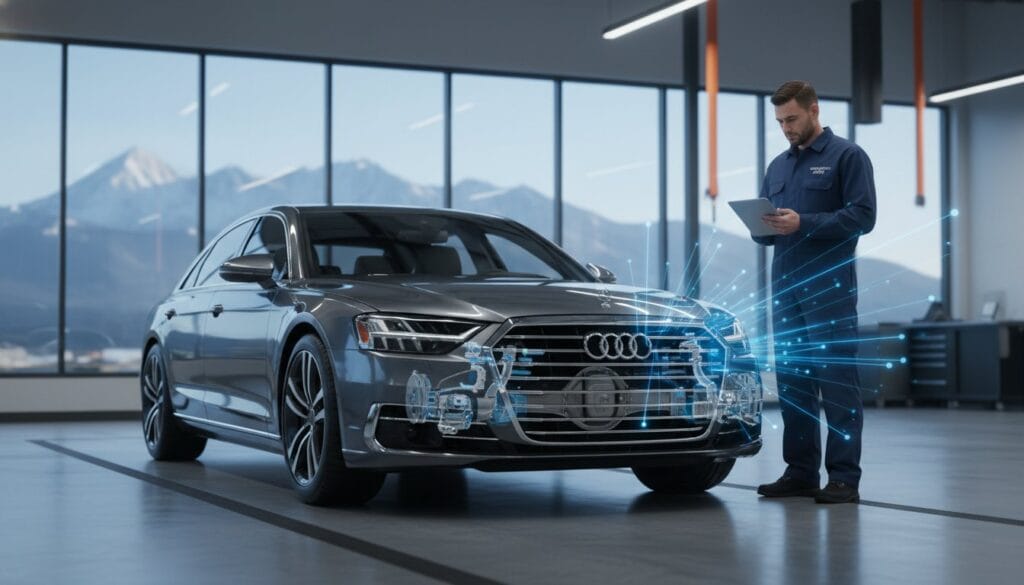
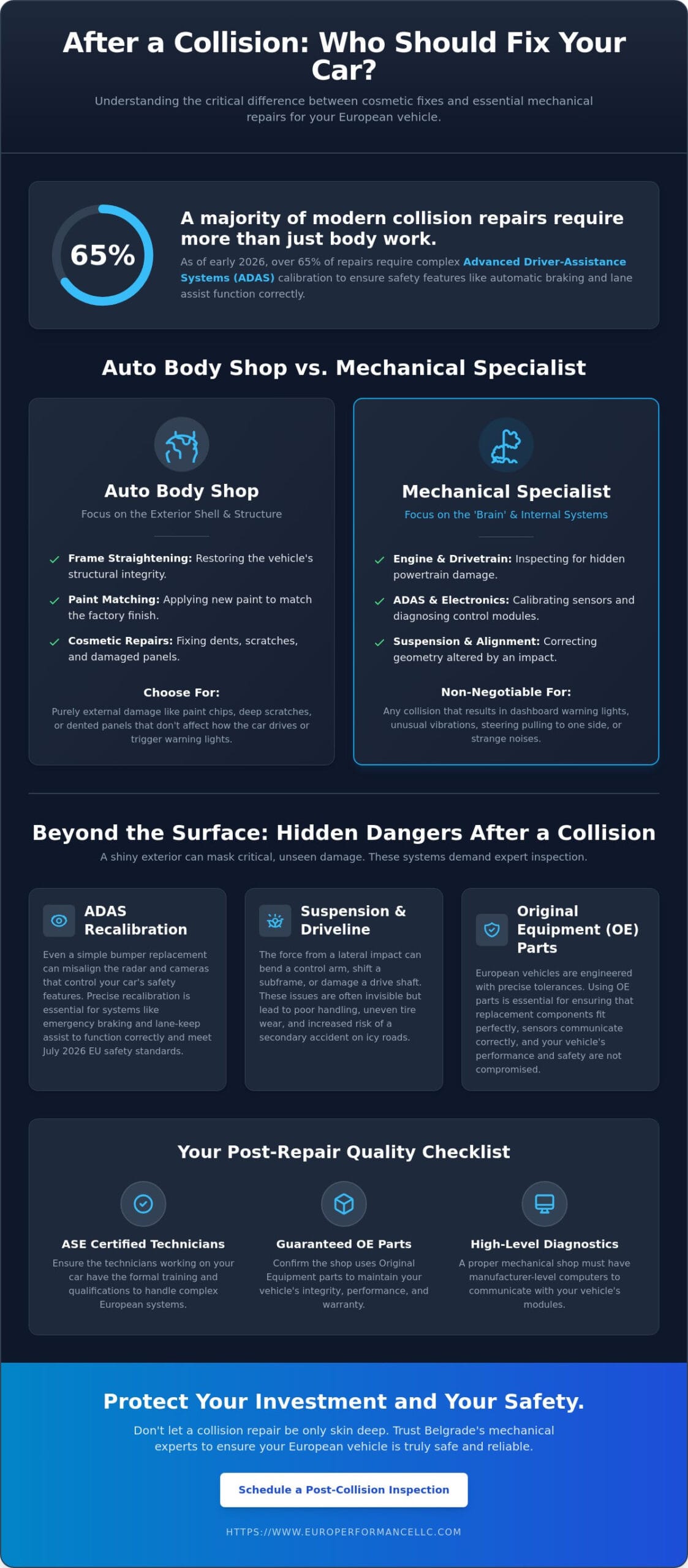
Did you know that as of early 2026, over 65% of all collision repairs now require complex ADAS calibration to ensure your safety systems actually work? While your first instinct after an accident might be to search for a local auto body shop to fix a crumpled bumper, a shiny exterior often masks compromised sensors or misaligned suspension components. You likely worry that a generic repair center will overlook the sophisticated “brain” of your Mercedes Benz, potentially leaving you with a car that looks great but fails in a crisis.
We understand that maintaining the mechanical integrity of your European vehicle is just as vital as a flawless paint job. You’ll learn how to distinguish between simple cosmetic work and the technical repairs your car needs to meet the July 2026 EU Phase 3 safety standards. This article previews the essential steps our ASE certified technicians in Belgrade take using OE manufacturer parts and precision tools. We’ll show you how to ensure your car is truly safe to drive, protecting both your family and your vehicle’s long-term resale value.
Key Takeaways
- Distinguish between the cosmetic focus of an auto body shop and the technical expertise required by a mechanical specialist to restore engines, drivetrains, and electronics.
- Understand why complex European suspension systems and drive shafts require specialized inspection to identify hidden damage that often follows a lateral impact.
- Learn why modern safety features like radar and cameras require precise ADAS recalibration even after a simple bumper replacement or minor collision.
- Identify why using OE (Original Equipment) parts is essential for maintaining the sensitive sensors and high-performance standards of European engineering.
- Discover the specific technical qualifications Belgrade owners should look for to ensure their vehicle remains safe and reliable after any repair.
Auto Body Shop vs. Mechanical Specialist: Understanding the Difference
Distinguishing between different types of repair facilities is the first step toward a proper recovery after an accident. An auto body shop serves as a specialist in the aesthetic and structural restoration of your vehicle. These facilities focus on the exterior shell, handling everything from frame straightening to paint matching. While a general Automobile repair shop might handle a variety of maintenance tasks, a dedicated body shop is equipped with specialized paint booths and hydraulic frame racks designed to return a vehicle’s appearance to factory specifications.
Mechanical specialists focus on the complex systems that lie beneath the surface. They are experts in the engines, drivetrains, and intricate electronic networks that define European engineering. After a significant impact, your vehicle often enters a diagnostic grey area where the damage isn’t just skin deep. A standard auto body shop often lacks the high-level diagnostic computers required to communicate with a BMW’s central gateway or a Mercedes-Benz’s control modules. This technical gap is why a collaborative approach is often required to ensure both the look and the logic of the car are fully restored.
To better understand the specific questions you should ask when selecting a repair facility, watch this helpful video:
When to Call an Auto Body Shop
You should prioritize an auto body shop when the damage is purely external or structural. In Montana, the high-altitude sun often leads to clear coat peeling or paint oxidation, which requires professional refinishing to prevent rust. If you have paint chips from gravel on I-90, deep scratches from a parking lot encounter, or dented panels that don’t affect how the car drives, the body shop is your destination. They also specialize in structural frame repair and the restoration of exterior trim pieces that have faded or cracked over time.
When a Mechanical Specialist is Non-Negotiable
Precision engineering requires a different level of technical scrutiny. If your dashboard displays a “Check Engine” light or safety system warnings after a collision, you need a specialist. Unusual vibrations, a steering wheel that pulls to one side, or new suspension noises indicate that the mechanical integrity of the car is compromised. For these critical issues, seeking Expert European Auto Repair in Belgrade, MT from the team at Euro Performance Auto Shop LLC ensures that ASE certified technicians evaluate the driveline and ADAS components. Our technicians focus on the intricate systems that a generic collision center might miss, ensuring your car remains safe and reliable on the road.
Critical Post-Collision Mechanical Repairs: Suspension and Driveline
A collision impacts more than just the exterior aesthetics of your vehicle. While a standard auto body shop excels at restoring the frame and paint, the intricate suspension systems of European-made vehicles require a specialized mechanical eye. High-performance brands like BMW utilize multi-link suspension designs that rely on absolute geometric precision. Even a low-speed lateral impact can bend a control arm or shift a subframe by millimeters. These minor deviations are often invisible to the naked eye but can lead to catastrophic component failure if left unaddressed.
Our local environment in Belgrade and Bozeman adds another layer of complexity. Montana’s severe winter conditions and freeze-thaw cycles create aggressive potholes that exacerbate even the smallest alignment issues. If your car isn’t tracking perfectly, the combination of icy roads and compromised suspension geometry significantly increases your risk of a secondary accident. You should consult guides on how to choose a reliable auto body shop to ensure the facility understands the boundary between cosmetic work and necessary mechanical teardowns. This is especially true for the gearbox and transmission mounts, which can shift or crack during a heavy jolt.
Precision Wheel Alignment for Safety
Standard “toe-and-go” alignments provided by generic tire centers aren’t sufficient for the active suspension systems found in modern Audi or Mercedes-Benz models. These vehicles require specialized equipment to calibrate camber, caster, and toe simultaneously to factory specs. You can read more in our Alignment Shop guide about why this precision matters. A mere 1-degree deviation from factory alignment specs can reduce your tire’s tread life by 20% over a single season of highway driving.
Driveline and Drive Shaft Integrity
The driveline is the most overlooked area after a collision. Lateral impacts can cause hairline fractures in aluminum or carbon fiber drive shafts. A standard auto body shop might miss these micro-stresses during a visual inspection. Using OE-quality CV joints and axles is mandatory because European performance standards don’t allow for the tolerances found in “equivalent” aftermarket parts. If you suspect your drivetrain has been compromised, have our ASE certified technicians perform a comprehensive driveline diagnostic to ensure your car is truly roadworthy.
The Role of ADAS Calibration in Modern Collision Recovery
Modern European engineering relies on a complex network of electronic “eyes” and “ears” known as Advanced Driver Assistance Systems (ADAS). These include radar units tucked behind bumpers, cameras mounted behind windshields, and sonar sensors embedded in the trim. While an auto body shop is responsible for the physical replacement of these components after a collision, the vehicle’s mechanical “brain” must be taught how to see again. If a sensor is misaligned by even two millimeters at the bumper, its field of vision could be off by several feet at highway distances. This creates “blind” safety systems that may fail to brake for a pedestrian or drift out of a lane without warning.
Industry experts are currently advocating for stricter ADAS calibration standards because as of early 2026, over 65% of all collision repairs require these technical resets. You can find more detail on why this is vital in our ADAS Calibration pillar. Failing to perform these steps correctly doesn’t just trigger a warning light; it compromises the active safety net you rely on. By July 2026, new regulations will mandate even more advanced features like Automatic Emergency Braking with cyclist detection, making precision even more critical.
The 3-Step ADAS Calibration Process
Our ASE certified technicians follow a methodical process to restore your vehicle’s safety features:
- Step 1: Pre-scan. We use specialized diagnostic tools to identify fault codes in the vehicle’s computer system and verify sensor health.
- Step 2: Calibration. Depending on the model, we perform static calibration using manufacturer-specific targets in a controlled environment, or dynamic calibration on the road.
- Step 3: Post-scan and Testing. We conduct a final scan and road test to verify that features like Adaptive Cruise Control are functioning with factory precision.
Why Body Shops Outsource This (And Why You Should Care)
Many collision centers lack the specialized equipment and clean room environments required for European ADAS work. High-end calibration systems often require an investment exceeding $50,000, which leads many a standard auto body shop to outsource this work to third parties. This can lead to longer wait times and a fragmented repair history. By choosing a mechanical specialist who performs these calibrations in-house, you ensure that the technicians who understand your engine and suspension are also the ones verifying your Lane Assist and collision avoidance systems. This unified approach guarantees that your high-value vehicle remains as safe as the day it left the factory.
Evaluating Shop Quality: OE Parts and ASE Certification
High-performance European engineering demands a level of precision that generic components simply cannot match. When you visit an auto body shop, you’re often presented with a choice between Original Equipment (OE) parts and “equivalent” aftermarket alternatives. OE parts are manufactured by the same companies that produced the original components for your vehicle, ensuring that every sensor and suspension link meets exact factory tolerances. Aftermarket parts frequently deviate by fractions of a millimeter. While this seems minor, it can cause persistent error codes in a Mercedes-Benz or lead to premature bushing failure in a BMW multi-link suspension.
The industry is shifting toward higher standards for these components. Proposed legislation from April 2026 already suggests that an auto body shop should be required to use OEM parts for critical safety systems like airbags to ensure they deploy correctly in a secondary impact. This trend underscores why we prioritize the mechanical “heart” of your vehicle. Using high-quality parts isn’t just about performance; it’s about maintaining the safety net that the original engineers designed for you and your family.
The OE Parts Advantage
Maintaining a documented OE repair history is a primary factor in preserving your vehicle’s resale value. Buyers of high-value European cars look for proof that repairs were performed with precision and quality in mind. Beyond value, OE parts ensure perfect fitment and longevity for complex Audi or Volkswagen systems. Choosing budget components often results in higher labor expenses later when those parts fail prematurely or require modification to fit correctly.
Certifications to Look For in Belgrade
Technical proficiency is non-negotiable for modern European diagnostics. You should always look for a facility that employs ASE certified technicians. These certifications must be renewed every five years to ensure the technician is up to date with the latest technology, including the complex electronic architectures of 2023 and newer models. A general mechanic may lack the specialized training for European-specific diagnostic software like ODIS or ISTA, which is essential for deep-level system coding.
Consistent care involves more than just accident recovery. Following a Factory Scheduled Maintenance guide ensures your car stays in peak condition between major service intervals. If you’re unsure if your recent repairs meet these high standards, schedule a technical inspection with our team to verify your vehicle’s mechanical integrity and safety.
Why Euro Performance Auto Shop LLC is Belgrade’s Mechanical Expert
Euro Performance Auto Shop LLC focuses specifically on the mechanical health of your European vehicle. While an auto body shop is the right choice for structural frame straightening or a fresh coat of paint, our team ensures the systems that actually drive the car are restored to factory standards. We serve the greater Bozeman and Gallatin County area from our specialized facility in Belgrade, Montana. Our shop is conveniently situated near the Bozeman Yellowstone International Airport, providing easy access for residents across the Gallatin Valley who demand precision for their high-value vehicles.
We utilize state-of-the-art technology to address the high-precision requirements of modern European engineering. This includes the latest tools for wheel alignment and the specialized equipment necessary for ADAS calibration. As the complexity of these systems increases, even a minor fender bender can compromise the safety sensors of your vehicle. We rely exclusively on parts from top OE manufacturers to guarantee that every replacement component matches the quality of the original build. This commitment to quality ensures your car performs exactly as the engineers intended, protecting your safety and your car’s long-term resale value in the Montana market.
Precision Work for Premium Brands
Our expertise covers the specialized systems found in BMW, Audi, Mercedes-Benz, and Volkswagen. These brands require a master-craftsman approach because their engineering tolerances are significantly tighter than those of domestic vehicles. We recommend a comprehensive mechanical inspection after any collision, even if your car was already repaired by a local auto body shop. A professional second look at your suspension geometry and electronic control modules provides the peace of mind that your investment is truly roadworthy. We don’t just clear fault codes; we verify the mechanical integrity of every system, from the multi-link suspension to the complex drivetrain components that are often overlooked during cosmetic repairs.
Schedule Your Post-Collision Inspection
We follow a transparent three-step process to get you back on the road safely. First, we schedule your appointment to ensure dedicated time for your vehicle’s specific needs. Second, we provide a detailed estimate based on a thorough diagnostic scan and physical inspection. Finally, our ASE certified technicians perform the necessary repairs using the latest technology and factory procedures. This methodical approach eliminates the guesswork often found at general repair centers. You deserve a partner who understands the intricacies of European performance and safety. Schedule your precision mechanical repair today at Euro Performance Auto Shop LLC and ensure your vehicle’s safety is never left to chance.
Protecting Your European Investment on Montana Roads
Choosing the right path after a collision ensures your car remains a high-performance machine rather than just a showpiece. While an auto body shop restores the exterior lines and paint, a mechanical specialist secures the underlying safety systems and drivetrain. By prioritizing ASE certified technicians and OE manufacturer parts, you protect the long-term resale value and operational reliability of your BMW or Mercedes-Benz. Don’t settle for repairs that are only skin deep when your safety depends on mechanical precision.
Our specialized equipment for ADAS calibration and wheel alignment ensures that every electronic and mechanical component functions with factory-level accuracy. We are committed to providing the transparency and technical excellence required for European-made vehicles in the Gallatin Valley. Trust your European vehicle to Belgrade’s mechanical experts at Euro Performance Auto Shop LLC. We look forward to helping you keep your vehicle safe and performing at its best on every Montana road.
Frequently Asked Questions
Is an auto body shop different from an auto repair shop?
An auto body shop is fundamentally different from a mechanical repair shop because it specializes in the vehicle’s exterior structure, panels, and paint restoration. While they ensure your car looks factory-new, a mechanical specialist focuses on the engine, drivetrain, and electronic systems. Both are often necessary after a collision to ensure the vehicle is both aesthetically restored and mechanically sound.
Do I have to go to a body shop recommended by my insurance?
You are not legally required to use a facility suggested by your insurance provider. You have the absolute right to choose the repair shop you trust for your European vehicle. Choosing a specialist ensures that your car receives the precise technical attention it needs, rather than the most cost-effective solution for the insurance company’s bottom line.
Why does my Audi need ADAS calibration after a minor fender bender?
Your Audi needs ADAS calibration because even a minor impact can shift sensors by as little as 2 millimeters. This small deviation causes safety systems like Lane Assist to miscalculate distances at highway speeds. Since over 65% of collision repairs in 2026 involve these sensors, skipping this step can leave your active safety features inoperable or dangerously inaccurate.
Can a regular mechanic perform a wheel alignment on a BMW?
A regular mechanic often lacks the specialized diagnostic software and high-precision racks required for a BMW multi-link suspension. European vehicles have extremely tight alignment tolerances that require specific loading procedures. Using a general shop may result in poor handling or steering wheel off-center issues, as they don’t always have access to the latest factory specifications for your specific model.
What happens if I don’t fix a minor vibration after an accident?
If you don’t address a minor vibration, you risk causing 20% faster tire wear or damaging expensive transmission components. Vibrations after an impact often signal a bent axle or a hairline fracture in a drive shaft. These mechanical issues can worsen quickly on Montana’s rough roads, leading to much higher repair costs if not diagnosed early by a specialist after your visit to an auto body shop.
Does Euro Performance LLC provide paint and body work?
Euro Performance LLC does not provide paint or collision repair services; we are a specialized European mechanical facility. We focus on technical repairs, ADAS calibration, and precision wheel alignment. If you’ve visited an auto body shop for exterior work, we recommend a follow-up mechanical inspection at our Belgrade shop to verify that your vehicle’s internal systems remain in peak condition.
How long does a typical mechanical repair take after a collision?
Mechanical repair timelines vary based on the extent of the damage and the specific parts required. A precision wheel alignment or ADAS calibration typically takes 2 to 4 hours. If we need to replace complex suspension components, the process may take 2 to 3 business days. We prioritize a methodical approach to ensure every repair meets our high standards for safety and reliability.
Will using a specialized shop instead of a body shop void my warranty?
Using a specialized independent shop will not void your vehicle’s warranty. Under federal law, you have the right to have your European car serviced by any qualified technician. We use parts from OE manufacturers and follow factory-prescribed procedures to ensure your warranty remains intact while providing the high-level expertise your high-performance vehicle requires.