
Blog

On a -22°F morning in Belgrade, Montana, last January, several Audi owners found their sophisticated German engineering silenced by a frozen battery. While the Quattro system is legendary for its grip on Highway 191, sub-zero temperatures can quickly compromise your vehicle’s complex electronics and ADAS sensors. Learning how to prepare your Audi for winter in Bozeman is no longer just about switching tires; it’s about protecting a high-value investment from the specific rigors of the Gallatin Valley.
You likely understand that Montana winters are unforgiving to even the most capable European cars. We agree that your peace of mind during the ski season depends on total vehicle reliability. This 2026 guide promises to help you master these extreme conditions with a specialized preparation strategy that prevents cold-start damage and ensures safety on the icy roads of Gallatin Canyon. We’ll preview the essential technical steps our ASE certified technicians recommend, from testing battery cold-cranking amps to calibrating sensors for heavy snow buildup, ensuring you drive with confidence all winter long.
Key Takeaways
- Understand why Bozeman’s -30°F temperatures require a specialized approach to Audi maintenance compared to standard domestic trucks.
- Learn how to prepare audi for winter in bozeman by performing critical high-load battery tests and G12/G13 coolant refreshes to prevent freezing.
- Discover the vital connection between precise wheel alignment and your Audi’s Advanced Driver Assistance Systems (ADAS) for maximum stability on icy roads.
- Master the “Montana Way” of navigating Highway 191 with an essential winter survival kit tailored specifically for high-performance European vehicles.
- Ensure your vehicle’s integrity by relying on ASE certified technicians who use only OE manufacturer parts to meet strict Audi factory standards.
Why Bozeman Winters Demand Specialized Audi Preparation
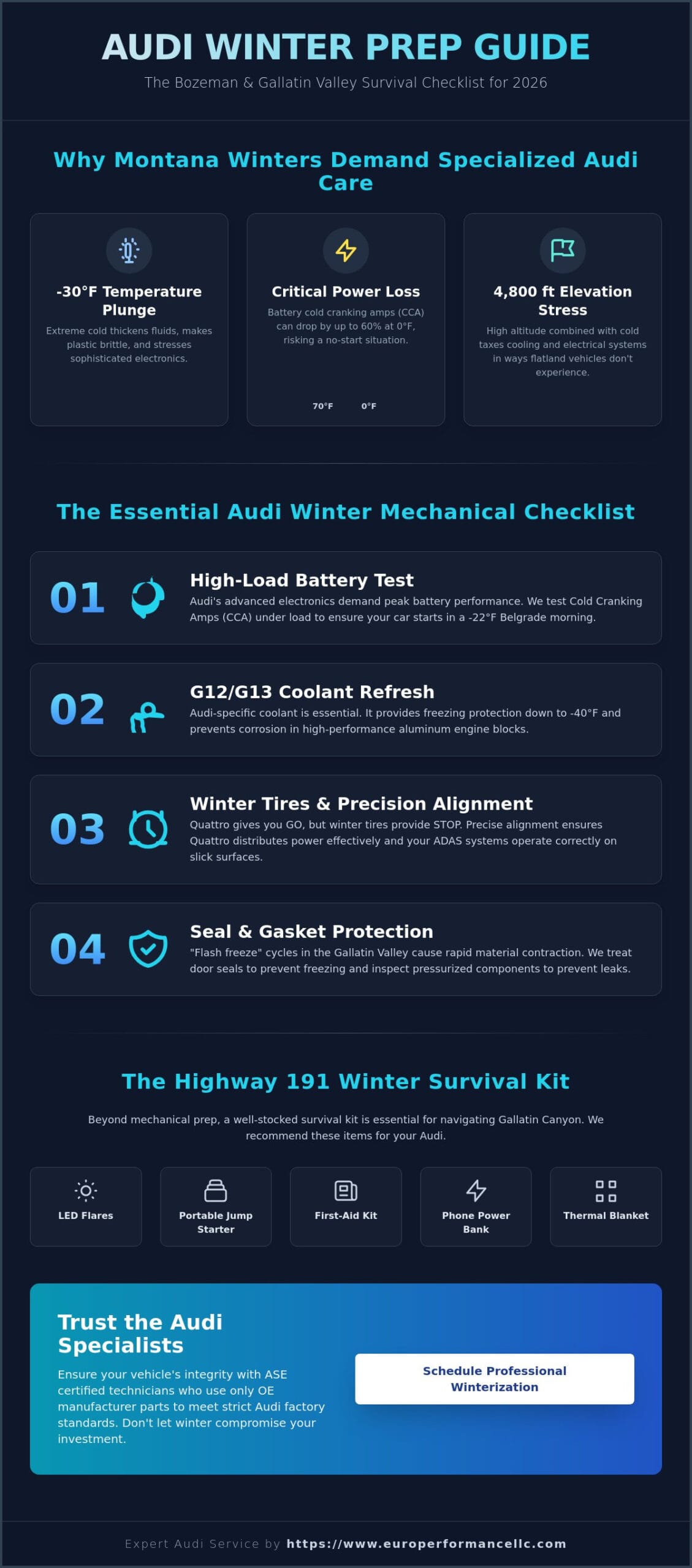
Bozeman winters are unforgiving. When temperatures plunge to -30°F, standard fluids can thicken and plastic components become brittle. Learning how to prepare audi for winter in bozeman requires more than just a quick oil change. It involves a deep understanding of how high-performance European engineering reacts to 4,800 feet of elevation and extreme thermal stress. While a domestic truck might rely on sheer mass and simple mechanical systems, your Audi uses complex sensors and tight tolerances that require a specialized approach. Our ASE certified technicians focus on precision readiness to ensure your vehicle remains reliable when the mercury drops.
Belgrade and Bozeman drivers face unique challenges compared to those in flatter, warmer regions. The combination of high-altitude air density and sustained sub-zero temperatures can tax an Audi’s cooling and electrical systems in ways a “flatland” driver never experiences. Preparing your vehicle isn’t just about convenience; it’s about maintaining the integrity of the OE manufacturers’ specifications under Montana’s harshest conditions.
To better understand the local conditions you’ll face, watch this helpful video from the Bozeman Police Department:
The Gallatin Valley Microclimate Factor
The “canyon commute” between Big Sky, Bozeman, and Belgrade creates unique engine temperature regulation issues. Rapid temperature swings, sometimes exceeding 35 degrees in a single afternoon, put immense pressure on Audi rubber seals and gaskets. According to 2026 regional climate data, the Gallatin Valley is seeing more frequent “flash freeze” cycles. This means your Audi service schedule must adapt. We recommend inspecting all pressurized components before the first major freeze to prevent catastrophic leaks caused by material contraction.
Quattro vs. Montana Ice: Setting Realistic Expectations
The physics of All-Wheel Drive (AWD) can be deceptive. While the Quattro system is world-class, “Go” does not equal “Stop” on icy Belgrade roads. You still need high-quality winter tires to provide the necessary friction for braking and cornering. Even the best tires can’t help if your chassis isn’t calibrated for the season. Specialized alignment is crucial for Quattro efficiency in snow. At Euro Performance LLC, we provide Expert European Auto Repair in Belgrade, MT, ensuring your suspension geometry is perfect. A Quattro system that’s even slightly out of alignment will struggle to distribute power effectively on slick surfaces, leading to unpredictable handling when you can least afford it.
- Precision fluid checks: Ensuring synthetic oils and coolants are rated for -40°F.
- Battery health diagnostics: Cold cranking amps drop by 60 percent at 0°F.
- Seal protection: Applying specialized treatments to door seals to prevent freezing.
Understanding how to prepare audi for winter in bozeman is the first step toward a stress-free season. By focusing on the specific technical needs of European machinery, you protect your investment and your safety.
The 2026 Audi Winter Mechanical Checklist
Understanding how to prepare audi for winter in bozeman requires a technical approach that goes beyond a simple oil change. Montana winters place extreme stress on German engineering; specifically the intricate sensor networks and cooling systems that define the Audi brand. Our ASE certified technicians recommend a five step mechanical audit to ensure your vehicle remains reliable when temperatures drop. Following NHTSA winter driving safety guidelines combined with these Audi-specific steps will keep you on the road during the harshest Gallatin Valley storms.
- Step 1: Conduct a high-load battery health test. Audi models are notoriously tech-heavy and power-hungry; a battery that works in September may fail during a December cold snap.
- Step 2: Inspect and refresh Audi-specific G12/G13 coolant levels. This specialized pink or purple fluid provides essential freezing point protection and prevents internal corrosion in aluminum engine blocks.
- Step 3: Evaluate brake pad thickness and rotor condition. Maximum stopping power is non-negotiable on slush and ice. We look for even wear and ensure ABS sensors are free of debris.
- Step 4: Verify heating, ventilation, and defrosting (HVAC) system efficiency. We check the heater core and cabin filters to ensure your windshield clears in seconds, not minutes.
- Step 5: Check all underbody shields and plastic covers. Snow packs into every crevice; loose shields can catch on frozen snow banks and tear away from the chassis.
Audi Battery Management and Cold Starts
Modern Audi vehicles utilize a complex Battery Management System (BMS). When you replace a battery, it’s mandatory to perform a “coding” process using a diagnostic tool. This tells the alternator the age and capacity of the new cell to ensure proper charging profiles. Without this, the car may overcharge the new battery, significantly shortening its lifespan. Belgrade nights frequently reach sub-zero temperatures, which can reduce a battery’s cranking amps by 50 percent. It’s a proven fact that a 4-year-old battery is a high-risk liability in Montana.
Fluid Dynamics: OE Coolant and Synthetic Oils
Cold-flow lubrication is vital for turbocharged engines. We use only OE-spec synthetic oil, typically 0W-20 or 5W-30, which maintains its viscosity even at -30°F. Generic washer fluid is another common failure point; it often freezes inside the heated Audi nozzles and cracks the plastic lines. We recommend a high-concentration winter mix rated for -40°F. For a full breakdown of fluid intervals, consult The Complete Audi Service Schedule. If you’re unsure about your vehicle’s current status, a quick professional Audi inspection can prevent a costly mid-winter breakdown.
Precision Systems: ADAS and Wheel Alignment in Snow
Your Audi relies on a complex network of sensors to manage Quattro all-wheel-drive and safety interventions. In the Gallatin Valley, road salt and liquid magnesium chloride create a conductive film over these sensors that can trigger system faults. When you’re researching how to prepare audi for winter in bozeman, you must account for these electronic vulnerabilities. Heavy snow on Highway 191 often causes “ghost” readings, where the Pre-sense system detects non-existent obstacles because radar waves reflect off dense, wet flakes. While the NHTSA winter driving guide provides a solid foundation for general vehicle safety, the high-performance tech in a German vehicle requires a more technical approach to winter readiness.
ADAS Calibration for Winter Safety
The cameras and radar units housed behind your Audi’s grille and windshield serve as the vehicle’s eyes. Slush buildup can blind these systems in seconds, but the more persistent threat is sensor misalignment. If you’ve had a windshield replaced due to Montana’s notorious road gravel or had any suspension components replaced, your sensors may be pointing slightly off-axis. Our ASE certified technicians use precision targets to ensure your Adaptive Cruise Control and Lane Assist are accurate to the millimeter. You can read more about why this matters in our guide on What is ADAS Calibration? Professional calibration prevents your car from making incorrect steering or braking corrections during a whiteout on the way to Big Sky.
Alignment Shop Insights for Bozeman Roads
Belgrade’s frost heaves and the deep potholes on 19th Avenue can knock your Audi out of alignment within a few weeks of the first freeze. This isn’t just a matter of tire longevity; it’s a critical safety issue for your electronic stability control (ESC). If your wheels aren’t perfectly straight, the steering angle sensor reports data that doesn’t match the vehicle’s actual path. This confuses the Quattro system, which might apply brakes to the wrong wheel during a slide. Understanding how to prepare audi for winter in bozeman requires a proactive four-wheel alignment before the snow sticks. Winter tires feature softer rubber compounds, which means even a 0.5-degree toe-out setting will scrub away expensive tread in a single season. It’s vital to be Choosing the Right Alignment Shop that utilizes the latest tools and technology to meet OE manufacturer specifications. Proper alignment ensures a flat contact patch, providing the maximum grip necessary for navigating icy mountain passes.
The Gallatin County Winter Survival Strategy
Bozeman winters demand more than just a capable Quattro system. When you learn how to prepare audi for winter in bozeman, you must account for the 20 mile stretch of the Gallatin Canyon where cell service vanishes completely. Being stranded in this “off-grid” zone without a plan is a significant safety risk. Your survival kit needs to be Audi-specific and Montana-tough. Beyond the standard heavy blankets and a metal collapsible shovel, your kit should include:
- Audi-Specific Tools: Keep your wheel lock key and a spare liter of OE-spec synthetic oil in the trunk. Cold snaps can cause minor fluid contractions that trigger sensors.
- High-Calorie Supplies: Pack non-perishable food and a way to melt snow for water if you’re stuck for several hours.
- Emergency Power: A dedicated jump starter pack is better than cables when there’s no one around to give you a boost.
Driving Highway 191 requires following the “Montana Way.” If you see three or more vehicles behind you, use the designated pull-overs to let them pass. It’s a matter of safety and local etiquette. Between October and April, dawn and dusk are high-risk times for wildlife. Elk and moose are frequent visitors to the roadway. A mature moose can weigh up to 1,500 pounds; their height means an impact often occurs at the windshield level of an A4 or Q5. If an animal jumps in front of you, brake hard and straight. Don’t swerve into oncoming traffic or off a steep embankment.
Winter Driving Tips for European Cars
Precision engineering allows for advanced control on ice. Use your Audi’s Tiptronic mode or steering wheel paddles to downshift when descending steep grades toward Big Sky. Engine braking reduces the risk of wheel lockup on black ice. Be aware that microclimates in the Gallatin Range are volatile. You might leave a sunny Bozeman valley and enter a total whiteout near Karst Stage within 15 minutes. Always check the MDT 511 app before heading out. It provides real-time data on road closures, plow locations, and friction levels on the asphalt.
Tire Selection: Winter Tires vs. All-Seasons
In Montana, all-season tires are effectively three-season tires. Once temperatures drop below 45 degrees Fahrenheit, the rubber compound in standard tires hardens. This significantly reduces your grip. Understanding how to prepare audi for winter in bozeman involves recognizing that your safety depends on the four contact patches of rubber on the road. Dedicated winter tires use specialized silica compounds that remain flexible in sub-zero conditions. This flexibility can shorten your stopping distance by as much as 30 percent on packed snow compared to all-seasons. If you have performance summer tires, store them in a climate-controlled garage. Leaving them in an unheated shed can cause the rubber to crack or develop permanent flat spots after just one season of Gallatin County cold.
Ensure your Audi is equipped with the right rubber and survival gear before the first storm hits. Schedule your winter safety inspection with our ASE certified technicians today.
Professional Audi Winterization at Euro Performance LLC
Audi engineering requires a specific level of technical precision that general repair shops often lack. Our ASE certified technicians follow the official Audi service schedule to ensure every component, from the Quattro all-wheel-drive system to the complex thermal management modules, functions perfectly in sub-zero temperatures. We use only parts from OE manufacturers. This commitment ensures your vehicle remains an Audi at its core. If you use generic aftermarket components during a Montana winter, you risk component failure when temperatures drop to -20°F or lower. Genuine parts are designed to handle the specific expansion and contraction rates of European alloys and plastics.
We’ve streamlined our workflow to respect your schedule and provide total transparency. Our process follows a logical three-step sequence: Schedule, Estimate, and Repair. First, you book your visit. Second, we provide a detailed digital estimate that explains exactly what your vehicle needs for the upcoming season. Finally, we perform the repairs using the latest diagnostic tools. Every service comes with our specialized European vehicle repair and maintenance guarantee. This provides the peace of mind you need when driving through the Gallatin Canyon or over Bozeman Pass in January.
The Value of an Independent Specialist
Belgrade and Bozeman owners frequently choose our shop over the dealership because we offer personalized care and direct communication with the people working on your car. We invest heavily in the latest diagnostic technology to provide dealership-level service with a local touch. Euro Performance LLC is the premier Belgrade garage for Euro vehicles. We understand that knowing how to prepare Audi for winter in Bozeman involves more than a simple fluid top-off; it requires a deep understanding of how high-performance German engines react to high-altitude, cold-start conditions.
Schedule Your Winter Inspection Today
Don’t wait for the first major blizzard of 2026 to find out your battery is weak or your glow plugs are failing. Early preparation saves you money by preventing emergency towing fees and cold-weather damage. You can book your appointment quickly through our online portal or by calling our office. Taking action now is the smartest way to learn how to prepare Audi for winter in Bozeman while avoiding the seasonal rush. Our team is ready to ensure your vehicle is safe, reliable, and warm all season long.
Secure Your 2026 Winter Drive
Bozeman’s winter environment remains one of the most challenging in the United States, with average snowfall often exceeding 80 inches per year in Gallatin County. Ensuring your Audi’s mechanical components and ADAS sensors are calibrated isn’t just about performance; it’s about safety on icy mountain passes. Proper winterization involves a meticulous review of specialized fluids, battery health, and wheel alignment to handle the specific stressors of sub-zero temperatures. These systems must work in perfect harmony to navigate the unpredictable Montana terrain.
Understanding how to prepare audi for winter in bozeman requires more than a standard oil change. It demands the precision of ASE Certified Technicians who utilize specialized Audi diagnostic tools to interface with your vehicle’s complex onboard computers. By using OE manufacturer parts only, you maintain the engineering integrity that makes your vehicle a superior winter machine. Our team focuses on every technical detail so you don’t have to worry when the snow starts falling.
Don’t wait for the first blizzard to find out your Quattro system or heating isn’t up to the task. Schedule Your Audi Winter Prep in Belgrade Today and experience the peace of mind that comes with professional service. Let’s make sure your Audi is ready for every mile of the 2026 season.
Frequently Asked Questions
Is Quattro enough for Bozeman winters, or do I need winter tires?
You need dedicated winter tires even with Quattro because all-wheel drive only provides traction for acceleration, not for braking or cornering. In Bozeman, temperatures frequently drop below 45 degrees Fahrenheit, causing all-season rubber to harden and lose its ability to grip the road. Our ASE certified technicians recommend tires with the 3-peak mountain snowflake symbol to ensure your Audi maintains its 100 percent safety rating on icy Montana mountain passes.
How often should I check my Audi battery in Montana?
You should have your Audi battery professionally tested at least twice a year, specifically before the first frost in October and after the final spring thaw. Cold temperatures can reduce a battery’s cranking power by 60 percent while the engine simultaneously requires twice as much current to start in sub-zero conditions. We use specialized diagnostic tools to measure Cold Cranking Amps (CCA) and ensure your European-made vehicle starts reliably during a Bozeman cold snap.
What is the best engine oil for an Audi in sub-zero temperatures?
The best engine oil for an Audi in sub-zero temperatures is a high-quality synthetic 0W-30 or 5W-30 that meets the VW 502 00 or 508 00 oil specifications. These low-viscosity oils are engineered to flow quickly to critical engine components during a cold start at -30 degrees Celsius. Using the correct OE manufacturer approved lubricant is essential for how to prepare Audi for winter in Bozeman and prevents premature wear on your timing belt and internal seals.
Why is my Audi check engine light flashing in the cold?
You must stop driving immediately if your check engine light is flashing because this indicates a severe engine misfire that can destroy your catalytic converter within minutes. Extreme cold often causes ignition coils or spark plugs to fail, leading to unburned fuel entering the exhaust system where it can reach temperatures over 1,200 degrees. Our ASE certified technicians utilize advanced electronic diagnosis to identify which specific cylinder is failing so we can perform a precise, reliable repair.
Can I use regular tap water in my Audi washer fluid reservoir?
You cannot use regular tap water in your Audi washer fluid reservoir because it will freeze solid and likely crack the plastic tank or pump when temperatures drop below 32 degrees Fahrenheit. Frozen water expands by 9 percent in volume, which often leads to expensive leaks in the headlight washer system and reservoir lines. Always use a winter-grade fluid rated for -40 degrees to keep your windshield clear of salt and road grime during Montana storms.
What should I do if my Audi ADAS sensors are blocked by snow?
You should manually clear snow and ice from the front grille, bumpers, and windshield cameras using a soft microfiber cloth to restore safety functions. When Advanced Driver Assistance Systems (ADAS) sensors are obstructed, your Audi will disable features like Pre Sense and adaptive cruise control to prevent errors. Because your vehicle relies on 16 to 24 different sensors to monitor the road, keeping these areas clean is a critical part of how to prepare Audi for winter in Bozeman.
How much does a winter pre-inspection cost at Euro Performance?
You should contact Euro Performance LLC directly to get an accurate quote for a winter pre-inspection on your specific Audi model. Our service includes a comprehensive 40-point check of your cooling system, battery health, and tire condition to ensure your vehicle meets Montana safety standards for 2026. We provide a transparent estimate before any work begins, so you know exactly what to expect for your European-made vehicle’s seasonal maintenance.
Does my Audi need a block heater for Bozeman winters?
Most modern Audi models do not require a traditional block heater because they use advanced synthetic oils that remain fluid at -40 degrees. However, installing a specialized oil pan heater can reduce engine wear and provide faster cabin heat during peak winter months in the Gallatin Valley. If your vehicle is parked outdoors overnight in temperatures consistently below zero, this addition offers extra protection for your engine’s internal components and helps preserve your battery life.