
Blog
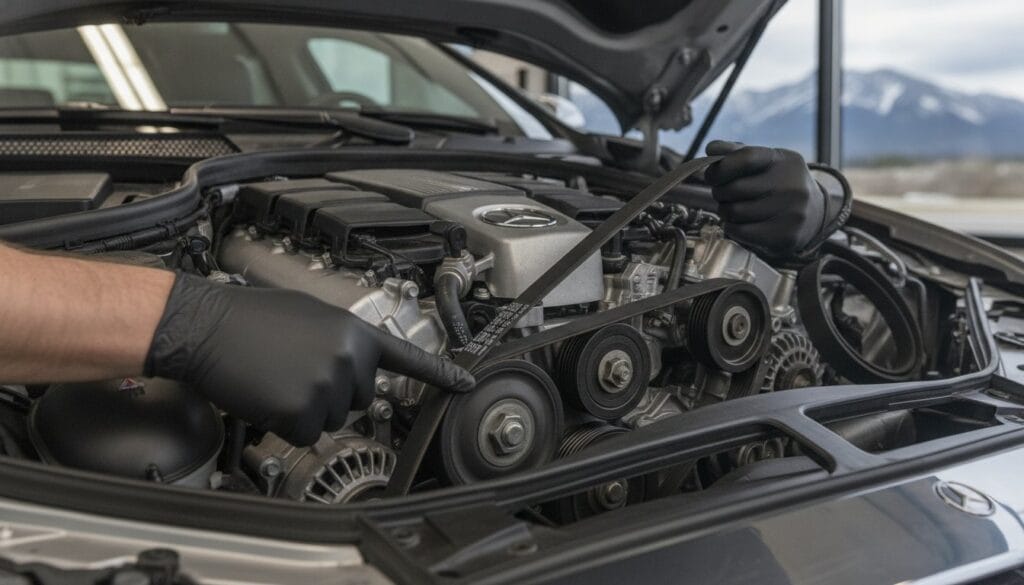
Imagine you’re pulling out of your driveway in Belgrade, and your Mercedes-Benz emits a sharp, piercing squeal that turns heads for all the wrong reasons. That sound isn’t just an embarrassment; it’s a warning that your engine’s lifeline is fraying. Most Mercedes owners recognize that a high-performance vehicle requires meticulous care, yet it’s easy to feel overwhelmed when deciding if you need a simple mercedes serpentine belt replacement or a complete overhaul of the tensioners and pulleys. You don’t want to risk a snapped belt that leaves you stranded on the side of the road with a lost power steering system or an overheated engine.
This guide explains how to identify critical wear in modern EPDM belts and why professional replacement is essential for preventing catastrophic engine failure. You’ll gain a clear understanding of the full repair scope, including why replacing idler pulleys and tensioners at the same time is a technical necessity for a quiet, reliable engine. We will also explore how specialized European auto repair experts in Belgrade utilize OE parts to maintain your vehicle’s factory standards and long-term reliability, ensuring your Mercedes-Benz remains the precision machine it was engineered to be.
Key Takeaways
- Understand why this single component is the critical link between your engine and essential systems like power steering and cooling.
- Recognize the subtle auditory and visual warning signs that indicate a mercedes serpentine belt replacement is overdue.
- Discover why a new belt might fail prematurely if you overlook the health of your tensioner and idler pulleys.
- Learn about the technical precision and specialized tools required to properly service the complex drive systems in European vehicles.
- Find out how local ASE certified specialists in Belgrade provide the meticulous care needed to protect your automotive investment.
What is a Mercedes Serpentine Belt and Why is it Critical?
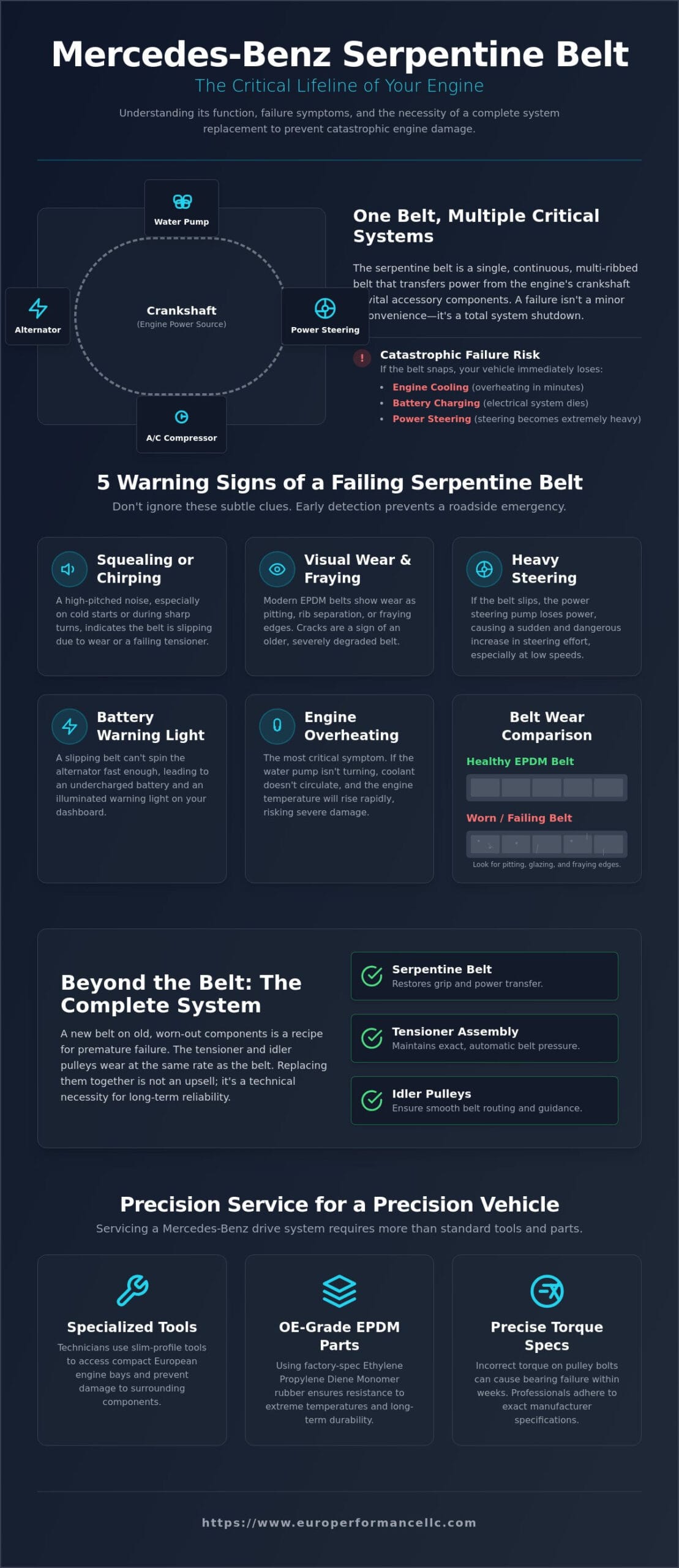
A serpentine belt is the mechanical heartbeat of your engine’s peripheral systems. In a Mercedes-Benz, this component is far more than a simple rubber strap. It’s a precision-engineered part designed to transfer rotational energy from the crankshaft to the alternator, power steering pump, and water pump simultaneously. When you schedule a mercedes serpentine belt replacement, you aren’t just buying a new belt. You’re restoring the synchronized operation of every major accessory that keeps your vehicle drivable and safe.
Mercedes-Benz engines utilize high-tension drive systems that require exact belt elasticity to maintain peak efficiency. If the belt fails, your vehicle loses more than just climate control. The water pump stops circulating coolant, which leads to immediate engine overheating. The alternator ceases charging the battery, and you lose hydraulic assistance for steering. Unlike older vehicles where a snapped belt was a minor inconvenience, a failure here can cause the belt to whip and damage expensive cooling lines or the plastic fan shroud.
To better understand the complexity of this component, watch this helpful video showing the process on various Mercedes models:
The Anatomy of a Mercedes Drive System
Modern Mercedes-Benz engines have transitioned away from the older V-belt style found in vintage models. Today, they utilize a multi-ribbed design that provides a much larger surface area for grip. This increased friction allows the belt to handle the high-torque demands of a modern alternator or a heavy-duty water pump. An automatic tensioner is integrated into the system to maintain constant pressure. This component ensures the belt doesn’t slip during rapid acceleration or heavy electrical loads. Mercedes-Benz engineers designed this system to maximize engine efficiency by reducing parasitic drag while ensuring every peripheral device receives the exact power it needs.
Why This Isn’t a ‘Standard’ Auto Repair
Performing a mercedes serpentine belt replacement isn’t like working on a domestic truck. European engine bays are famously compact. Technicians often need specialized slim-profile tools just to access the tensioner without removing the entire radiator assembly. Precision is non-negotiable. Every chassis, whether it’s a W211 E-Class, a W212, or a W204 C-Class, has unique torque specifications for the idler pulleys. Using the wrong torque can lead to pulley bearing failure within weeks. For owners in Belgrade, the choice of material is equally important. We use OE-grade EPDM (Ethylene Propylene Diene Monomer) rubber. This material is specifically designed to resist the extreme temperature fluctuations of Montana winters without cracking or losing its structural integrity.
5 Symptoms Your Mercedes Serpentine Belt Needs Replacement
Identifying the symptoms of a failing belt is the first step in preventing a roadside emergency. Because modern Mercedes-Benz engines are so well insulated, these warning signs can be subtle until they become critical. Scheduling a timely mercedes serpentine belt replacement ensures that a minor noise doesn’t escalate into a total system shutdown. If you notice any of the following five indicators, your drive system requires immediate professional attention.
- Squealing or Chirping: This high-pitched noise typically occurs during cold starts or when making sharp turns. It indicates the belt is slipping against the pulleys because it has lost its grip or the tensioner is failing.
- Visual Wear and Rib Separation: While older belts would crack, modern EPDM belts often show wear through “pitting” or the separation of the longitudinal ribs. Fraying along the edges is a sign of misalignment.
- Heavy Steering: Since the belt drives the power steering pump, any slip will result in a sudden increase in steering effort. This is particularly dangerous during low-speed maneuvers.
- Battery Warning Light: If the alternator isn’t spinning at the required RPM, your dashboard will display a battery symbol. This means your electrical system is running solely on reserve battery power.
- Rising Engine Temperature: In many models, the belt powers the water pump. A failing belt stops coolant circulation; this leads to rapid overheating that can warp cylinder heads within minutes.
The ‘Glazing’ Test: What to Look For
Heat and constant friction can transform the underside of your belt into a shiny, slick surface known as “glazing.” This hardened rubber loses the flexibility needed to wrap tightly around the pulleys. Even if the belt looks physically intact without deep cracks, a glazed belt will slip under load. We also look for fluid contamination. Common Mercedes oil leaks from the oil filter housing or front crankshaft seal can saturate the rubber; this causes it to swell and rot prematurely. If you suspect your belt is slipping, our technicians at Euro Performance Auto Shop LLC can perform a professional diagnostic inspection to verify the integrity of your drive system.
Montana Climate Factors: Cold Starts and Belt Stress
Living in Belgrade presents unique challenges for automotive rubber components. Our sub-zero winters make EPDM rubber brittle, which increases the likelihood of snapping during a high-torque cold start. Additionally, road salt and magnesium chloride used on Montana highways can work their way into the pulley bearings, creating abrasive wear that shreds the belt from the inside out. Temperature fluctuations in the Gallatin Valley accelerate belt fatigue by causing the material to expand and contract rapidly. This constant thermal cycling weakens the internal cords, making proactive maintenance essential for local drivers.
The Mercedes Serpentine Belt Replacement Process
Replacing a drive belt on a Mercedes-Benz requires a methodical approach that goes beyond simply swapping a part. This is a systematic restoration of the engine’s peripheral drive system. Our technicians follow a rigorous protocol to ensure every component functions with factory precision. When you trust us with your mercedes serpentine belt replacement, we follow these five essential steps to guarantee long-term reliability.
- Step 1: Gaining Access: We begin by removing the plastic engine covers and, depending on the model, the cooling fan shroud. This creates the necessary clearance to work safely without damaging the radiator.
- Step 2: Relieving Tension: Using a specialized long-reach breaker bar or a Mercedes-specific 17mm socket, we rotate the automatic tensioner. This releases the high-pressure hold on the belt, allowing for safe removal.
- Step 3: Documenting the Path: Mercedes-Benz belt routing is notoriously complex. We map the exact path around the alternator, water pump, and AC compressor to ensure the new belt follows the factory configuration perfectly.
- Step 4: Component Inspection: With the belt removed, we spin every idler pulley and accessory by hand. We listen for the dry, metallic grinding of failing bearings and check for lateral “play” that indicates a pulley is ready to seize.
- Step 5: Final Seating: We install the new belt and verify that every longitudinal rib is perfectly seated in the pulley grooves. A single rib sitting slightly askew will cause the belt to shred almost immediately upon startup.
Why OE Parts are Non-Negotiable
Many shops use “fits-all” aftermarket belts to save on costs. However, Mercedes-Benz engines are sensitive to belt length deviations of even a few millimeters. An incorrectly sized belt forces the automatic tensioner to operate outside its designed range, leading to premature spring failure. We exclusively use OE-spec EPDM belts that match the exact friction coefficients required by your vehicle. Incorporating this inspection into your Factory Scheduled Maintenance is the most effective way to catch these issues before they result in a breakdown.
Professional Diagnosis vs. DIY Guesswork
DIY guides often overlook the critical secondary checks that an ASE certified technician performs. During a mercedes serpentine belt replacement, we inspect the harmonic balancer for rubber degradation or “wobble.” If the balancer is failing, a new belt won’t solve the underlying vibration. Furthermore, the aluminum threads in modern European engine blocks are fragile. Using improper tools or excessive force on the tensioner bolt can strip these threads, necessitating an expensive engine-out repair. We also ensure the belt’s path is clear of sensitive wiring looms or sensors that are frequently tucked near the pulley system in newer models.
Beyond the Belt: Why Tensioners and Pulleys Matter
A fresh belt is vital, but it’s only as reliable as the mechanical components that guide it. Many online tutorials suggest a quick mercedes serpentine belt replacement as a standalone fix to keep repair costs low. This approach is technically flawed. The drive system is a synchronized assembly where every part relies on the others. If you ignore the automatic tensioner or the idler pulleys, you’re likely setting yourself up for a repeat failure within a few thousand miles. In many cases, a “bad belt” is actually the victim of a failing pulley that has stopped spinning freely.
The automatic belt tensioner is a calibrated component with an internal spring designed to maintain specific pressure. Over years of operation, this spring loses its “memory” and can no longer provide the consistent force required. When tension drops, the belt vibrates. This vibration doesn’t just cause noise; it sends micro-shocks into the bearings of your alternator and AC compressor, leading to much more expensive repairs down the road. Similarly, idler pulleys contain sealed bearings that eventually dry out. When these bearings seize, the pulley stops turning, and the belt continues to slide over the stationary metal. The resulting friction generates enough heat to melt or snap the belt instantly, regardless of how new the rubber is.
The ‘While You Are In There’ Philosophy
We always recommend evaluating the cost-benefit of a complete drive belt kit versus a single belt. Most of the expense in this repair is the labor required to gain access to the front of the engine. Once the belt is removed, the labor to swap a tensioner or idler pulley is minimal. By addressing the entire system at once, you prevent “double labor” costs where you’d otherwise pay the full entry fee again a few months later when a pulley starts squealing. A fresh tensioner also serves as a stabilizer, protecting your high-value accessories from the damaging effects of belt slap and harmonic resonance.
Identifying Seized Pulley Bearings
Our technicians use a specialized “spin test” whenever the belt is removed. By spinning each pulley by hand, we listen for a dry, metallic grinding sound. A healthy pulley should spin silently and stop quickly; if it spins like a loose skateboard wheel, the internal grease has vanished. We also check for “walk,” which occurs when a pulley bearing is so worn that the pulley no longer sits perfectly perpendicular to the belt path. If the pulley is tilted, it will guide the belt off the tracks. For a comprehensive check, our team at Euro Performance Auto Shop LLC provides Expert European Auto Repair that includes a full driveline and pulley assessment to ensure your Mercedes remains reliable on the road.
Don’t risk a snapped belt due to a neglected pulley; contact us to schedule a professional drive system inspection today.
Expert Mercedes-Benz Maintenance in Belgrade, MT
Euro Performance Auto Shop LLC serves as the premier destination for Mercedes-Benz owners across the Gallatin Valley who demand technical excellence. We provide dealership-level precision with the personalized attention only a local specialist can offer. Our ASE certified technicians have spent years mastering the complexities of European engineering, from the intricate cooling systems of an S-Class to the high-output alternators of the AMG line. When you visit us for a mercedes serpentine belt replacement, we don’t treat it as a generic repair. We treat it as a critical maintenance event. We use advanced diagnostic technology to verify the alignment of your entire drive assembly, ensuring that every component functions perfectly under the hood.
The Euro Performance Auto Shop LLC Advantage
Our commitment to using parts from OE manufacturers ensures your Mercedes stays within the strict factory standards set by the original engineers. We understand that local driving conditions require high-grade EPDM materials that won’t fail under pressure. Our transparency is what builds long-term trust with our clients. We make it a point to show you the specific wear patterns on your components, explaining the technical “why” behind every service we perform. This educational approach ensures you’re never in the dark about your vehicle’s health. We often identify these needs during our Expert Oil Change Services. These routine appointments are the ideal time for a proactive belt inspection, allowing us to spot the early signs of degradation before they lead to a roadside emergency.
Schedule Your Mercedes Service Today
Protect Your Mercedes-Benz Performance
Maintaining the drive system of your Mercedes-Benz is about preserving the engineering integrity of your vehicle. You’ve seen that a professional mercedes serpentine belt replacement requires more than just a new piece of rubber. It demands a meticulous inspection of the automatic tensioner and idler pulleys to prevent premature failure. Using OE-spec materials is vital for enduring the temperature swings of the Gallatin Valley without compromising performance. By addressing the entire drive assembly at once, you avoid the inconvenience of unexpected breakdowns and the cost of redundant labor.
Our team at Euro Performance LLC combines technical mastery with a commitment to transparency. Our ASE Certified Technicians utilize specialized European diagnostic tools and top-tier OE manufacturer parts to ensure every repair meets factory specifications. Located conveniently in Belgrade, we provide the precision your high-value asset requires. Schedule Your Mercedes Serpentine Belt Replacement at Euro Performance LLC today. We’re here to help you drive with confidence and peace of mind.
Frequently Asked Questions
How often should a Mercedes serpentine belt be replaced?
Most Mercedes-Benz models require a detailed inspection at 60,000 miles and a full replacement by 90,000 miles. For drivers in the Belgrade area, we recommend replacement every four to six years regardless of mileage. The extreme temperature shifts in the Gallatin Valley cause EPDM rubber to expand and contract, which accelerates the aging process beyond what is typical in milder climates.
Is it okay to drive with a squeaking serpentine belt?
You should not continue to drive with a squeaking belt for an extended period. That noise is a clear indicator of slipping or a failing pulley bearing. The friction generated by a slipping belt creates excessive heat that can cause the rubber to glaze or snap without further warning. A squeak is essentially your vehicle’s final warning to address the drive system before you lose critical functions like power steering.
What happens if the serpentine belt snaps while I’m driving?
How much does a Mercedes serpentine belt replacement cost in Belgrade?
The total investment for a mercedes serpentine belt replacement depends on your specific chassis and whether the tensioners or idler pulleys also need attention. Because labor is a significant portion of the service, we provide comprehensive inspections to determine exactly which components are worn. Addressing the entire pulley system at once is the most cost-effective way to ensure long-term reliability and avoid the expense of multiple shop visits.
Can a bad serpentine belt cause my Mercedes to not start?
Yes, a failing belt can lead to a no-start condition indirectly. If the belt is slipping or broken, the alternator cannot charge the battery while the engine is running. Eventually, the battery’s reserve power will be depleted, leaving it with insufficient voltage to engage the starter motor. If your battery warning light is illuminated, the drive belt is one of the first components we inspect.
Why is my new serpentine belt still making noise?
A noisy new belt usually indicates that the automatic tensioner or an idler pulley was not replaced during the initial service. If the tensioner has lost its internal spring strength, it can’t keep the new belt at the required tension. Noise can also stem from misaligned pulleys or worn bearings that were not detected during a simple belt swap. This is why we emphasize a full system diagnostic.
Should I replace the water pump when I replace the belt?
This is not always mandatory but is often recommended based on your vehicle’s mileage. Many Mercedes-Benz water pumps are driven by the serpentine belt. If our technicians detect any coolant seepage or shaft play while the belt is off, replacing the pump at that time is technically efficient. It saves you from paying the same labor entry fee twice if the pump fails shortly after the belt service.
Does Euro Performance LLC use genuine Mercedes-Benz parts?
We utilize OE (Original Equipment) manufacturer parts that meet the exact technical specifications of your vehicle. This ensures the belt’s friction coefficient and the tensioner’s spring rate match the factory engineering. By using parts from the same manufacturers that supply Mercedes-Benz, we maintain the precision and reliability your vehicle requires for Montana’s demanding driving conditions.