
Blog

What if the most important step before approving a major repair isn’t deciding whether to say yes, but understanding exactly what you’re being asked to approve? If you’re unsure what failed, why the repair is needed, or how the estimate could change, the right questions to ask a mechanic before a major repair can bring the decision into focus.
A complex diagnosis should come with a clear explanation. You deserve to understand the evidence behind it, which parts and labor are included, and what could affect the estimate or timing. Asking for those details isn’t second-guessing your mechanic. It’s a practical way to make an informed decision about your vehicle.
This guide covers what to ask about the cause and scope of a repair, diagnostic findings, parts, estimates, timing, and approval before work begins. At Euro Performance Auto Shop LLC, ASE-certified technicians trained on European vehicles use advanced diagnostics to support clear repair conversations for European-make cars and trucks. With the right information, you can weigh your options and choose a next step with greater confidence.
Key Takeaways
- Use the questions to ask a mechanic before a major repair to understand what failed, what evidence supports the diagnosis, and which work is recommended.
- Before approving repairs, clarify what the estimate covers, which parts are proposed, what could change the scope, and how you’ll receive updates about timing.
- Euro Performance’s ASE-certified technicians are trained on European vehicles and use advanced diagnostics to support a clear repair discussion.
- Financing includes a 30-second application, No hard credit check, No fees or penalties, 90% of people are approved, and 3, 6, or 12-month flexible payment plans.
- DO NOT TO DRIVE your vehicle when Check Engine light is flashing… we recommend to tow your vehicle to the closest repair shop available. Steering wheel shake is also a warning sign: warped front brake discs can require prompt brake-system inspection, and prolonged driving can damage steering and suspension components.
Questions to Ask a Mechanic Before a Major Repair Starts
Hearing that your vehicle may need a major repair can be stressful, especially when the symptoms are unfamiliar and the diagnosis involves parts or systems you can’t easily inspect yourself. You don’t need to master the technical details before talking with a mechanic. You do need a clear explanation of what failed, what work is proposed, and which decisions are yours to make before repairs begin.
Keep the conversation focused on evidence and next steps. A general Auto repair overview provides background, but your discussion should address your vehicle’s specific symptoms and findings. Start with these questions:
- What failed, and what evidence supports that diagnosis?
- Which repair is essential now, and what could be monitored?
- What is the proposed work intended to address?
- What decisions or approvals are needed before work proceeds?
For another perspective on preparing for a repair conversation, watch this video:
What should I ask before approving a major repair?
Start with: “What failed, and what evidence supports that diagnosis?” Then ask what the mechanic observed or tested and how those findings relate to the symptoms you reported. For example, if you mentioned a warning light or unusual noise, ask which finding connects that symptom to the recommended repair. This helps distinguish a confirmed problem from possible causes that are still being investigated.
Next, ask which work is essential now and what can be monitored. If a repair can wait, ask what changes to watch for and what could happen if you delay it. Clarify what the proposed work is meant to correct and whether it addresses one problem or several. These questions help you understand the repair’s purpose, not just its name.
How can I keep the conversation clear?
Ask the mechanic to explain unfamiliar terms in everyday language or point out the relevant component if that would help. Write down the diagnosis, recommended work, and any unanswered questions. Before approving, repeat the plan in your own words and ask the mechanic to correct anything you’ve misunderstood. If the scope still isn’t clear, request a pause so you can review the recommendation before deciding.
A well-informed repair approval means you understand what failed, what work you’re authorizing, and what questions remain. You’re not expected to diagnose the vehicle yourself. You should be able to describe the recommendation clearly and know which decision comes next.
Keep safety concerns separate from routine questions. DO NOT TO DRIVE your vehicle when Check Engine light is flashing… we recommend to tow your vehicle to the closest repair shop available. Steering wheel shake is also not normal: “This is definitely not a normal driving condition… warped front brake discs… inspect brake system… prolonged driving can damage steering and suspension components.”
Questions That Clarify the Diagnosis and Repair Scope
A clear diagnosis connects what you noticed to what the mechanic found, then explains why a particular repair is recommended. That connection matters in complex cases, where one symptom can have more than one possible cause or a fault may affect related systems. Rather than stopping at a part name or warning code, ask the mechanic to walk you through the reasoning.
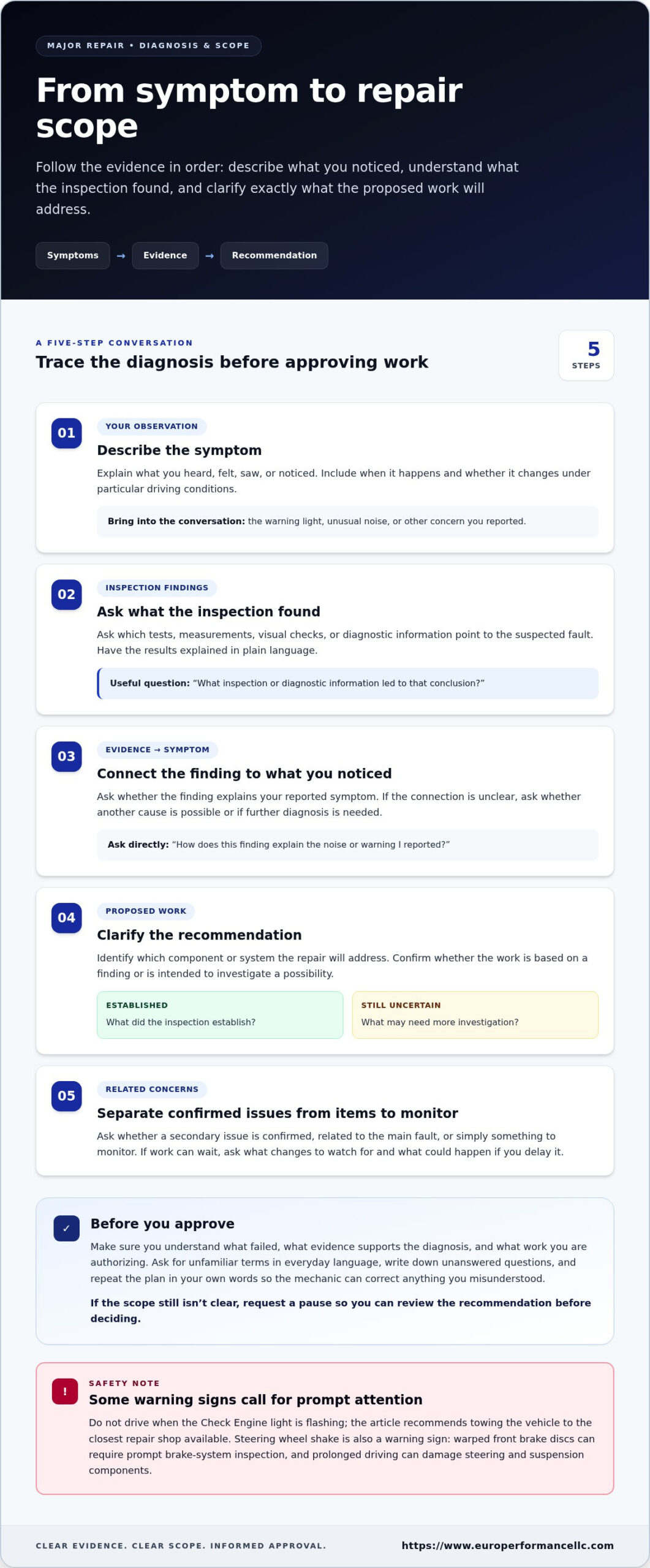
Use this sequence to follow the explanation from your first observation to the proposed work:
- Describe the symptom. Explain what you heard, felt, saw, or noticed, including when it occurs and whether it changes under particular driving conditions.
- Ask what the inspection found. What tests, measurements, visual checks, or diagnostic information point to the suspected fault? Ask what the results mean in plain language.
- Connect the finding to the symptom. Does this finding explain what you reported? If not, ask whether the symptom could have another cause or whether further diagnosis is needed.
- Clarify the recommendation. Which component or system will the repair address? Is the recommended work based on a confirmed finding, or is it intended to investigate a possibility?
- Separate related concerns. Ask whether any secondary issue is confirmed, related to the main fault, or simply something to monitor.
What evidence supports the mechanic’s diagnosis?
Ask, “What inspection or diagnostic information led to that conclusion?” The answer might refer to a visible condition, a measurement, or information from a diagnostic scan. You don’t need to interpret technical data yourself. Ask what it means and how it supports the conclusion. If the mechanic uses an unfamiliar term or warning code, request a plain-language explanation and ask whether the result matches the symptoms you described.
If the explanation doesn’t connect the evidence to your concern, ask directly: “How does this finding explain the noise or warning I reported?” A clear answer should distinguish what the inspection established from what remains uncertain. That helps you understand whether the recommended repair addresses a confirmed cause or whether more testing may be needed.
What exactly will the repair address?
Ask which components or systems are included in the proposed work and what each part of the repair is intended to correct. If another issue comes up, clarify whether it’s confirmed, a possible secondary concern, or a separate recommendation. Ask what decision would be needed if additional work becomes necessary. This keeps the approved scope distinct from future possibilities.
A diagnostic finding is what the inspection shows; a repair recommendation is the work proposed in response. Keeping those ideas separate makes it easier to understand the reasoning and assess the scope. For European-make vehicles, expert European auto repair in Belgrade brings specialized vehicle knowledge into that conversation. Euro Performance’s ASE-certified technicians are trained on European vehicles and use advanced diagnostics. Learn more about European auto repair at Euro Performance.
Safety concerns require prompt attention. DO NOT TO DRIVE your vehicle when Check Engine light is flashing… we recommend to tow your vehicle to the closest repair shop available. For steering-wheel shake, “This is definitely not a normal driving condition… warped front brake discs… inspect brake system… prolonged driving can damage steering and suspension components.”
Questions About Repair Estimates, Parts, Timing, and Financing
A repair estimate is easier to evaluate when you know what it includes, what assumptions it depends on, and how the shop will handle a change in scope. These questions to ask a mechanic before a major repair help you compare the estimate, parts, timing, and payment details without relying on guesswork. Ask for clear explanations, then keep the answers with your repair records.
Use this table to guide the conversation. The questions are prompts, not assumptions about what a particular repair will require.
| Topic | Ask | Clarify |
|---|---|---|
| Estimate | What labor and parts are included in this estimate? | Which repair tasks are covered, and what could change the estimate if the findings or scope change? |
| Approval | How will you explain and get approval for a change to the proposed work? | How will I know what changed and why before deciding whether to proceed? |
| Parts | What parts are proposed, and where are they sourced? | What options are included in the recommendation, and how do they relate to the repair? |
| Timing | What factors may affect the estimated repair timeline? | Could further diagnosis, parts sourcing, or a change in repair scope affect the schedule? |
| Guarantee and payment | What repair guarantee applies, and what payment options are available? | Ask for the applicable guarantee details and exact financing terms before choosing. |
What should I clarify about the estimate and parts?
Ask the mechanic to explain the estimate by task, including the labor and parts associated with the recommended repair. If it includes several operations, ask what each one addresses. Then ask what happens if inspection or repair work reveals a different issue. You should understand how the shop will explain a scope change and get your decision before proceeding with additional work.
Parts sourcing is also worth discussing, particularly for European vehicles. Euro Performance partners with OE manufacturers and leading suppliers for parts. Ask which parts are proposed for your repair and how the selected parts support the recommended work.
How should I discuss timing, guarantee, and payment?
Ask what factors may affect the estimated timeline and how you’ll be informed if new findings or parts sourcing change the expected schedule. Euro Performance offers a satisfaction guarantee on all repairs. Ask for the guarantee details that apply to your repair so you understand its terms without assuming a specific duration or coverage.
Euro Performance financing includes 90% of people are approved and a 30-second application. The terms are No hard credit check and No fees or penalties, with 3, 6, or 12-month flexible payment plans. Review these terms alongside the estimate and choose the payment approach that works for you.
Keep safety separate from scheduling decisions. Steering wheel shake is not normal: “This is definitely not a normal driving condition… warped front brake discs… inspect brake system… prolonged driving can damage steering and suspension components.”
A Pre-Approval Checklist for Major Repairs and Safety
Before authorizing a major repair, pause long enough to confirm that the diagnosis, proposed work, estimate, and communication plan make sense to you. The questions to ask a mechanic before a major repair are most useful when they lead to clear decisions: what you’re approving now, what remains uncertain, and how you’ll be informed if the repair scope changes.
Use this checklist during the final conversation. You don’t need to resolve every technical detail yourself, but you should be able to explain the plan in your own words before giving approval.
What should I confirm before authorizing the repair?
Ask the mechanic to connect the recommended work to the diagnosed issue and the symptoms you reported. Confirm what’s included, what isn’t, and how the shop will discuss any change before proceeding. If new findings could affect the plan, ask what information you’ll receive so you can make a considered decision rather than feel rushed.
- Diagnosis: Can I describe what the mechanic found and how it relates to my concern?
- Repair purpose: Does the proposed work address the diagnosed issue and stated symptoms?
- Approved scope: Which specific work am I authorizing, and are any additional items separate recommendations?
- Estimate: Do I understand what labor and parts it covers, and what could cause the scope to change?
- Changes: How will the mechanic explain new findings and get my decision before expanding the work?
- Communication: Who will update me, and what information will I receive if the diagnosis, estimate, or timing changes?
- Next step: Do I have any unanswered questions that need clarification before I approve?
Keep the estimate and your notes together. If the explanation changes during the conversation, write down the updated recommendation and make sure you understand what differs from the original plan. A clear record helps you follow the decisions without relying on memory.
Which warning signs call for immediate attention?
Some symptoms call for a safety-focused response, not a routine approval discussion. If the steering wheel shakes, treat the warning seriously and arrange a prompt brake-system inspection. If the Check Engine light is flashing, remember that you should never drive your vehicle in this condition and instead arrange for a tow. Don’t assume the vehicle is safe to drive.
This is definitely not a normal driving condition, as warped front brake discs require an immediate inspection of the brake system to ensure safety, because prolonged driving can cause severe damage to your steering and suspension components.
For major repair questions involving a European vehicle, schedule specialized European auto repair with Euro Performance Auto Shop LLC in Belgrade, MT. Appointments are strongly recommended.
How Euro Performance Approaches Major European-Car Repairs
A major repair discussion should leave you with a clear picture of the reported concern, the diagnostic findings, and the work being recommended. Euro Performance Auto Shop serves European-make cars and trucks in Belgrade, MT. Its ASE-certified technicians are trained on European vehicles and use advanced diagnostics to evaluate repair concerns. That specialized experience can help keep a complex repair conversation focused on the vehicle in front of you.
The questions to ask a mechanic before a major repair are useful prompts for understanding how a diagnosis leads to recommended work. Ask what the diagnostic findings show, how they relate to the symptoms, and which work the shop proposes in response. If a technical term is unfamiliar, ask for a straightforward explanation. You should be able to understand the reasoning without interpreting diagnostic information on your own.
What expertise supports European vehicle diagnosis?
European vehicles can have manufacturer-specific systems and service requirements. Euro Performance’s technicians are ASE-certified and trained on European vehicles, and advanced diagnostic capabilities support the evaluation of a concern. The diagnostic equipment does not replace a clear explanation: ask what information the assessment produced and how the recommended repair addresses the issue. The shop also partners with OE manufacturers and leading suppliers for parts, giving you a clear point of discussion about the parts proposed for a repair.
Parts sourcing is one useful detail to clarify as you review the repair plan. Ask which parts are included and how they fit the proposed work. Euro Performance offers a satisfaction guarantee on all repairs. Ask for the terms that apply to the repair so you understand the guarantee without assuming coverage or duration beyond what is stated.
How can I prepare for a repair appointment?
A few notes can make it easier to describe the issue accurately. Before the appointment, record:
- The symptom, such as a noise, vibration, warning light, or change in how the vehicle operates.
- When it occurs and whether anything seems to make it start, stop, or change.
- Any warning messages you’ve seen, using the wording shown on the vehicle when possible.
- Questions you want answered about the diagnosis, recommended work, parts, or next steps.
Appointments are strongly recommended and can be made by phone, email, text, or online form. If your questions involve preventive service rather than a current repair concern, ask about Factory Scheduled Maintenance for your European vehicle.
For a flashing Check Engine light, follow this safety instruction: For steering-wheel shake, “This is definitely not a normal driving condition… warped front brake discs… inspect brake system… prolonged driving can damage steering and suspension components.”
When you’re ready to discuss a European-car repair, schedule a repair appointment with Euro Performance Auto Shop in Belgrade, MT.
Move Forward With a Clear Repair Plan
A major repair doesn’t have to feel like a decision made in the dark. Use the questions to ask a mechanic before a major repair to keep the conversation focused on what the vehicle needs and what you’re agreeing to next. If something still feels unclear, ask for the explanation in simpler terms before deciding.
Before your appointment, gather notes about the symptoms and warning messages you’ve noticed, along with the questions you want answered. A focused conversation can help you understand the proposed next step and feel more prepared to make a decision for your vehicle.
Euro Performance Auto Shop is here to help with major European-car repair concerns. Bring your questions and discuss the repair plan with a team experienced in European vehicles. Schedule a major-repair appointment with Euro Performance and take the next step with greater confidence.
Frequently Asked Questions
What should I do if my Check Engine Light is flashing?
This warning calls for towing, not driving the vehicle to a shop under its own power. If possible, note any other warning messages to share during the repair conversation.
Does Euro Performance service Sprinter vans?
Euro Performance’s service focus is European-make cars and trucks. Have the vehicle’s make and model ready when discussing a repair or maintenance concern so the conversation starts with clear vehicle details.
Is a basic fluid check complimentary at Euro Performance?
Yes. Check Basic Fluids is listed as Complimentary at Euro Performance. This applies to the basic fluid check only. It isn’t a full inspection or a repair, and it doesn’t establish the cause of a separate vehicle concern. If you’ve noticed a symptom, such as a warning message or fluid loss, describe it separately so the service discussion can address that concern clearly.
How can I make an appointment for a major repair?
An appointment is strongly recommended for a major repair. You can make one by phone, email, text, or online form. Before booking, note your vehicle’s make and model, the main concern, and any warning messages you’ve seen. Bringing that information, along with your questions to ask a mechanic before a major repair, can help you organize the conversation and explain what prompted the appointment.
Where can I find my vehicle’s service-due information?
Service-due information appears in your vehicle’s instrument cluster. Depending on the vehicle, the display may show an item such as Service A or B1. Record the exact wording shown, since these labels don’t have one universal meaning or interval across all vehicles. Sharing the message during a maintenance discussion gives the technician a useful starting point for understanding the prompt displayed in your vehicle.
Does Euro Performance work on European trucks as well as cars?
Yes. Euro Performance serves European-make cars and trucks. When discussing a repair or maintenance concern, have the vehicle’s make and model ready so the conversation starts with clear vehicle details. If the instrument cluster displays a service reminder, note its wording too, as that can help distinguish a scheduled-maintenance prompt from a new symptom.