
Blog
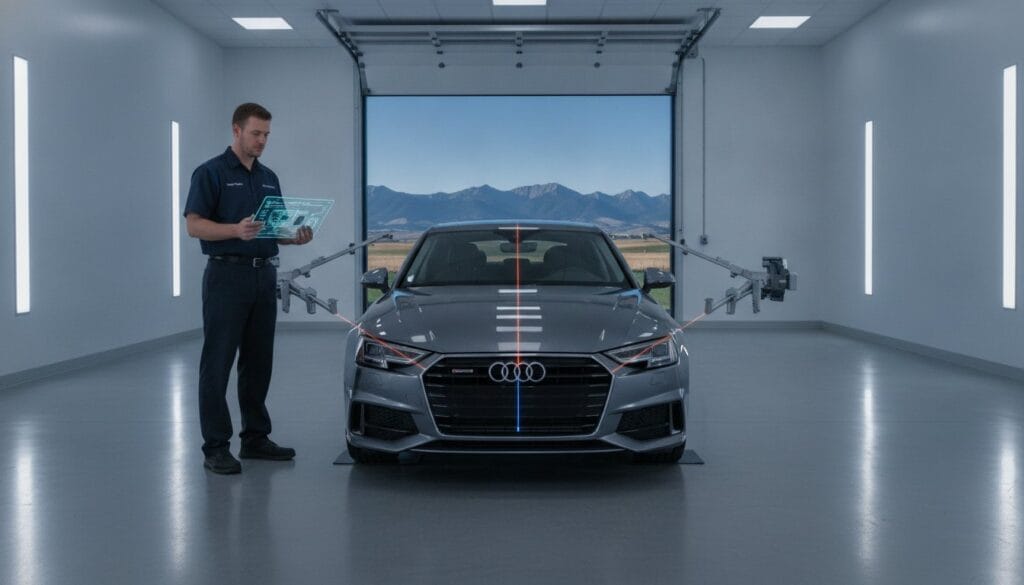
For a modern European vehicle, a mechanical wheel alignment is only half the job. Without the digital handshake of a precision calibration, your car’s most advanced safety features are essentially operating in the dark. It is common to feel a sense of unease when cryptic dashboard warning lights appear or when you wonder if it is time to schedule ADAS calibration after a minor service. You deserve to know that your vehicle’s complex electronics are handled with the same meticulous care that went into its engineering, rather than being left to chance at a generic repair shop.
We understand the frustration of long dealership wait times and the anxiety of trusting a high-value asset to a shop without specialized expertise. This guide explains exactly when and why this service is vital for maintaining factory safety standards for drivers in Belgrade, MT. You will learn about the specific triggers for recalibration, the technical requirements for brands like Audi and Mercedes, and how our ASE certified technicians use specialized diagnostic technology to restore your total confidence in every safety system.
Key Takeaways
- Understand why ADAS sensors are the digital half of your vehicle’s safety system and how they work in tandem with mechanical components like wheel alignments.
- Identify the critical maintenance triggers, such as suspension repairs or sensor replacements, that indicate when you must schedule adas calibration to maintain factory safety standards.
- Learn the technical differences between static and dynamic calibration and why your European vehicle may require both for optimal sensor performance.
- Discover why specialized diagnostic tools and ASE certified technicians are essential for handling the complex electronic architecture found in BMW, Audi, and Mercedes models.
- Gain total confidence in your vehicle’s safety features by choosing a specialized local expert in Belgrade as a precise alternative to the Bozeman dealerships.
What is ADAS Calibration and Why is it Essential?
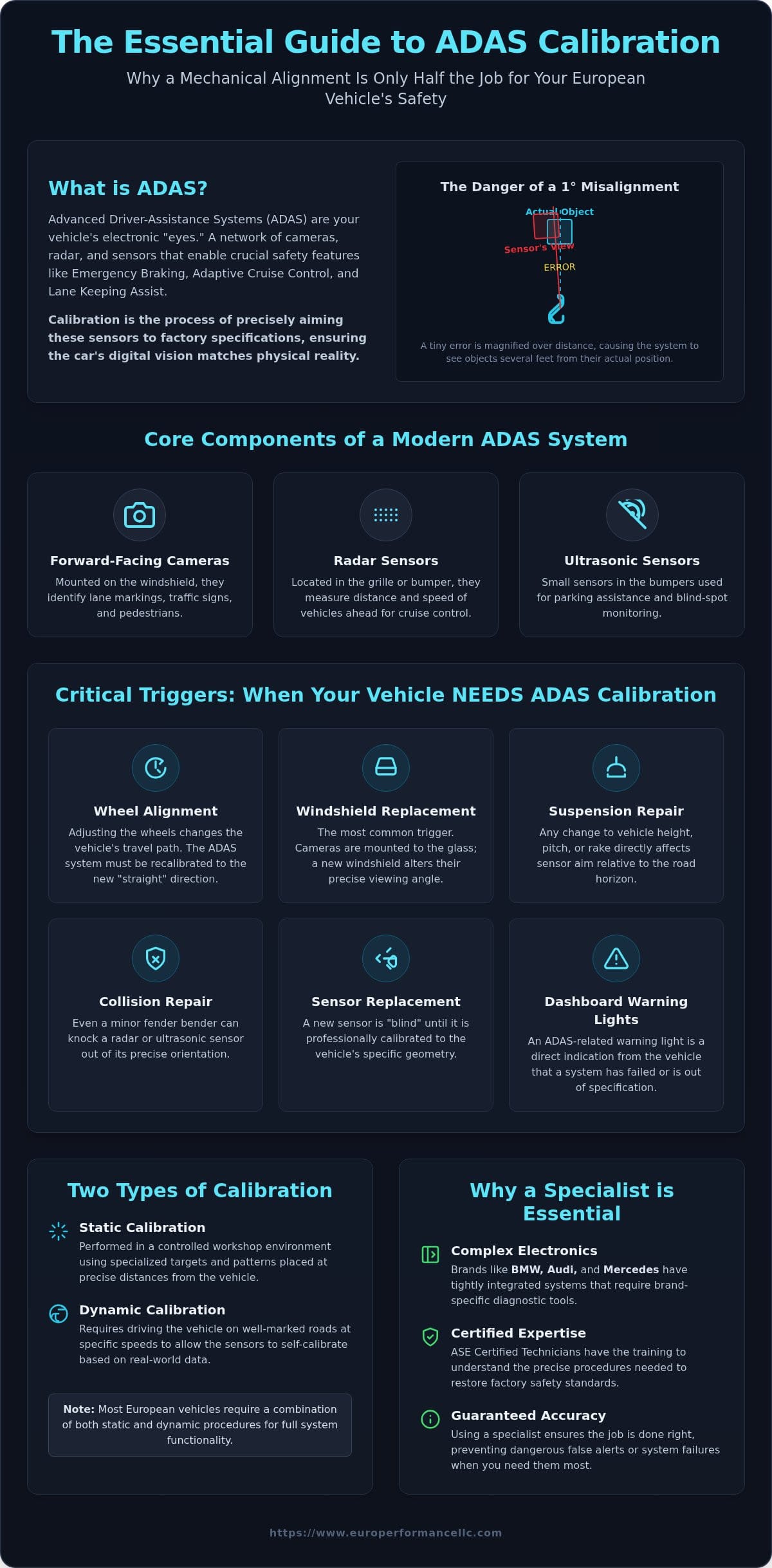
Advanced Driver Assistance Systems, commonly known as ADAS, represent the sophisticated electronic architecture that allows your European vehicle to perceive its surroundings. This network includes high-resolution cameras, radar units, and sonar sensors that act as the vehicle’s “eyes.” These components are responsible for active safety features such as Emergency Braking, Adaptive Cruise Control, and Lane Keeping Assist. For these systems to function reliably, the vehicle’s computer must precisely understand where each sensor is pointing relative to the road.
Precision is the hallmark of European engineering. Even a one-degree misalignment in a long-range radar sensor can result in the system “seeing” an object several feet away from its actual position. This discrepancy often leads to dangerous false alerts, “ghost braking” on open roads, or a complete system failure when you need it most. ADAS calibration is the process of resetting sensor aiming to factory specifications. When you schedule adas calibration, you ensure that the digital interpretation of the environment matches the physical reality of the road.
The Components of a Modern ADAS System
Your vehicle utilizes a multi-layered approach to environmental sensing. Each component has a specific role in your safety:
- Forward-facing cameras: These are typically mounted behind the windshield near the rearview mirror. They identify lane markings, traffic signs, and pedestrians.
- Radar sensors: Located behind the front grille or bumper, these units measure the distance and closing speed of vehicles ahead.
- Ultrasonic sensors: These small, circular sensors in the front and rear bumpers are essential for parking assistance and blind-spot monitoring.
How Misalignment Affects Driving in Montana
Driving in Montana presents unique challenges for sensitive electronics. On high-speed stretches of I-90 or Highway 191, a slight sensor error is magnified by velocity. If your lane-keep system is misaligned, it may provide corrective steering at the wrong moment, creating a safety hazard rather than preventing one.
Local environmental factors also play a significant role. Heavy snow, ice buildup, and road debris common in Belgrade can impact sensor housings. A minor impact from a chunk of ice or a small stone can nudge a radar bracket out of its precise orientation. Because these systems are so tightly integrated into the vehicle’s performance, you should schedule adas calibration anytime the physical state of your car changes, whether through repair or environmental wear.
When Should You Schedule ADAS Calibration?
Many owners assume that sensor recalibration is only necessary after a major accident. In reality, your vehicle’s safety systems are part of a holistic ecosystem where even minor mechanical changes require a digital reset. Knowing when to schedule adas calibration protects both your vehicle’s safety systems and your investment in European engineering. Because brands like BMW and Mercedes rely on precise chassis geometry to inform their safety logic, any service that alters the vehicle’s “stance” or “horizon” necessitates a professional calibration.
While local specialists focus on the digital reset, professional repair centers such as Ace Autobody emphasize that structural repairs and electronic calibration must go hand-in-hand to ensure modern safety systems function correctly after any collision.
The most critical link exists between your sensors and your wheels. A precision wheel alignment changes the direction the vehicle travels relative to its frame. If the wheels are adjusted but the forward facing camera still thinks the car is centered based on the old alignment, the Lane Keep Assist may steer you into another lane. This is especially vital for European cars equipped with air suspension or active dampening systems, as these components constantly adjust the vehicle’s height and pitch.
Windshield replacement remains the most common reason for this service. Since cameras are typically bonded to the glass, a new windshield creates a different mounting angle, even if it’s off by a fraction of a millimeter. Similarly, post-collision requirements apply even to minor fender benders. A small tap to the bumper can jar a radar bracket, causing your Adaptive Cruise Control to miscalculate the distance to the car in front of you. If you’ve recently had body work or glass repair, you should consult with a specialist to verify your sensor alignment.
Common Triggers for Scheduling Service
Routine maintenance and specific repairs often act as triggers for recalibration. You should plan for this service in the following scenarios:
- Suspension Repairs: Replacing struts, shocks, or control arms changes the ride height and sensor orientation.
- Windshield Service: Any time the glass is removed or replaced, the camera must be taught its new position.
- Tire Size Changes: Modifying the diameter of your wheels or tires alters the vehicle’s pitch. If you plan to discover Platinum Wheels for custom rims or high-performance tires, remember that these upgrades require sensor recalibration to ensure safety.
Signs Your Sensors are Out of Sync
Your vehicle may provide subtle or overt clues that it’s time to schedule adas calibration. Pay close attention to these symptoms:
- Dashboard Warning Lights: Messages like “System Unavailable” or “Sensor Blocked” often indicate a calibration error rather than a physical obstruction.
- Steering Anomalies: If the steering wheel vibrates or “pulls” unexpectedly while Lane Keep Assist is active, the camera is likely misaligned.
- Erratic Braking: Adaptive Cruise Control that brakes too late or too aggressively suggests the radar unit is not accurately measuring the closing speed of traffic.
Static vs. Dynamic Calibration: Ensuring Your Sensors Are Perfectly Aligned
Calibration methods are not interchangeable. Depending on your vehicle’s make and model, a technician may use static methods, dynamic methods, or a precise combination of both. European manufacturers like Audi and Mercedes-Benz often mandate a rigorous two-step process to ensure total accuracy. This dual approach verifies that sensors are aligned both in a controlled setting and under real-world driving conditions, providing the redundancy needed for high-speed safety systems.
When you schedule adas calibration at a specialized facility, you are ensuring that your car’s electronic “brain” is perfectly synced with its physical sensors. Standard shops often lack the specialized diagnostic technology required to handle the complex electronic architecture of BMW or Mercedes vehicles. We utilize manufacturer-grade hardware to ensure these systems are restored to their original factory specifications.
The Static Calibration Environment
Static calibration occurs within a highly controlled shop environment. It requires specialized equipment, including OE-level targets that are specific to each European brand. The process is incredibly sensitive to the physical surroundings. For instance, the shop floor must be perfectly level within a fraction of a degree. Even slight variations in lighting or floor pitch can cause the calibration to fail or, worse, result in an incorrect setting that leads to system errors. A standard repair garage typically lacks the level surfaces and specialized diagnostic technology required for this precision work. At Euro Performance LLC, our ASE certified technicians use specialized targets to ensure your cameras and radar units are aimed with surgical precision before the vehicle ever leaves the bay.
The Dynamic Calibration Road Test
Once the static alignment is complete, many European vehicles require a dynamic calibration. This is essentially a “teaching” phase where the vehicle’s computer learns to recognize road markings, traffic patterns, and environmental obstacles in real time. Dynamic calibration requires the vehicle to be driven for a set time at a consistent speed. Our team utilizes the local road conditions around Belgrade to perform these final verifications. We look for clear lane markings and steady traffic flow to ensure the sensors are communicating correctly with the vehicle’s braking and steering systems. When you schedule adas calibration with us, we don’t just rely on shop-floor data. We verify that your safety systems perform exactly as intended on the Montana roads where you drive every day.
Why European Vehicles Require a Calibration Specialist Over General Shops
European engineering prioritizes a highly integrated driving experience. In these vehicles, the safety electronics are not standalone modules; they are deeply woven into the chassis and steering systems. Choosing a general repair facility or a national chain often means settling for “one size fits all” aftermarket software. This generic software may not communicate correctly with a BMW’s proprietary control units or an Audi’s complex bus system. To maintain the integrity of these systems, you should schedule adas calibration with a facility that understands these specific technical nuances.
The health of your sensors is inextricably linked to your factory scheduled maintenance schedule. As components like control arm bushings or steering racks wear down over time, the physical orientation of the vehicle shifts. A specialist recognizes that a sensor error code might actually be a symptom of mechanical wear elsewhere in the vehicle. By addressing the root mechanical cause alongside the digital recalibration, we ensure a long-term solution rather than a temporary fix.
The Difference Between a Glass Shop and a Performance Shop
A primary distinction exists between shops that only replace glass and those that service the entire vehicle. Glass shops specialize in the camera mounted to the windshield. However, they rarely have the equipment or expertise to evaluate the rear-radar units or the suspension geometry that dictates where that camera is looking. At Euro Performance LLC, we focus on the whole vehicle. We verify that suspension wear is not causing your sensor misalignment before we begin the digital reset. Having a technician who can perform both the mechanical wheel alignment and the electronic calibration ensures that the two systems are in perfect harmony.
Specialized Diagnostic Tools for European Makes
The diagnostic technology required for European vehicles is a significant investment. Many general shops in Montana rely on universal scanners that offer limited access to deep-level calibration protocols. We utilize OE-level diagnostic software designed specifically for European makes, ensuring we can access the same precise settings used at the factory. Our team stays updated with the latest manufacturer protocols, including upcoming 2026 standards, to keep your vehicle at the forefront of safety technology. Trusting your car to ASE certified technicians who specialize in European performance provides a level of peace of mind that a generalist cannot match. If you are ready to ensure your safety systems are operating with factory precision, contact our Belgrade team today to review your service needs.
How to Schedule Your ADAS Calibration at Euro Performance Auto Shop LLC
Securing factory precision for your safety systems is a straightforward process designed around the needs of Montana drivers. When you’re ready to schedule adas calibration, our team ensures every technical requirement is met before your vehicle returns to the road. We operate with a level of transparency that eliminates the confusion often associated with complex electronic repairs. Our facility at 658 Jetway Dr Unit A is equipped to handle the specific needs of high-end European makes, providing a local alternative that rivals the capabilities of major dealerships without the long wait times.
Precision work requires preparation. To ensure your cameras and radar sensors are aimed with surgical accuracy, we ask that you bring your vehicle with a full tank of fuel and remove any heavy cargo from the trunk. These steps allow the vehicle to sit at its true “curb weight,” which is a critical baseline for sensor alignment. If your calibration is part of an insurance claim following a windshield replacement or minor collision, our staff can provide the necessary documentation to assist with your claim processing. We believe in clear communication regarding both the technical necessity of the work and the associated costs.
Booking Your Appointment in Belgrade
Scheduling your service is efficient and flexible. You can use our online booking tool or call our Belgrade location directly to speak with a service advisor. We understand that your time is valuable, so we provide estimated turnaround times upfront; most standard ADAS recalibrations are completed within a few hours. For residents in the Bozeman and Belgrade area, our location near the airport offers a convenient hub for specialized care. We coordinate your calibration with any necessary mechanical work, such as a wheel alignment, to minimize your vehicle’s downtime.
The Euro Performance Auto Shop LLC Difference
Our commitment to excellence is reflected in our choice of components and our diagnostic rigor. We use top OE manufacturer parts for any sensor replacements to ensure perfect compatibility with your vehicle’s existing systems. After every service, we provide a comprehensive European performance report. This document details the successful alignment of your safety modules and provides a digital “health check” of your car’s electronic architecture.
We directly address the common concern that calibration is an unnecessary “upsell.” In the modern automotive landscape, calibration is a safety requirement mandated by manufacturers, not an optional add-on. When you schedule adas calibration with us, you’re not just buying a service; you’re investing in a final safety check performed by ASE certified technicians. This meticulous verification is the only way to guarantee that your Lane Assist and Emergency Braking systems will perform exactly as the engineers intended during a critical moment on the road.
Restore Your Confidence in European Engineering
Maintaining the precision of your European vehicle requires a commitment to both mechanical and digital accuracy. Your advanced safety systems rely on sensors that must be perfectly aligned to provide reliable protection on Montana roads. Whether you’ve recently replaced a windshield or completed a wheel alignment, the final step in your service must be a professional recalibration. General shops often lack the specialized European diagnostic technology required for the complex electronic architecture of brands like BMW, Audi, and Mercedes-Benz.
By choosing a local specialist, you ensure that your vehicle’s cameras and radar units are reset to factory specifications by ASE certified technicians. Our facility in Belgrade serves the greater Bozeman area with the specific targets and level surfaces necessary for both static and dynamic procedures. Don’t leave your safety to chance or settle for generic software that doesn’t fully integrate with your vehicle’s performance. It’s time to ensure your lane-keep and braking systems are ready for every journey across the Treasure State.
Schedule your precision ADAS calibration at Euro Performance LLC today and drive with the peace of mind that comes from expert verification.
Frequently Asked Questions
Is ADAS calibration necessary after a windshield replacement?
Yes, calibration is mandatory after replacing a windshield because forward-facing cameras are mounted directly to the glass. Even a minute shift in the mounting angle can cause the camera to miscalculate distances. This leads to errors in emergency braking and lane assist systems. Most manufacturers require a digital reset to ensure the camera’s field of vision aligns perfectly with the vehicle’s centerline.
How long does an ADAS calibration appointment typically take?
A standard appointment usually takes between one and three hours to complete. This timeframe depends on whether your European vehicle requires a static calibration, a dynamic road test, or both. Complex systems in brands like BMW may require more setup time to align specialized targets. We recommend you plan for a half-day service to ensure every safety module is verified with factory precision.
Does auto insurance cover the cost of ADAS recalibration?
Most comprehensive auto insurance policies cover recalibration when it is required following a covered repair. This includes windshield replacements or collision work. Since calibration is a safety requirement rather than a cosmetic upgrade, adjusters typically approve these costs. You should verify your specific coverage with your provider, but our team can assist with the necessary documentation for your claim.
Can I drive my car if the ADAS system needs calibration?
You can physically drive the car, but your active safety features may be unreliable or disabled. Driving with uncalibrated sensors increases the risk of unexpected braking or lane-keep assist steering the vehicle incorrectly. It is safer to disable these features manually until you can schedule adas calibration. We recommend addressing the issue promptly to restore the full safety profile of your European car.
Why can’t any mechanic perform ADAS calibration on my Audi or BMW?
European vehicles utilize proprietary electronic architectures that require specialized diagnostic technology and brand-specific targets. General mechanics often lack the perfectly level shop floors and OE-level software needed for Audi or BMW systems. Without these tools, a technician cannot access the deep-level modules required to reset the sensors. Specialized training is also necessary to understand the nuances of integrated steering and suspension systems.
What happens if I skip ADAS calibration after an alignment?
Skipping calibration after a wheel alignment causes a disconnect between the car’s physical direction and its digital perception. The sensors will continue to aim based on the old alignment settings. This often results in the vehicle fighting the driver to stay in a lane it incorrectly perceives as shifting. It compromises the accuracy of every assistance feature, from adaptive cruise control to pedestrian detection.
Will my dashboard tell me if my ADAS system is misaligned?
Your dashboard will not always provide a warning light for a simple misalignment. While a complete system failure will trigger an error message, a slight deviation might only cause erratic behavior. You might notice the car drifting before lane assist kicks in or the cruise control following too closely. Professional verification is the only certain way to ensure the system is operating within factory tolerances.
How much does ADAS calibration cost in Belgrade, MT?
The investment for this service varies based on the complexity of your vehicle’s sensor suite and the required calibration methods. Factors like the number of cameras and radar units influence the total labor time. Because European cars often require specialized targets and software, we provide custom estimates for every client. When you are ready to schedule adas calibration in Belgrade, contact us for a detailed breakdown based on your specific model.