
Blog
You are turning onto a snow-packed street in Bozeman when a rhythmic, metallic clicking sound begins to echo from your front wheels. It is a sound that immediately triggers anxiety about repair costs and vehicle safety, especially when you rely on your Volkswagen to handle Montana’s unpredictable winter conditions. You want to ensure your car remains reliable without the stress of dealership markups or the risk of a general shop that lacks specialized tools for German engineering.
When seeking vw cv axle repair bozeman drivers often face the choice between a quick fix and a lasting solution. We understand that your vehicle is a high-value asset that requires meticulous care to survive our local environment. In this guide, we will help you identify the specific signs of a failing CV axle and explain why specialized European expertise is essential for maintaining performance in a climate where sub-zero temperatures make rubber components brittle. You will gain a clear understanding of the repair process, from diagnosing torn boots to installing OE-spec assemblies, so you can drive with confidence and enjoy a quiet, smooth ride through several more Montana winters.
Key Takeaways
- Identify the early warning signs of driveline failure, such as rhythmic clicking sounds during low-speed turns and grease accumulation on your wheels.
- Understand how the Gallatin Valley’s extreme temperature swings turn flexible rubber boots brittle, making them prone to cracking and contamination.
- Discover why specialized vw cv axle repair bozeman requires precision-machined components designed specifically for the high-torque demands of European engines.
- Learn how to assess the “point of no return” for a contaminated CV joint to decide between a simple boot repair or a more economical full axle replacement.
- Gain confidence in your vehicle’s winter safety by choosing ASE Certified technicians who provide a meticulous, service-oriented alternative to the dealership.
Signs Your VW Needs CV Axle Repair in Bozeman
Identifying a failing driveline component early is the best way to avoid a roadside breakdown in the Gallatin Valley. When you need vw cv axle repair bozeman specialists provide the diagnostic precision required for European engineering. A failing CV axle often communicates its distress through specific sounds and tactile feedback that you can detect before a complete failure occurs. If you neglect these warnings, the joint can eventually shear or seize. This leads to a total loss of power to the wheels, leaving you stranded even if the engine is running perfectly.
The core of this system is the Constant-velocity (CV) joint. These components allow the drive shafts to transmit power at a variable angle, at constant rotational speed, without an appreciable increase in friction or play. Because Volkswagens often feature high-torque engines, these joints are under significant stress during every acceleration and turn.
To better understand how these components function and what a replacement entails, watch this helpful video:
Audible Red Flags: Clicking vs. Clunking
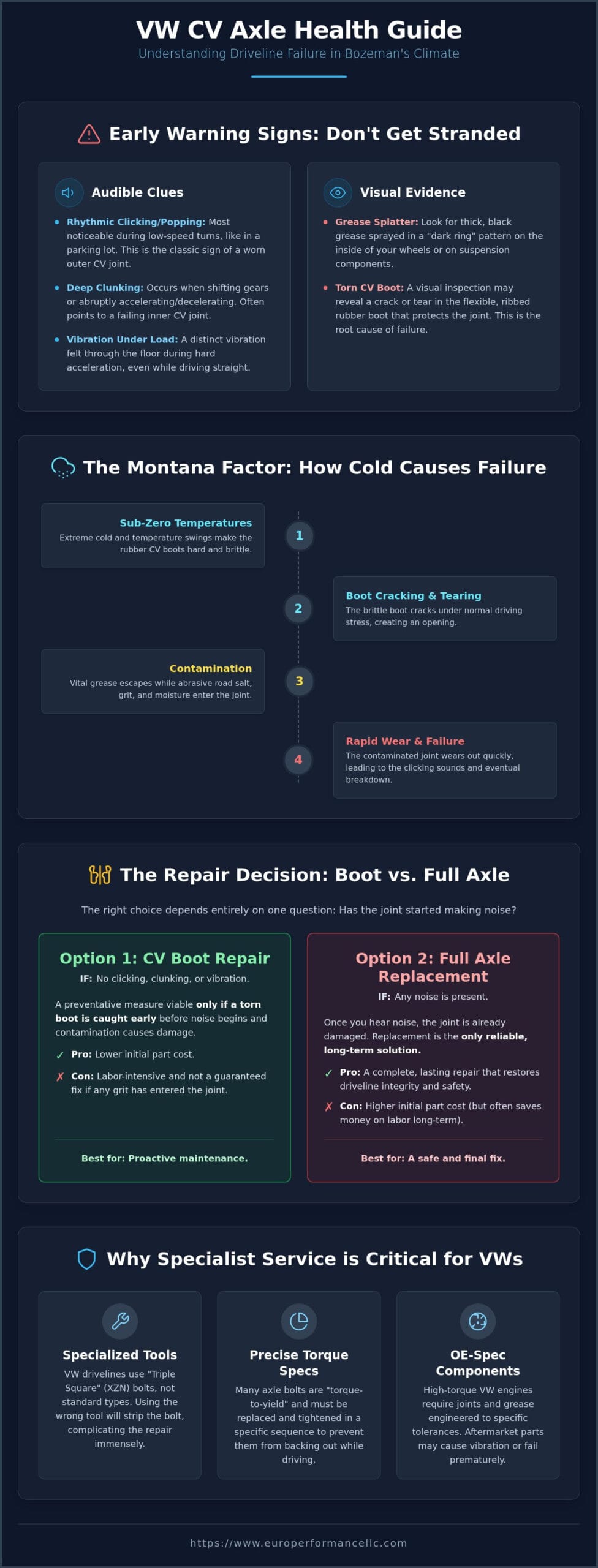
The most common symptom of a failing outer CV joint is a rhythmic clicking or popping sound. You will notice this most clearly during low-speed turns, such as when you are pulling into a parking spot or making a U-turn. This sound indicates that the internal bearings have worn grooves into the housing, causing them to “jump” under load. You can perform a simple parking lot test by driving in tight circles in both directions. If the clicking intensifies as you turn the wheel further, the outer joint is likely compromised.
Conversely, a deep clunking sound usually points to internal play within the driveline. This often happens during gear shifts or when you suddenly decelerate. While clicking is related to steering angles, clunking often signals that the inner joint or the splines are failing. Inner joint failure also manifests as a distinct vibration through the floorboard during hard acceleration, even if the steering remains quiet.
Visual Inspections for the Savvy VW Owner
You don’t need to be a professional mechanic to spot the early warning signs of a failing axle. The joint is protected by a flexible rubber boot filled with specialized molybdenum grease. When this boot tears, centrifugal force flings the grease out of the joint. Look for a “dark ring” of thick, black grease sprayed across the inside of your wheel well or on the brake components.
A small tear in the boot is a ticking time bomb. Once the grease escapes, the metal-on-metal components of the joint begin to overheat. More importantly, Montana’s road salt and grit enter the tear, acting like sandpaper on the precision-machined surfaces. If you catch a torn boot early, a simple cleaning and rebooting might save the axle. However, once the noise starts, a full replacement is usually the only reliable path forward.
Why Specialized VW Driveline Service Matters
Volkswagen engineering requires a fundamentally different approach than domestic or Asian vehicle maintenance. When you seek vw cv axle repair bozeman specialists understand that these components are precision-machined to handle the high-torque output characteristic of turbocharged European engines. Many Volkswagen models utilize a “bolt-on” flange system at the transmission side rather than the “press-fit” splines common in domestic cars. This design requires specific triple-square (XZN) drivers and strict adherence to torque-to-yield specifications. Using the wrong tools or incorrect torque settings can lead to bolts backing out, which causes catastrophic driveline failure while driving.
Precision Engineering of the Volkswagen Driveline
Many Volkswagen models employ a triple-roller joint, also known as a tripod joint, at the inner axle position. This design is specifically engineered to absorb engine vibrations and provide a smooth power delivery under varying loads. However, these joints are highly sensitive to the quality of the lubricating grease and the exact tolerances of the internal rollers. Adhering to European performance standards at Euro Performance Auto Shop LLC ensures that these intricate internal components are serviced with the meticulousness they require. This level of care is essential for preserving the signature German road feel and crisp handling that defines the Volkswagen driving experience.
The Danger of Generic ‘White Box’ Axles
While the lower price point of generic “white box” axles is appealing, these parts often lead to immediate performance issues. It doesn’t pay to cut corners on a high-torque drivetrain. Aftermarket components frequently use lower-grade steel that lacks the rigorous heat treatment found in Original Equipment (OE) parts. This often results in the following problems:
- Immediate Vibrations: Substandard balancing in generic axles can cause “new” vibrations during acceleration that weren’t present before the repair.
- Incorrect Axle Length: Generic parts sometimes vary in length by only a few millimeters. This discrepancy can cause the joint to bottom out during suspension travel, damaging transmission seals or wheel bearings.
- Inferior Boot Material: Low-quality rubber boots on generic axles often fail within a single season, especially when exposed to Montana’s road chemicals.
Specialized tools are a requirement, not an option, for this level of repair. Without the correct axle pullers and hub presses, a technician risks damaging the delicate magnetic tone rings used by the ABS and traction control systems. We focus on using OE-spec components and factory-approved lubricants to ensure the repair remains reliable through Montana’s varying road conditions. If you suspect your vehicle is suffering from driveline wear, you can consult with the specialists at Euro Performance Auto Shop LLC who understand the specific technical requirements of your Volkswagen.
The Montana Factor: How Cold Impacts Your VW’s CV Boots
Living in the Gallatin Valley presents unique challenges for European vehicle owners. While your Volkswagen is designed for the Autobahn, the extreme temperature fluctuations in Bozeman put immense stress on the driveline. It’s common to experience a 60-degree temperature swing within a 24-hour period, moving from -20°F at night to 40°F by the afternoon. For those seeking vw cv axle repair bozeman winters often reveal the limitations of aging rubber components. These rapid cycles of thermal expansion and contraction cause the CV boots to lose their structural integrity faster than they would in a more temperate climate.
Temperature Extremes and Rubber Elasticity
The CV boots on your Volkswagen are made from high-grade synthetic rubber or thermoplastic. These materials are designed to remain flexible while rotating at high speeds. However, sub-zero temperatures alter the rubber’s molecular structure, making it brittle. When the material loses its elasticity, the constant flexing required during steering and suspension movement leads to hairline cracks. These cracks often appear during the first deep freeze of the season. Once the boot loses its seal, the lubricating grease escapes and contaminants enter the joint. We prioritize these visual inspections during factory scheduled maintenance to catch these cracks before they become full-blown tears. Identifying a “hardened” boot early can prevent the need for a complete axle replacement later in the winter.
Road De-Icers: The Silent Driveline Killer
Montana’s road management involves heavy use of magnesium chloride and other liquid de-icers. While these chemicals keep the roads passable, they are highly corrosive to the exposed driveline components of your VW. Magnesium chloride is particularly aggressive because it clings to surfaces and attracts moisture. This accelerates the degradation of both rubber boots and the plastic clips that secure them. You might notice “salt-rot” appearing as white, crusty deposits on the axle shafts or mounting hardware.
This corrosion doesn’t just affect the rubber; it can seize the mounting bolts, making future repairs more difficult and time-consuming. We recommend a thorough undercarriage wash after every major snowstorm to remove these chemical residues. If you notice a tear in the boot, the presence of road salt inside the joint acts as an abrasive. It destroys the precision-machined bearings in a matter of days. This environmental pressure is why winter and early spring are the most common times for driveline failure in Belgrade and Bozeman. Catching these issues during a routine check ensures your vehicle remains safe on icy mountain passes.
CV Axle Replacement vs. Boot Repair: Making the Right Choice
Choosing between a boot repair and a full axle replacement requires a methodical assessment of the joint’s internal condition. If you have already detected the rhythmic clicking mentioned in previous sections, you have likely passed the “point of no return.” Simply replacing a rubber boot on an already noisy joint is a waste of resources. The internal bearings have already suffered physical wear, and a new boot will not reverse that structural damage. For effective vw cv axle repair bozeman specialists evaluate the degree of contamination and mechanical play before recommending a specific course of action.
The Boot-Only Repair: A Window of Opportunity
A boot-only repair is a highly effective preventative measure, but the window of opportunity is narrow. It is only a viable option if the tear is caught immediately and the internal grease remains free of road grit. The process is technically demanding. It involves removing the axle from the vehicle, completely disassembling the joint, and cleaning out every trace of old lubricant. Once cleaned, the assembly is re-packed with specialized molybdenum grease and sealed with a new high-strength boot. This is a proactive maintenance move that preserves the original factory components, which are often of higher quality than budget aftermarket alternatives. However, this is only a fix for a leak, not a fix for a mechanical noise.
Full Axle Replacement: The Long-Term Solution
In many cases, a full axle replacement is the most logical choice for both reliability and labor efficiency. The time required to meticulously clean and rebuild an old joint often makes the labor cost comparable to simply installing a new, complete assembly. A factory-spec unit ensures that the entire driveline is perfectly balanced. This precision prevents the high-speed steering wheel shimmy that often plagues lower-quality repairs. When we replace the entire unit, you receive new inner and outer joints, fresh boots, and a guarantee of structural integrity.
Technical accuracy is paramount during this installation. Volkswagen uses one-time-use “stretch” bolts for the main axle nut. These fasteners are designed to be tightened to a specific torque and then turned an additional set number of degrees to reach their maximum clamping force. Reusing an old bolt or failing to follow these specifications can lead to the hub loosening over time, which creates a significant safety risk. After the physical installation is complete, a visit to a professional alignment shop is a critical final step. A new axle can subtly influence suspension geometry. A precise alignment ensures your tires wear evenly and your Volkswagen maintains its signature handling. If you are concerned about your driveline, contact our team for a comprehensive inspection and a transparent repair plan.
Bozeman’s Trusted Specialist for Volkswagen Driveline Repair
Choosing the right partner for your vehicle’s maintenance is as critical as the repair itself. Euro Performance Auto Shop LLC provides a methodical, engineering-focused alternative to the local dealership. When you require vw cv axle repair bozeman residents deserve a shop that treats their Volkswagen with the precision it was designed for. Our facility is equipped with modern diagnostic equipment and specialized tools specifically curated for European manufacturing standards. By focusing exclusively on European brands, we eliminate the uncertainty that often comes with general repair shops that split their focus across various domestic and Asian makes.
Expertise You Can Trust in the Gallatin Valley
Our ASE Certified technicians approach every driveline issue with a focus on reliability and transparency. We don’t just replace parts; we investigate the root cause of the failure. This process-oriented approach ensures that we address adjacent components, such as transmission seals or wheel bearings, that may have been stressed by a failing axle. Because we understand the environmental pressures of the Gallatin Valley discussed earlier, we exclusively utilize OE-quality components. These parts are engineered to withstand chemical de-icers and extreme thermal cycles, providing a repair that lasts through several Montana winters.
Proper service often requires more than just mechanical installation. As your car’s suspension geometry shifts during a repair, it can impact safety systems. Our expertise in ADAS Calibration and wheel alignment ensures that your Volkswagen’s driver-assistance features remain accurate after the driveline is restored. This comprehensive approach, similar to the precision standards maintained by Car Suspension Repair, provides the peace of mind that comes from knowing every aspect of your vehicle’s safety has been verified by a specialist. We maintain a meticulous standard of care, mirroring the high-level engineering of the products we service, without the aggressive sales language often found elsewhere.
Schedule Your VW Service Today
Booking your inspection is a straightforward process. Belgrade and Bozeman drivers can expect a clear, step-by-step explanation of our findings before any work begins. During your initial driveline diagnostic, we perform a thorough visual and audible assessment to determine if a boot repair or a full assembly is necessary. We provide an honest, authoritative recommendation based on the current state of your CV joints and the age of your vehicle. Transparency is a core component of our value proposition, ensuring there are no hidden fees or unnecessary upsells during the repair process.
Maintaining your Volkswagen’s performance shouldn’t be a source of anxiety. By choosing a specialist who understands the local climate impact and the technical specificities of German drivelines, you ensure your vehicle remains a reliable asset for years to come. Contact Euro Performance Auto Shop LLC for your VW CV axle repair to experience a higher standard of European automotive care and restore the quiet, smooth-driving experience you expect from your Volkswagen.
Restore Your Volkswagen’s Precision Driveline
Maintaining the integrity of your driveline is a vital step in preserving the precision and safety of your European vehicle. By recognizing early indicators like rhythmic clicking or escaped grease, you can address issues before they lead to a complete loss of power on the road. Montana’s extreme temperature swings make specialized care a necessity rather than a luxury, as sub-zero weather quickly compromises standard rubber components. Choosing specialized vw cv axle repair bozeman ensures that your vehicle receives the technical attention and OE-quality parts required to endure our local environment.
Our facility in Belgrade, MT, is staffed by ASE Certified Technicians who utilize specialized European diagnostic tools to deliver meticulous results. We provide a transparent repair process that prioritizes your safety and your vehicle’s longevity. Whether you need a proactive boot replacement or a complete axle assembly, the team at Euro Performance Auto Shop LLC is here to provide the engineering-focused service your Volkswagen deserves. Schedule Your VW CV Axle Inspection at Euro Performance Auto Shop LLC today. We look forward to helping you enjoy a smooth and quiet driving experience through many more Montana seasons.
Frequently Asked Questions
How much does it cost to fix a CV axle on a VW in Bozeman?
The total cost for a professional repair depends on your specific Volkswagen model and the choice between OE-quality components or aftermarket alternatives. Labor rates for specialized European service in the Gallatin Valley reflect the level of technical expertise and specialized tooling required for German engineering. When you request a quote for vw cv axle repair bozeman specialists provide a detailed breakdown based on the complexity of your vehicle’s driveline and suspension configuration.
Can I drive with a clicking CV joint?
Driving with a clicking CV joint is a significant safety risk and should only be done to reach a nearby repair facility. The clicking sound indicates that the internal bearings are no longer properly seated in their races and are experiencing physical wear. If the joint fails completely, it can shear or seize. This results in a total loss of power to the wheels and can potentially cause a dangerous loss of control during a turn.
How long does a VW CV axle repair take?
A standard axle replacement usually requires between two and four hours per side. This timeframe can vary based on whether your VW utilizes a traditional bolt-on flange or a more labor-intensive press-fit design. When performing vw cv axle repair bozeman technicians also account for the time necessary to perform a test drive and verify that the new components are balanced and operating quietly before returning the vehicle to you.
Why does my VW vibrate when I accelerate but not when I coast?
Vibration during acceleration that disappears while coasting is a primary indicator of a failing inner CV joint. Unlike the outer joint, which typically clicks during low-speed turns, the inner joint handles the vertical movement of the suspension and the high torque from the engine. When the internal rollers wear down, they create a mechanical imbalance that manifests as a shuddering sensation through the floorboard specifically when the driveline is under load.
Is it better to replace one or both CV axles at the same time?
Replacing both axles simultaneously is not a technical requirement, but it is often a practical choice for long-term reliability. Because both axles are exposed to the same Montana road chemicals and extreme temperature swings, they often reach the end of their service life at similar intervals. Servicing both sides at once ensures a symmetrical feel in the driveline and can save you from a second visit to the shop a few months later.
Do I need an alignment after replacing a CV axle on my Volkswagen?
A professional wheel alignment is a necessary final step after any driveline work that involves removing suspension mounting bolts. Because the axle passes through the wheel hub, a technician must often disconnect the ball joints or strut mounts to gain access. Failing to perform an alignment after the repair can lead to rapid tire wear and can negatively impact the accuracy of your vehicle’s driver-assistance systems and ADAS calibration.
Will a torn CV boot cause my VW to fail an inspection?
A torn CV boot is considered a critical maintenance deficiency that will be flagged during any professional multi-point inspection or pre-purchase evaluation. While Montana does not require a state-mandated annual safety inspection, a torn boot indicates that the joint is no longer protected from road grit and moisture. It is a high-priority repair because the presence of road salt inside the joint will lead to rapid mechanical failure and a much higher repair bill.
What is the difference between an inner and outer CV joint?
The outer CV joint allows the wheels to turn for steering, while the inner joint allows the axle to move up and down with the suspension travel. Outer joints are located near the wheel hub and experience more extreme angles, which is why they are the most common source of clicking sounds. Inner joints are located near the transmission and are designed to slide in and out to accommodate the changing distance between the wheel and the gearbox as you drive.