
Blog

A clean interior and a reassuring test drive can’t confirm what’s happening under the hood. If the maintenance history is incomplete, deciding what to service first on a newly purchased used BMW means putting safety and verifiable needs ahead of optional repairs. Check for warning lights, leaks, unusual noises, and visible wear, then have overdue or uncertain maintenance assessed before relying on the car for everyday driving.
Which issues need attention now and which can wait depends on the BMW’s year, engine, mileage, condition, and service records. This guide explains how to identify safety-critical concerns, check for overdue maintenance, and build a plan around your specific model before spending on optional work. A technician familiar with European vehicles can help verify service needs and provide prioritized findings. Euro Performance Auto Shop LLC in Belgrade has ASE-certified technicians who provide European-vehicle maintenance and diagnostics.
Key Takeaways
- Separate urgent safety concerns from maintenance that can be scheduled later.
- Use the BMW’s year, engine, mileage, and service history to guide priorities.
- Use inspection findings to sort services into immediate, overdue, and monitor-or-plan categories.
- Address safety-critical findings before convenience items or optional upgrades.
- Seek diagnosis when records are incomplete or warning lights, unusual noises, or leaks need attention.
What to service first on a newly purchased used BMW: start with safety
Before assuming maintenance is current, establish the BMW’s condition. A seller’s recent inspection or a dashboard service reminder can offer useful clues, but neither confirms that every safety concern or overdue item has been addressed. Start with symptoms and the car’s current condition, then verify what the specific vehicle requires.
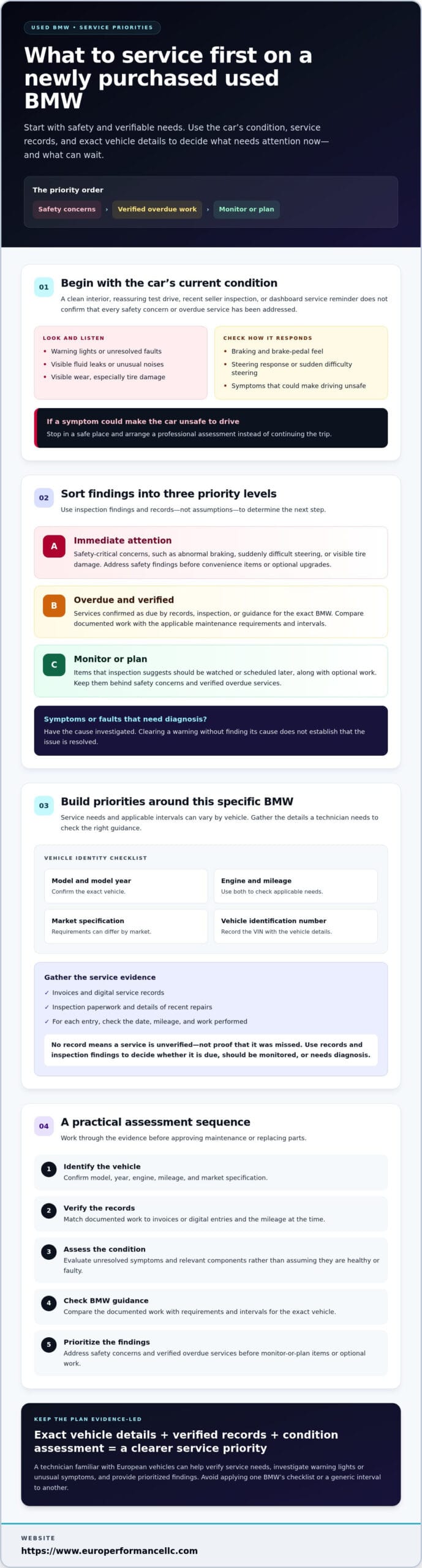
Sort findings into three groups: concerns that could affect safe driving, services that records or inspection show are due, and symptoms or faults that need further diagnosis. The right plan depends on the model year, engine, mileage, market specification, and maintenance history. A technician can help compare the car’s condition with guidance for that exact configuration.
For a general overview of BMW-specific repair topics, consult this BMW repair and maintenance guide, then confirm service requirements against information for your vehicle.
The following video discusses maintenance for BMWs with the B58 engine. Use it as background, not as a substitute for assessing your car.
Start with safety-critical systems and warning signs
Look for visible fluid leaks and pay attention to braking, tire condition, steering response, and warning lights. An abnormal brake pedal, suddenly difficult steering, or visible tire damage warrants prompt attention. If a symptom could make the car unsafe to drive, stop in a safe place and arrange a professional assessment instead of continuing the trip.
Don’t approve repairs based only on age, reputation, or a general online checklist. Recommendations should be supported by inspection findings. Some warnings require diagnostic testing to identify the cause. Clearing a warning without finding that cause doesn’t establish that the issue is resolved.
Gather the BMW’s identity and maintenance records
Write down the model, year, engine, mileage, market specification, and vehicle identification number (VIN). Gather invoices, digital service records, inspection paperwork, and details of recent repairs. Check what each record documents, including the date, mileage, and work performed. If you’re still considering a purchase, see this used-car pre-purchase inspection guide for a separate inspection checklist.
With those details, a technician can help identify gaps and verify applicable service procedures and intervals for the exact BMW. This provides a sound starting point for a prioritized maintenance plan instead of replacing parts based on assumptions.
How to prioritize overdue maintenance on a used BMW
A useful service plan matches the car’s identity, records, and present condition with maintenance guidance for that specific BMW. Work through the evidence rather than treating every undocumented service as automatically overdue.
- Identify the vehicle: Confirm its model, model year, engine, mileage, and market specification.
- Verify the records: Match invoices and digital service entries to the work completed and mileage at the time.
- Assess its condition: Have unresolved symptoms and relevant components evaluated instead of assuming they’re healthy or faulty.
- Compare with BMW guidance: Check applicable maintenance requirements and intervals for the exact vehicle.
- Prioritize findings: Address safety concerns and verified overdue services before monitoring items or optional work.
This sequence helps distinguish a genuine maintenance need from a gap in paperwork. The Federal Trade Commission’s guidance for used-car buyers discusses getting an independent mechanic inspection, which can help assess a car’s condition instead of relying only on seller-provided information.
Verify the correct BMW service schedule
Use the car’s exact model, year, engine, mileage, and market to find applicable manufacturer guidance. Compare documented work with services due now or approaching their specified interval. Requirements can differ across BMW models and engines, so don’t apply one vehicle’s service list or a generic online interval to another. If the guidance or records are unclear, ask a technician to verify them.
Decide what missing records mean
If there’s no documentation for a service, treat it as unverified, not proof that the work was missed. Look for invoices or digital records, then use inspection findings to decide whether service is due, a component should be monitored, or further diagnosis is needed. A technician can explain the evidence behind each recommendation and help avoid replacing parts solely because the history is incomplete.
For a broader explanation of schedule-based care, see this factory-scheduled maintenance guide. Confirm BMW-specific procedures and intervals against current information for your exact vehicle. Euro Performance LLC provides European-vehicle maintenance and diagnostics at its Belgrade shop. Drivers in the Bozeman area can learn about European-vehicle maintenance support as they plan next steps.
Which used BMW services deserve attention now and which can wait?
Set priorities based on evidence, not a parts list. A worn tire, fluid leak, or warning light may need prompt attention, but the finding should be assessed before deciding what repair is needed. Use inspection results and service guidance for the exact BMW to sort concerns into three groups:
| Priority | Examples to assess | How to decide |
|---|---|---|
| Immediate safety concerns | Brake problems, damaged or unsuitable tires, steering symptoms, faulty exterior lighting, or a significant leak | Arrange prompt professional assessment if a finding could affect safe operation. Stop driving if the car may be unsafe. |
| Verified overdue services | Oil or other scheduled maintenance without documentation, or a service identified as due under applicable BMW guidance | Confirm the interval, mileage, and service history before authorizing work. |
| Monitor or plan | Battery condition, minor seepage, cooling-system observations, or drivetrain symptoms that need further evaluation | Record the finding and follow the technician’s advice on monitoring, diagnosis, or planned service. |
These categories help organize findings; they aren’t automatic repair instructions. A low battery test result, for example, needs interpretation in context and doesn’t by itself establish that replacement is the only appropriate next step. A dashboard warning is a reason to investigate, not proof that a particular component has failed. Check the vehicle’s identification details and open recall information through NHTSA’s Check for safety recalls resource.
Safety and condition findings that may need prompt attention
Prioritize verified problems with braking, tires, steering, or lighting, and leaks that could affect safe operation or indicate a developing fault. If braking or steering behavior changes, or a warning appears alongside unusual symptoms, don’t assume the vehicle is safe to drive. Note when the symptom occurs, any warning messages, and what the inspection finds. Ask why a repair is recommended before approving the work.
Routine services and model-specific checks to plan
Review oil and other scheduled services against requirements for the BMW’s exact model, year, engine, mileage, and market. Have a qualified technician assess cooling, transmission, or engine concerns when symptoms, records, or inspection findings point to them. A timing-system recommendation, for example, should be verified for that specific engine and model year, not copied from advice about another BMW.
This evidence-based approach helps determine what to service first on a newly purchased used BMW without replacing every fluid or component simply because the history is incomplete. Keep safety findings and verified overdue maintenance at the top of the plan. Document and monitor items without a confirmed fault or due service as appropriate. For owners maintaining a vintage or collector European car, specialized facilities like grandprixcafe.com offer professional vehicle services and maintenance suited to classic models.
A practical first-month service plan for your used BMW
A first-month plan doesn’t mean replacing every fluid or part as a precaution. It means turning the vehicle’s records and inspection results into a clear sequence: establish a baseline, address safety-critical findings, complete confirmed overdue maintenance, then plan nonurgent work. This helps you decide what to do first without losing track of what can wait.
Before regular driving: establish a baseline
Confirm the BMW’s identity and current mileage. Gather available service records and list warning messages, noises, leaks, changes in handling, or other symptoms. If the history is incomplete or concerns remain, arrange an inspection before relying on the car for regular driving. Have any issue that may affect safe operation assessed promptly.
Ask for findings you can act on: what was inspected, what needs attention now, what service is confirmed overdue, and what should be monitored or investigated further. An ordered plan is more useful than a long, unexplained list of suggested work. If a recommendation is unclear, ask what evidence supports it and whether it relates to safety, a verified service requirement, or a developing concern.
After the first inspection: schedule and document
Use the inspection results and applicable BMW guidance to decide what happens next. Address safety-critical findings first, then schedule confirmed overdue maintenance. Plan nonurgent work according to the vehicle’s condition and specified service requirements, not an arbitrary deadline or blanket checklist. If more diagnosis is needed before recommending a repair, keep that step visible in the plan.
Keep a simple record for future service decisions. Save inspection reports and repair invoices, and note the mileage and date for each completed item. This builds a reliable maintenance history from your first day of ownership and helps you compare future recommendations with work already performed. Similarly, for vehicle owners who also manage a camper or recreational vehicle, discover Thurton Auto Centre to explore dedicated maintenance schedules and servicing options.
If you’re in the Bozeman area and need help interpreting findings or planning European-vehicle maintenance, Euro Performance LLC is located in Belgrade, Montana. Learn more in this European auto repair overview, or contact Euro Performance about your BMW’s maintenance needs.
When a BMW specialist should inspect your newly purchased car
A specialist assessment is useful when the service history is incomplete, a warning light remains on, or you notice unusual noises, leaks, or recurring symptoms. These clues don’t identify a failed part on their own. A technician can inspect the vehicle and use diagnostic equipment to investigate the cause, then relate findings to the BMW’s model, engine, year, mileage, and applicable service guidance.
A clear visit should follow a straightforward process: discuss the car’s history and symptoms, inspect and diagnose concerns, then explain findings in priority order. Ask which issues affect safe operation, which services are confirmed due, and which items can be monitored or assessed later. This turns uncertainty about what to service first on a newly purchased used BMW into a documented plan instead of a guess.
What to bring to a BMW maintenance assessment
Bring the VIN, current mileage, available service records, and recent repair invoices. Write down symptoms and when they occur, including dashboard messages, noises, leaks, or changes in how the car drives. Mention recent repairs, since that context can help guide diagnosis. Before agreeing to work, ask what the inspection found and how each recommendation relates to safety, vehicle-specific service guidance, or observed condition.
How to choose the next repair step with confidence
Look for explanations that distinguish a confirmed fault from a possible cause or preventive recommendation. If a repair is advised, ask what evidence supports it, whether further diagnosis is needed, and how urgently it should be addressed. Where replacement parts are appropriate, Euro Performance LLC uses parts from top OE manufacturers. The goal is a clear basis for deciding what to do now and what can wait.
Euro Performance LLC is a European-vehicle repair shop in Belgrade, Montana. Its ASE-certified technicians provide diagnostics, routine maintenance, factory-scheduled maintenance, and complex repair work. For BMW owners in the Bozeman area whose vehicle history or inspection findings remain unclear, a specialist assessment can help establish next steps. Learn about BMW service at Euro Performance in Belgrade.
Start Your BMW Ownership with a Clear Service Plan
Knowing what to service first on a newly purchased used BMW starts with understanding the condition of your specific car, not following a blanket checklist. Use its records, inspection findings, and applicable BMW guidance to separate safety concerns and confirmed maintenance needs from items that can be monitored or planned. Organized service documentation will also make future decisions clearer.
If records are incomplete or a warning, leak, or recurring symptom needs diagnosis, an experienced European-vehicle technician can help clarify the next step. Euro Performance LLC’s ASE-certified technicians provide European-vehicle maintenance and complex diagnostic services at the shop in Belgrade, Montana.
Schedule a BMW service assessment to discuss your vehicle’s history and inspection needs. Clear findings and priorities can help you build a thoughtful maintenance plan for the miles ahead.
Frequently Asked Questions
What should I service first after buying a used BMW?
Start by checking safety-related concerns and establishing the car’s condition before assuming its maintenance is current. Look for brake or steering symptoms, damaged tires, warning lights, and visible leaks. Then review records and compare completed work with service requirements for the exact model, year, engine, mileage, and market. Prioritize confirmed safety issues and overdue maintenance, not a blanket list of parts to replace.
Should I change the oil immediately after buying a used BMW?
Change the oil if records show it’s due, applicable BMW maintenance guidance calls for service, or an inspection indicates a need. A recent, documented oil service may mean an immediate change isn’t necessary. Check the date, mileage, and details on the invoice, then compare them with requirements for your specific BMW. If the history is unclear, ask a technician to verify the service status instead of relying only on a seller’s verbal assurance.
Is a pre-purchase inspection enough after I buy a used BMW?
Not always. A pre-purchase inspection provides information about the car’s condition at the time it was examined, but it doesn’t establish that every future service is current or address symptoms that develop later. Review the inspection report alongside maintenance records after purchase. If warning lights, leaks, unusual noises, or recurring concerns remain, arrange further assessment. Use the findings to distinguish urgent issues from services that can be planned or monitored.
Can I rely on the BMW dashboard service reminder?
Use the dashboard reminder as one source of maintenance information, not a complete condition assessment. It may indicate that scheduled service is approaching, but it doesn’t confirm the condition of brakes, tires, steering, visible leaks, or every system that may need diagnosis. Compare the reminder with service records and guidance for the exact vehicle. If a warning light appears or the car behaves differently, have the cause assessed instead of assuming it’s only a routine reminder.
How do I know which BMW maintenance is overdue?
Identify the car’s model, model year, engine, mileage, and market specification, then compare its service records with applicable BMW maintenance guidance. Invoices and digital records can confirm what work was completed and at what mileage. If a service has no documentation, treat it as unverified rather than automatically overdue. A technician can assess condition, check relevant requirements, and explain which items are due, need diagnosis, or can be monitored.
What if my used BMW has no service records?
Build a maintenance baseline instead of assuming every service has been missed. Record the vehicle’s identity and mileage, note warning messages or symptoms, and arrange an inspection if the history is unknown or concerns remain. Ask for findings that separate safety-critical issues, confirmed service needs, and items to monitor. Keep the resulting report and invoices so future decisions are based on documented work and the car’s condition, not guesswork.
Should I replace BMW transmission fluid after buying a used car?
Don’t replace transmission fluid solely because you’ve bought the car or can’t find a service record. Confirm the correct maintenance guidance for the BMW’s model, year, engine, and transmission, review available service history, and have any drivetrain symptoms assessed. Ask a qualified technician whether fluid service is due or appropriate for the vehicle’s condition. A model-specific recommendation is more reliable than applying one interval or rule across the BMW range.
When should I take a newly purchased BMW to a specialist?
Arrange an assessment if maintenance records are incomplete, a warning light is on, or you notice unusual noises, leaks, recurring symptoms, or changes in how the car drives. Bring the VIN, mileage, available invoices, and notes on when symptoms occur. Euro Performance LLC’s ASE-certified technicians provide European-vehicle maintenance and complex diagnostics at its Belgrade, Montana, shop. Ask for documented findings prioritized by safety, verified service needs, and items suitable for monitoring.
Contact Euro Performance LLC to discuss a BMW service assessment.