
Blog
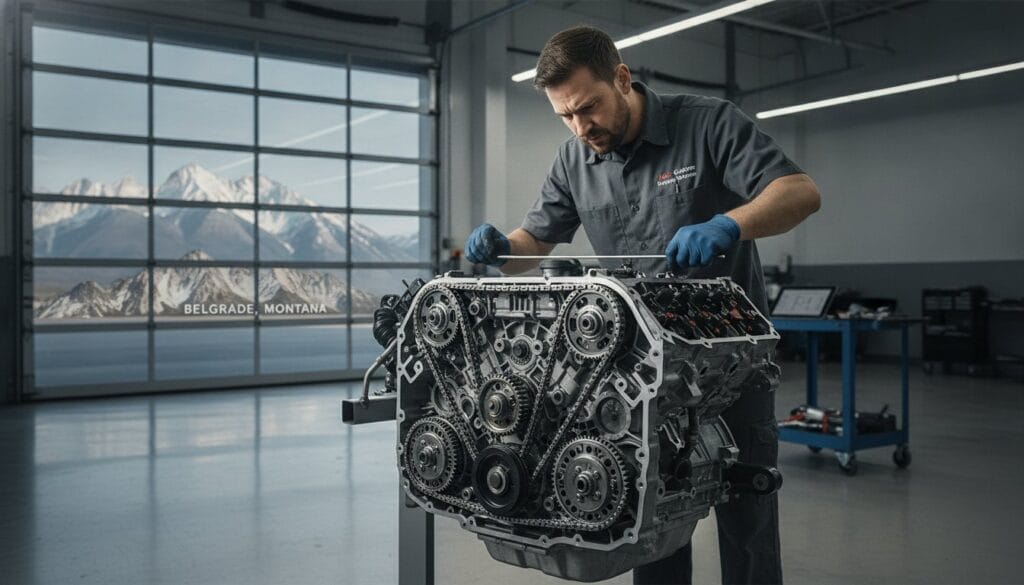
A single skipped link on your Audi’s timing chain can instantly transform a high-performance German engine into a $20,000 repair bill. It’s a sobering reality for owners of these precision-engineered vehicles, especially when facing the initial sticker shock of a service quote. You likely already know that keeping your engine’s internal clock in sync is vital, but finding a balance between fair pricing and technical excellence is often the hardest part of the process.
This guide provides a professional breakdown of the audi timing chain replacement cost for 2026, helping you understand the labor-intensive requirements of these complex interference engines. We’ll explore why labor constitutes the largest portion of the expense and which OE components must be replaced alongside the chain to prevent future failure. By the end of this article, you’ll have the technical insight needed to choose a specialist who uses factory-grade diagnostics rather than guesswork, ensuring your vehicle remains reliable for the next 100,000 miles.
Key Takeaways
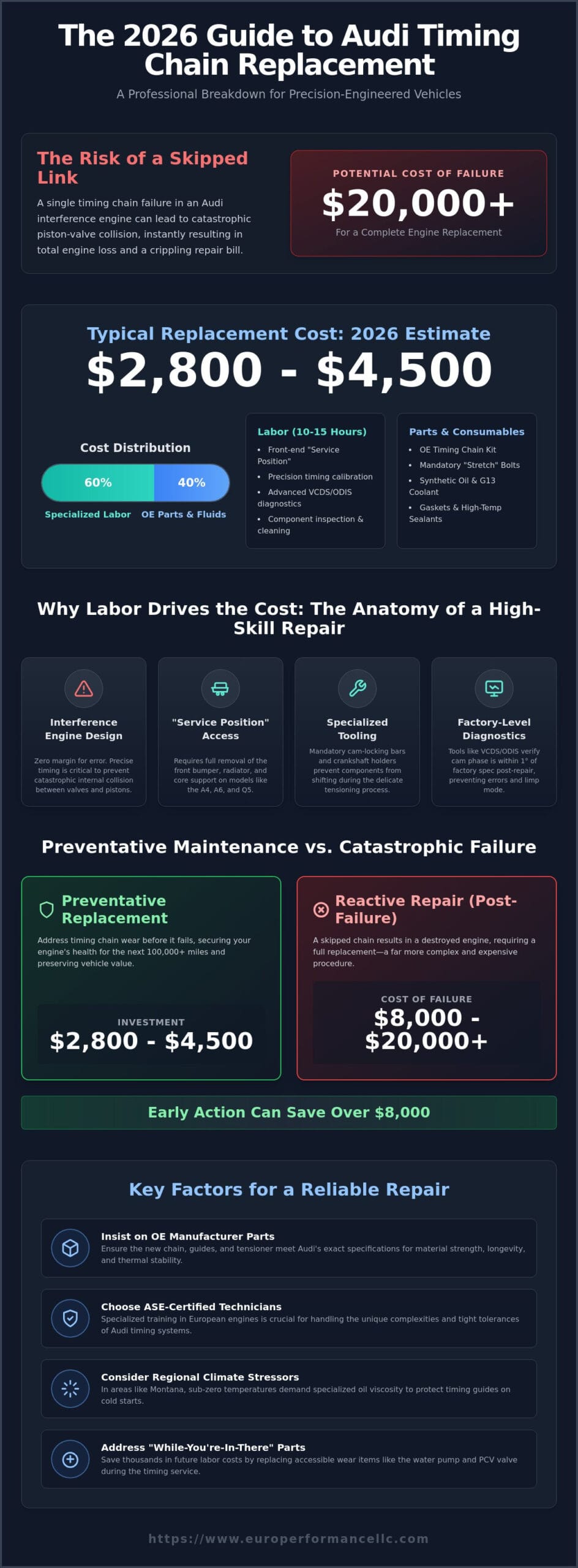
- Understand why the 2026 audi timing chain replacement cost typically ranges from $2,800 to $4,500, largely due to a 60% labor-to-parts ratio in European engine work.
- Learn how the “Service Position” and rear-mounted chains on 3.0T V6 engines necessitate extensive front-end removal and precision timing adjustments.
- Discover how preventative replacement can save over $8,000 compared to a reactive engine replacement after a catastrophic interference failure.
- Identify the specific stressors that Montana’s sub-zero temperatures place on timing chain guides and why specialized oil viscosity is critical.
- Gain insight into the necessity of using OE manufacturer parts and ASE-certified technicians to ensure your engine’s timing is reset to factory standards.
Factors Influencing Audi Timing Chain Replacement Cost in 2026
Understanding the total audi timing chain replacement cost requires looking past the raw numbers. In 2026, national industry benchmarks for a high-quality service typically fall between $2,800 and $4,500. This range reflects the increasing complexity of modern Audi powerplants and the rising cost of precision-engineered components. Most owners are surprised to find a 40/60 split between parts and labor. While the chain itself is a critical component, the majority of your investment goes toward the meticulous labor required to access, calibrate, and verify the timing system.
The configuration of your engine plays a massive role in the final invoice. Longitudinal engines, found in the A4 and A6, often require the front of the vehicle to be moved into a “service position” to allow access. Transverse engines, like those in the A3 or TT, present different spatial challenges. Because most Audi powerplants utilize an interference engine design, there is zero margin for error during this process. If the timing is off by even a single degree, the valves and pistons can collide, leading to a total engine loss. This technical risk is why specialized expertise is non-negotiable.
Smart owners also account for “while-you-are-in-there” items. Replacing the water pump, PCV valve, and various gaskets adds to the initial audi timing chain replacement cost, but it prevents you from paying for the same 10 to 15 hours of labor again six months later. Using new “stretch bolts” is another mandatory step; these are one-time-use fasteners that ensure the timing covers remain leak-free under high thermal stress.
2026 Cost Breakdown Table
- OE Timing Chain Kit: Includes the primary chain, hydraulic tensioner, updated guides, and specialized gaskets.
- Labor Hours: Standard book time ranges from 10 to 15 hours depending on engine displacement and chassis clearance.
- Essential Consumables: Fresh synthetic oil, OE-spec G12/G13 coolant, and high-temp specialized sealants.
Why Regional Location Matters for Pricing
In the Belgrade and Bozeman corridor, local labor rates for European specialists align with the high level of technical training required for these vehicles. Shipping specialized OE parts to Montana also adds a logistical layer to the pricing structure. In Gallatin County, fair market value for specialized Audi service reflects the high demand for ASE-certified technicians who can handle the region’s specific environmental challenges and ensure long-term engine reliability.
Why Labor Drives the Price: The Technical Complexity of Audi Timing
Labor accounts for the majority of the audi timing chain replacement cost because the process is more akin to surgery than a standard repair. Technicians must maintain absolute synchronization between the crankshaft and camshafts. Even a 1-degree deviation in timing can trigger a permanent Check Engine Light or cause the ECU to put the vehicle into a restricted “limp mode.” Verifying this precision requires advanced factory diagnostics like VCDS or ODIS to monitor cam phase deviation in real-time. These tools allow a specialist to see exactly how much the chain has stretched before a single bolt is turned.
Precision isn’t just a goal; it’s a requirement dictated by the physics of the engine. Research into the dynamic behavior of a timing chain shows how harmonic vibrations and thermal expansion can impact chain tension. To counteract these forces during installation, specialized cam-locking bars and crankshaft holding tools are mandatory. Without these, the camshafts can “jump” during the tensioning process, leading to catastrophic results. A standard socket set and general mechanical knowledge aren’t enough to guarantee the longevity of a modern Audi engine.
The ‘Service Position’ Explained
For longitudinal engines found in the A4, A6, and Q5 models, technicians must perform a procedure known as the “Service Position.” This involves the methodical removal of the front bumper, radiator, and core support to create an open workspace at the front of the engine. While labor-intensive, this step is vital for ensuring the new guides and tensioners are seated perfectly. It also provides a unique opportunity to inspect other european performance components, such as the serpentine belt system and turbocharger cooling lines, ensuring total vehicle reliability.
The Risks of Improper Installation
Many “all-makes” shops attempt these repairs without the necessary Audi-specific tooling or technical data. This is a dangerous gamble. Because Audi utilizes interference engines, there is no physical clearance between a wide-open valve and a piston at the top of its stroke. A single mistake during the chain installation can lead to bent valves or cracked pistons, effectively doubling the audi timing chain replacement cost by requiring a full cylinder head rebuild. This technical risk is why ASE certification and European specialization are critical requirements for your service provider. If you suspect your engine timing is drifting, you should consult with a specialized technician who understands these high-stakes requirements and can provide a precise diagnostic report.
Model-Specific Variations: 2.0T TFSI vs. 3.0T V6 Supercharged
The total audi timing chain replacement cost is heavily dictated by the specific architecture of your engine. While the Audi lineup shares a commitment to performance, the mechanical layout varies significantly between models. An inline-four engine presents a different set of challenges than a V6 or V8. Understanding these differences helps you identify why a quote for a Q7 might be substantially higher than one for an A4. Precision engineering means that every millimeter of clearance counts, and some engines simply require more labor to access their internal timing components.
The 2.0T Tensioner Crisis
The EA888 2.0T engine, found in the popular A4 and Q5 models, is the most common visitor for timing services. Historically, these engines faced a known weakness in the hydraulic tensioner design. Early versions could fail without warning, allowing the chain to skip and causing the valves to collide with the pistons. By 2026, the industry has standardized on an updated, robust tensioner that has significantly improved reliability. Owners should listen for a metallic rattle during a cold start; this is often the first sign that the guides are worn. Because of these high stakes, preventative replacement is a mandatory highlight in the audi service schedule.
3.0T and V8 Complexity
The 3.0T V6 Supercharged engine, utilized in the S4 and Q7, introduces a much higher level of technical difficulty. Unlike the 2.0T, which features a front-mounted chain, the 3.0T utilizes a complex network of four separate chains located at the rear of the engine block. This “rear-timing” design often necessitates a full engine-out procedure. A brief “clack” or “chatter” upon startup in these models typically indicates that the upper timing chain tensioners are no longer holding pressure. For the 4.2L V8 found in older S5 or RS4 models, the engine-out reality is even more pronounced due to the sheer size of the powertrain within the engine bay.
At Euro Performance Auto Shop LLC, we manage these complex engine-out procedures using specialized hydraulic cradles and factory-standard lifting equipment. We also address a common gap in the service market by focusing on the quality of the parts kit. Many general repair shops use “white box” aftermarket kits to keep their quotes low, but these components often lack the hardened steel specifications found in OE parts from manufacturers like INA or Iwis. Even as we move further into 2026, the new generation of hybrid Audis continues to rely on high-stress internal combustion engines that require this same level of meticulous timing maintenance to handle frequent start-stop cycles. This emphasis on component integrity is universal; for instance, those managing industrial power units can discover Representaciones BURG SpA for critical engine components.
Preventative vs. Reactive: How Early Replacement Saves Thousands
Choosing between preventative maintenance and a reactive emergency repair is the difference between a manageable service and a total engine loss. Industry data for 2026 suggests that a preventative audi timing chain replacement cost is roughly one-third the price of a full engine replacement. When a chain fails, the internal components of an interference engine collide, leading to bent valves and scarred pistons. A new long-block engine can easily exceed $12,000 in total costs, making the decision to wait a high-stakes gamble with your vehicle’s value.
Montana’s extreme climate plays a decisive role in component longevity. During -20°F winters, engine oil thickens significantly, which delays the hydraulic tensioner’s ability to take up slack during a cold start. This momentary looseness causes the chain to slap against plastic guides, making them brittle and prone to shattering over time. Specialized oil filters are essential in these conditions because they prevent bypass valve issues that can starve the timing system of lubrication during sub-zero ignitions. Modern Audi owners have a digital advantage in this regard. By utilizing factory scheduled maintenance intervals, technicians can use VCDS software to monitor “Block 093” data. This diagnostic field measures the phase position between the camshaft and crankshaft, providing a data-driven deadline for when the service must be performed.
The Cost of Catastrophic Failure
When the chain skips, the synchronization that keeps the engine running safely is lost. The resulting valve-to-piston contact is often non-repairable without a complete cylinder head rebuild or a new engine block. While some owners look toward used engines to save money, these units often come with unknown maintenance histories and may be nearing their own timing failure. Investing in a new engine is prohibitively expensive for older models, often exceeding the total book value of the vehicle itself. It’s a financial scenario that is easily avoided through proactive monitoring.
Symptoms You Can’t Ignore
The most common warning sign is the “Death Rattle,” a distinct metallic chattering sound that occurs during the first few seconds after a cold start. If the Check Engine Light illuminates with fault codes P0011 or P0016, the ECU has already detected a significant timing deviation. These codes are a final warning before the engine becomes inoperable. If you are in the market for a pre-owned vehicle, a used car pre purchase inspection is the most effective way to identify these hidden risks before they become your financial burden. If you have noticed a rattle on startup or a sudden drop in fuel economy, schedule a diagnostic session with our ASE-certified team to verify your chain stretch before it leads to a total engine failure.
Audi Timing Service in Belgrade: The Euro Performance Advantage
Selecting a service center for your engine’s most critical maintenance is a decision that directly impacts the long-term viability of your vehicle. At Euro Performance LLC, we understand that the audi timing chain replacement cost represents a significant investment in your car’s future. Our approach centers on technical precision and transparency, utilizing ASE-certified technicians who specialize exclusively in European engineering. Unlike generic “all-makes” shops that service every variety of vehicle, our team possesses the specific mechanical intuition and specialized training required to navigate the complexities of Audi’s unique timing systems.
Our commitment to quality starts with the components we install. We exclusively use OE manufacturer parts from trusted suppliers like INA and Iwis, ensuring every chain, guide, and tensioner meets factory-hardened steel specifications. We never compromise your engine’s safety with “white box” aftermarket kits that often lack the durability required for high-stress European powerplants. This focus on premium components, combined with our use of advanced VCDS and ODIS diagnostics, allows us to provide dealership-level technical accuracy. We don’t guess; we use data to pinpoint exact cam phase deviation, providing you with a clear, documented status of your engine’s health.
Serving the Belgrade and Bozeman Community
Conveniently located in Belgrade near Jetway Dr, our facility serves as the local alternative to expensive Bozeman dealerships. We specialize in the complex driveline and engine-out procedures that many general repair shops decline due to the high technical risk involved. Our focus on European performance ensures that we have the specialized hydraulic cradles and timing lock tools on hand, allowing us to perform these intricate repairs with methodical efficiency. This geographic specialization means your vehicle receives the attention of a master craftsman who understands how Montana’s environment affects your engine’s specific needs.
Schedule Your Timing Health Check
Protecting your investment begins with an accurate assessment. During a timing chain diagnostic appointment, we perform a comprehensive digital scan to measure chain stretch and inspect the timing covers for signs of oil seepage or guide wear. We provide every owner with a detailed digital inspection report, including photos and diagnostic data, before any work is authorized. This transparent process ensures you have all the facts necessary to make an informed decision about your vehicle’s maintenance. Don’t wait for a startup rattle to turn into a catastrophic failure. Schedule your Audi diagnostic session today and ensure your engine remains synchronized for the road ahead.
Securing Your Audi’s Long-Term Engine Reliability
Managing the audi timing chain replacement cost is an essential part of maintaining your vehicle’s high-performance standards. You now understand that while labor drives the majority of the expense, it’s a necessary investment in precision that prevents a five-figure engine failure. By prioritizing preventative diagnostics over reactive repairs, you ensure that your engine’s internal timing remains synchronized for the long haul. This proactive approach is especially vital for Montana drivers who must account for extreme temperature fluctuations that stress mechanical components.
At Euro Performance LLC, our ASE-certified technicians utilize specialized European diagnostics and our high-quality OE parts guarantee to provide the meticulous service your Audi requires. We focus on building reliability through transparent documentation and technical excellence. Schedule your Audi’s timing chain diagnostic at Euro Performance LLC to get a clear picture of your engine’s health. Taking this step today provides the peace of mind that comes from knowing your vehicle is in the hands of specialized experts who value precision as much as you do.
Frequently Asked Questions
What is the average Audi timing chain replacement cost in 2026?
The total audi timing chain replacement cost typically ranges from $2,800 to $4,500 for most 2.0T and 3.0T models. High-performance V8 engines often exceed this range because they require a full engine-out procedure to access the rear-mounted chains. Your final investment depends on the specific engine displacement and whether you choose to replace adjacent components like the water pump during the service.
At what mileage should I replace my Audi’s timing chain?
Most specialized technicians recommend a replacement between 80,000 and 120,000 miles. While some factory manuals suggest the chain is a lifetime part, real-world wear on the plastic guides and hydraulic tensioners often necessitates earlier intervention. Using advanced diagnostics to measure cam phase deviation is the most accurate way to determine the exact service deadline for your specific vehicle.
Can I drive my Audi with a noisy timing chain?
You shouldn’t drive your vehicle if you hear a rattling or chattering sound from the engine bay. This noise, often called the “death rattle,” indicates that the chain is loose and slapping against the timing covers or guides. Continuing to drive in this condition significantly increases the risk of the chain skipping a tooth, which leads to immediate and catastrophic engine failure.
Why is Audi timing chain labor so expensive compared to other cars?
The labor cost is high because of the “service position” requirement and the complexity of German engine architecture. Technicians often have to remove the entire front bumper, radiator, and core support just to reach the timing covers on longitudinal engines. For V6 and V8 models, the chains are frequently located at the rear of the block, making the job much more time-intensive than on a standard domestic vehicle.
What other parts should be replaced during a timing chain service?
A professional service includes new chains, updated tensioners, guides, and all “one-time-use” stretch bolts. It’s also highly recommended to replace the water pump, thermostat, and relevant gaskets while the engine is already disassembled. Replacing these items simultaneously saves you from paying for the same 10 to 15 hours of labor again if a minor component fails later.
Is the Audi timing chain a ‘lifetime’ part as some manuals claim?
The “lifetime” claim is generally a marketing term that doesn’t account for the reality of mechanical wear. Over time, plastic guides become brittle from heat cycles and hydraulic tensioners can lose their ability to maintain pressure. Most owners find that replacing the system proactively is much cheaper than dealing with the consequences of a failed “lifetime” component after the 100,000-mile mark.
Will a failed timing chain destroy my Audi’s engine?
Yes, a failed chain will cause the valves and pistons to collide because Audis use interference engines. This collision results in bent valves, damaged piston crowns, and potentially a cracked cylinder head. In most cases, the cost of repairing this damage is so high that a complete engine replacement is the only viable option, which can cost upwards of $20,000.
How do I know if my Audi tensioner has been updated?
Technicians can verify the tensioner version by removing a small inspection plug on the lower timing cover. The updated design features a specific serrated locking system that is visible to a trained eye. If your Audi was built before 2013 and hasn’t had this service performed, it likely still has the original failure-prone tensioner that should be replaced immediately.