
Blog

With the average post-warranty maintenance cost for European vehicles reaching up to $3,600 annually in 2026, the “wait and see” approach to service is officially the most expensive way to own a car. You chose a precision-engineered machine for its performance and safety, but that same engineering requires a specific, proactive strategy to avoid the high cost of unexpected repairs. It’s completely understandable to feel a sense of distrust when generic shops treat your Mercedes-Benz like any other sedan, or to feel confused when your dashboard displays a cryptic service code.
This guide allows you to master your european car maintenance schedule by providing a clear, expert-led breakdown of factory requirements and brand-specific nuances. We’ll explore the latest 2026 programs like Audi Signature Care, explain how Belgrade’s sub-zero temperatures impact your battery life, and provide a roadmap to ensure 200,000-mile reliability. By the end of this article, you’ll have the technical knowledge needed to maximize your vehicle’s resale value and maintain total confidence on Montana’s roads.
Key Takeaways
- Understand why high-performance European engineering requires more frequent oil and filter services than the generic 10,000-mile interval suggests.
- Learn how to navigate your specific european car maintenance schedule, including brand-specific requirements for BMW’s cooling systems and Audi’s Haldex AWD units.
- Identify how Montana’s extreme cold and corrosive road salts impact your vehicle’s rubber seals and suspension components.
- Discover why choosing an independent specialist using OE manufacturer parts provides superior value without compromising the integrity of your factory warranty.
- Gain clarity on interpreting advanced dashboard service lights and Condition Based Service (CBS) alerts to prevent catastrophic mechanical failure.
The Philosophy of European Engineering and Maintenance
European vehicles are not simply transportation; they are feats of high-performance engineering designed with tighter mechanical tolerances than most domestic cars. While a standard engine might have broader clearances, German and Italian powerplants operate with extreme precision to achieve superior power-to-weight ratios. This efficiency often results in higher engine operating temperatures, which places immense stress on every gasket, seal, and fluid. Understanding your european car maintenance schedule requires a shift in perspective. You aren’t just changing oil; you’re preserving a complex thermal management system.
To better understand this concept, watch this helpful video:
Adopting a “set and forget” mentality is the fastest way to trigger cascading component failures. Many owners follow “minimum factory requirements” to save money, but these intervals are often designed to get a car through its lease period, not to reach 200,000 miles. Optimal performance maintenance involves proactive inspections that identify wear before it compromises the vehicle’s safety. A standard motor vehicle service might cover the basics, but European cars demand a more meticulous approach to maintain their factory-rated dynamics.
Tighter Tolerances and Fluid Integrity
High-compression European engines degrade oil faster than their domestic counterparts due to the shear forces and heat generated within the cylinder head. Using generic oil is a gamble you’ll likely lose. Specific synthetic certifications, such as BMW LL-01 or VW 502.00, are non-negotiable because they contain the exact additive packages required to protect specialized valve trains. Similarly, the role of specialized coolant is vital. Using the wrong fluid can lead to rapid corrosion of alloy engine blocks, resulting in porous metal and permanent engine damage.
The Interconnected Nature of European Systems
In a modern European vehicle, the mechanical hardware and electronic control units function as a single, integrated organism. A minor vacuum leak in the intake manifold can cause the transmission to shift harshly because the computer can no longer accurately calculate engine load. This interconnectedness means that diagnostics must be holistic. Our ASE certified technicians use factory-level tools to scan for “soft codes” that don’t always trigger a dashboard light but indicate a system is drifting out of spec. Addressing these small deviations is the key to long-term reliability and peak performance.
Universal Service Milestones: A Mileage-Based Timeline
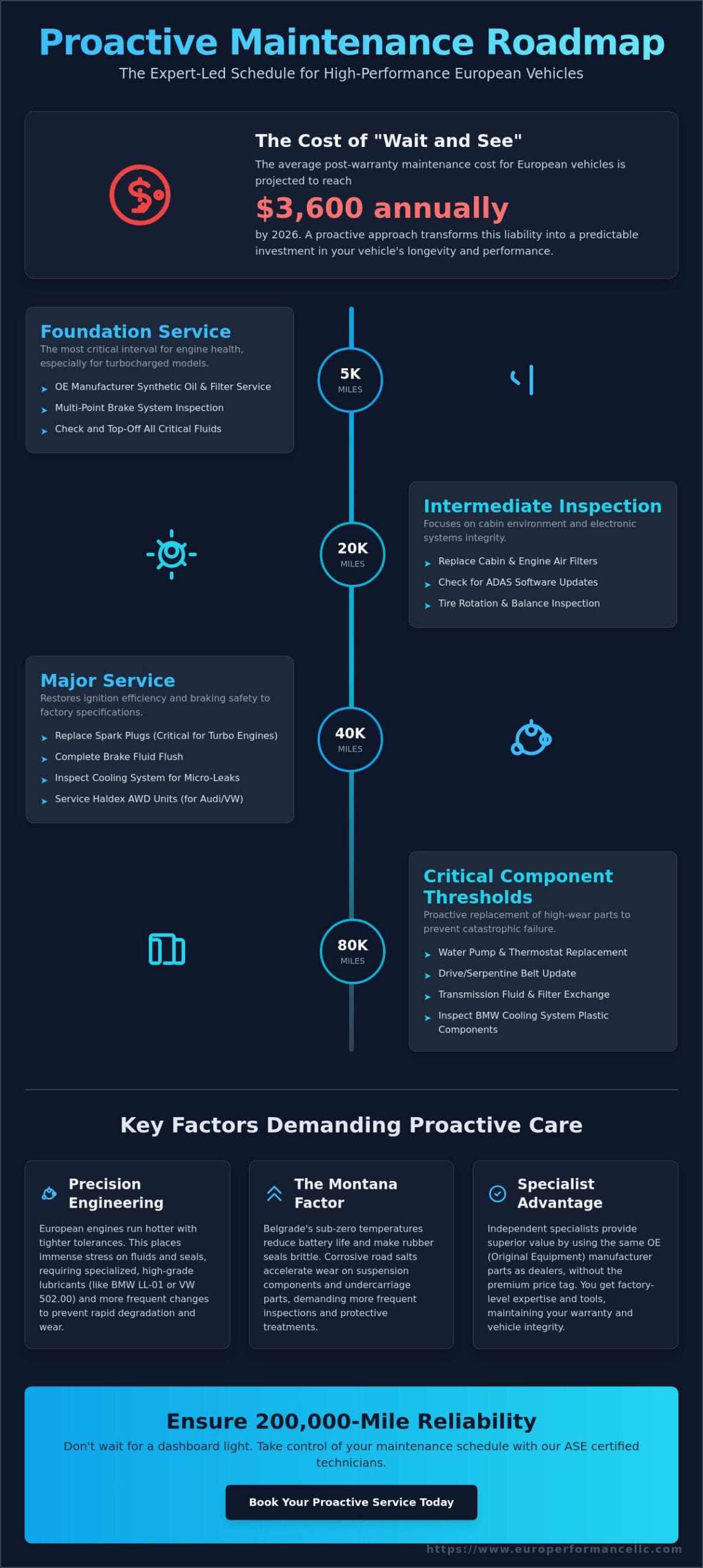
While many 2026 manufacturer manuals suggest 10,000-mile intervals, following a more rigorous european car maintenance schedule is the most effective way to ensure long-term reliability. These milestones act as a technical blueprint. They allow our ASE certified technicians to identify wear patterns before they compromise your safety. Adhering to a mileage-based timeline prevents the high cost of emergency repairs by replacing components at the end of their predictable service life.
- Every 5,000 to 7,500 Miles: Perform an oil and filter service using OE manufacturer lubricants. This interval includes a multi-point inspection of the braking system and fluid levels.
- Every 15,000 to 20,000 Miles: Conduct an intermediate inspection. This includes replacing cabin air filters and checking the Advanced Driver Assistance Systems (ADAS) for software updates.
- Every 30,000 to 40,000 Miles: Execute a major service. This involves replacing spark plugs, flushing the brake fluid, and inspecting the cooling system for micro-leaks.
- Every 60,000 to 80,000 Miles: Address critical component thresholds. This is the window for water pump replacement, drive belt updates, and transmission fluid exchanges.
The 5,000-Mile Rule for Turbocharged Engines
Modern European engines often utilize turbochargers that spin at speeds exceeding 200,000 RPM. These components rely on a thin film of oil for cooling and lubrication. Over time, heat causes even the best synthetic oils to break down. Waiting until 10,000 miles can lead to carbon buildup on intake valves and premature turbo failure. We recommend expert oil change services in Bozeman every 5,000 miles to flush out contaminants. During these visits, we visually inspect for early signs of oil pan or valve cover leaks to keep your engine bay pristine.
Major Service Intervals (30k-60k Miles)
European braking systems are hygroscopic. They naturally absorb moisture from the atmosphere, which can lower the boiling point of the fluid and cause internal corrosion in the ABS module. A biennial brake fluid flush is non-negotiable for maintaining pedal feel and system longevity. This milestone is also the time to debunk the “Lifetime Fluid” myth regarding transmissions. Most OE manufacturers of the gearboxes themselves recommend fluid exchanges by 60,000 miles to prevent friction plate wear. If your european car maintenance schedule includes suspension work or a wheel alignment, you must ensure your shop performs ADAS calibration. Even a one-degree deviation in alignment can cause lane-keep assist systems to malfunction. Research from the U.S. Department of Energy highlights significant cold weather effects on vehicles, making these major services even more critical in Montana. If you are unsure of your vehicle’s current status, you can schedule a comprehensive evaluation with our specialized team.
Brand-Specific Nuances: BMW, Audi, Mercedes, and VW
While universal timelines provide a baseline, a truly effective european car maintenance schedule must account for the proprietary engineering philosophies of each marque. BMW’s approach to service differs significantly from Mercedes-Benz, and failing to recognize these brand-specific nuances often leads to expensive mechanical failures. Our ASE certified technicians understand that these vehicles aren’t just different brands; they’re different engineering ecosystems that require specialized diagnostic tools and knowledge.
BMW utilizes a Condition-Based Service (CBS) system to manage maintenance. This isn’t a simple mileage counter; it uses sensors and complex algorithms to monitor oil quality, brake pad thickness, and spark plug wear. However, the CBS doesn’t always account for the cooling system’s plastic components. We’ve seen that expansion tanks and water pumps often reach their service limit by 80,000 miles. Proactive cooling system refreshes are vital to prevent catastrophic overheating in these high-performance engines.
For Porsche owners, the maintenance focus shifts toward high-performance dynamics. Brake pads and rotors are designed for maximum friction and heat dissipation, meaning they often require replacement sooner than those on standard luxury vehicles. Similarly, aggressive factory alignment settings can lead to accelerated tire wear. Frequent inspections of the suspension geometry and tire tread depth are necessary to maintain the handling precision you expect from the brand.
Audi and VW Maintenance Specifics
Audi and Volkswagen share many engine platforms, particularly the 2.0T and 3.0T units. These powerplants frequently experience warping in the plastic water pump and thermostat housings. Addressing these small coolant leaks early is critical to avoid being stranded. Additionally, direct-injection engines suffer from carbon buildup on the intake valves. Carbon cleaning every 50,000 miles is a “hidden” necessity to restore lost power and fuel economy. You can find more detail in our complete Audi service schedule. For models equipped with Quattro or 4Motion, servicing the Haldex AWD unit every 30,000 miles ensures the rear differential engages reliably during Montana winters.
Mercedes-Benz Service A vs. Service B
Mercedes-Benz uses an alternating schedule to simplify ownership. Service A typically occurs at 10,000-mile intervals and focuses on synthetic motor oil replacement and a thorough fluid check. Service B occurs at the 20,000-mile mark and is far more comprehensive. It includes a brake fluid exchange and cabin air filter replacement, which are vital for system longevity and passenger health. Resetting the ASSYST PLUS system requires specialized diagnostic tools that communicate directly with the vehicle’s central computer. Our team ensures every point on the factory checklist is verified to maintain your vehicle’s warranty and performance standards.
The Montana Factor: Adjusting for Belgrade and Bozeman Climates
Montana owners can’t rely on a “one size fits all” european car maintenance schedule. Belgrade and Bozeman experience winter temperatures that frequently drop below -20°F, with extreme snaps reaching -40°F. These conditions place unique thermal stresses on high-performance engines and specialized rubber components. While a standard manual might suggest generic intervals, the Gallatin Valley’s environment demands a climate-calibrated approach to preserve your vehicle’s longevity and safety.
Magnesium chloride and road salt are the invisible enemies of European engineering. These de-icing agents are highly corrosive to aluminum suspension components and exposed brake lines. Frequent undercarriage washes are helpful, but they don’t replace the need for an annual inspection of the protective coatings and rubber boots. For owners seeking to protect their vehicle’s exterior from these harsh elements, Peotter’s Auto Spa provides specialized high-end surface preservation. Additionally, mountain driving involves steep grades that increase the thermal load on your braking system and transmission cooling loops. If you frequently traverse the Bozeman Pass, your fluid intervals should be more frequent than those recommended for sea-level driving.
Suspension and Alignment in the Rockies
Precision handling is a hallmark of European cars, but it’s easily compromised by Montana’s infrastructure. Potholes and frost heaves are common in late winter and early spring; they can knock even the most robust suspension out of spec. A minor deviation in your wheel alignment doesn’t just cause uneven tire wear. It also impacts your vehicle’s safety technology. Modern European cars require ADAS calibration whenever the suspension geometry is altered. Our Belgrade garage utilizes advanced alignment technology specifically designed for the tight tolerances of German and Italian makes. This ensures your lane-keep assist and emergency braking systems function exactly as the manufacturer intended.
Battery and Fluid Protection
Extreme cold significantly reduces a battery’s Cold Cranking Amps (CCA) and overall capacity. In Montana, a battery older than three years is a liability. Unlike domestic vehicles, modern European batteries often require “coding” or “registering” via specialized diagnostic software after replacement. This process tells the alternator’s charging profile to adjust for the new battery’s internal resistance. Furthermore, we verify that your engine coolant provides protection down to -40°F. Using the wrong concentration can lead to frozen blocks or cracked radiator end tanks. High-quality winter wipers and specialized washer fluid that won’t freeze on your windshield are also essential for maintaining visibility during heavy snow. If you haven’t prepared your vehicle for the upcoming season, trust our team to perform a comprehensive winterization of your European performance machine.
Dealer vs. Independent Specialist: Making the Right Choice
Choosing the right facility to manage your european car maintenance schedule is a decision that impacts both your vehicle’s performance and your long-term ownership costs. Many owners believe they must return to the dealership to maintain their factory warranty. This is a common misconception. The Magnuson-Moss Warranty Act of 1975 protects your right to choose an independent specialist for your vehicle’s care. As long as the service is performed according to manufacturer specifications and documented correctly, your warranty remains fully intact.
Independent specialists provide a level of cost transparency that high-volume dealerships often lack. Because we focus exclusively on specialized repair and service rather than vehicle sales, our operations are streamlined for technical efficiency. Furthermore, general repair shops often lack the proprietary diagnostic software required to communicate with modern European control modules. Without these specialized tools, a shop cannot perform deep-system health checks or reset sophisticated service counters, which are essential for 2026 models.
Why ASE Certification and OE Parts Matter
ASE certification is the gold standard for automotive expertise. Our ASE certified technicians undergo rigorous training and testing to stay current with the precision engineering found in European vehicles. This expertise ensures that every diagnostic step is methodical and accurate. Parts quality is another area where we refuse to compromise. We avoid “white box” aftermarket components that often fail prematurely. Instead, we use OE (Original Equipment) parts from manufacturers like Bosch, Lemförder, and ZF. These are the same components used on the assembly line, ensuring a factory-level fit and finish. Our team provides expert factory scheduled maintenance that mirrors dealership standards while offering a more personalized approach.
The Customer Experience in Belgrade
A dealership atmosphere is often defined by high volume and a rotating staff of service advisors. In our Belgrade facility, we prioritize a direct, transparent relationship with every client. We take the time to explain the technical “why” behind every service recommendation, which builds the trust necessary for high-value vehicle ownership. If you’re in the market for a pre-owned Mercedes-Benz or BMW, we highly recommend a pre-purchase inspection. This technical audit identifies hidden wear patterns or deferred maintenance before you commit to the purchase. Don’t leave your vehicle’s reliability to chance. Schedule your 2026 maintenance check today to ensure your European performance machine is ready for the road ahead.
Protect Your Engineering Investment for the Road Ahead
Proactively managing your european car maintenance schedule is the single most effective way to preserve the performance and safety of your vehicle. Our team specializes in the unique requirements of BMW, Audi, Mercedes, and VW models. We utilize ASE Certified Technicians and Advanced ADAS Calibration Technology to ensure every system functions with factory precision. Whether you’re preparing for a mountain pass commute or simply want to maximize your car’s resale value, having a trusted technical partner makes all the difference in your vehicle’s longevity.
Schedule Your Precision European Service at Euro Performance Auto Shop LLC today to secure your vehicle’s future. We look forward to helping you enjoy the full potential of your European performance machine for many years to come.
Frequently Asked Questions
How often should a European car be serviced?
A standard european car maintenance schedule typically requires a minor service every 5,000 to 7,500 miles and a major inspection every 30,000 miles. While some 2026 manufacturer manuals suggest 10,000-mile intervals, our experience in Montana shows that more frequent care prevents premature wear. Following this proactive timeline ensures that critical fluids and filters are replaced before they lose their protective properties in extreme temperatures.
Do European cars really need special oil?
Yes, European engines require specific synthetic oils that meet strict manufacturer certifications such as BMW LL-01 or Mercedes-Benz 229.5. These lubricants are engineered to handle the higher operating temperatures and tighter tolerances characteristic of German engineering. Using a generic oil that lacks these approvals can lead to sludge buildup and could potentially damage your turbocharger or variable valve timing components over time.
What is the difference between Service A and Service B for Mercedes?
Service A is a basic maintenance visit performed at 10,000-mile intervals, focusing on synthetic oil replacement and a multi-point inspection. Service B occurs every 20,000 miles and is more comprehensive. It includes all Service A tasks plus a brake fluid exchange and cabin air filter replacement. These alternating visits are essential for keeping your Mercedes-Benz within factory specifications and maintaining its long-term resale value.
Why is my European car service more expensive than a domestic car?
European vehicles often require higher fluid capacities and specialized OE manufacturer parts that cost more than generic alternatives. For example, a high-performance engine may require 7 to 9 quarts of premium synthetic oil compared to 5 quarts in a domestic car. Additionally, the specialized diagnostic software and ASE certified technicians required to service these complex systems represent a higher investment in technical precision.
Can I take my BMW or Audi to a regular oil change shop?
Taking your vehicle to a generic quick-lube shop is risky because they often lack the specialized diagnostic tools needed to reset service lights or perform system health checks. They may also use non-certified oil filters or fluids that don’t meet factory standards. For a sophisticated BMW or Audi, an independent specialist ensures that every task on your european car maintenance schedule is completed with technical accuracy.
How do I know if my timing belt needs to be replaced?
Most manufacturers recommend replacing the timing belt between 60,000 and 90,000 miles to prevent catastrophic engine failure. You should look for visual signs of wear such as cracking, fraying, or glazing on the belt’s surface. If you hear a high-pitched shrieking or ticking sound coming from the front of the engine, it’s vital to have an ASE certified technician inspect the system immediately.
Does skipping a service interval void my warranty?
Skipping a service interval doesn’t automatically void your entire warranty, but it can lead to the denial of specific claims related to that neglected component. If an engine failure occurs and you can’t provide documentation of regular oil changes, the manufacturer may refuse coverage. Maintaining detailed records of every service performed is the best way to protect your rights under the Magnuson-Moss Warranty Act.
What are the signs that my European car’s suspension is failing?
Common signs of suspension failure include excessive dipping during braking, clunking sounds over bumps, or visible oil leaking from the shock absorbers. Because European cars rely on precision handling, even minor wear can impact your safety systems. If your wheel alignment is off, it can also cause your ADAS sensors to provide inaccurate data, making a professional inspection essential for your vehicle’s safety.