
Blog

The 100,000-mile mark is often viewed as the beginning of the end for a luxury vehicle, but for a well-maintained Audi, it is often just the halfway point. It’s natural to worry about the cost of specialized European parts or the fear of a sudden transmission failure as the odometer climbs. You need to know if your vehicle is a sustainable asset or a looming financial burden. A central question for every owner is exactly how many miles do audi’s last when they are treated with professional care.
This guide will show you that reaching the 200,000-mile milestone is a realistic goal achieved through technical precision rather than luck. We will outline the specific maintenance strategies required to protect your engine and provide a clear roadmap for high-mileage longevity. You’ll gain the confidence to manage your vehicle’s long-term potential effectively.
We’ll examine the critical service milestones that prevent catastrophic issues and explain why specialized repair remains more cost-effective than buying a new car. From factory scheduled maintenance to advanced diagnostics, you will learn how to keep your Audi performing at its peak for the second hundred thousand miles.
Key Takeaways
- Understand why 150,000 to 200,000 miles is the realistic baseline for European performance engineering when supported by methodical care.
- Identify how different engine architectures and the Quattro all-wheel-drive system influence long-term driveline wear and durability.
- Learn why standard oil changes are insufficient for high-mileage goals and which critical components require a mid-life refresh at the 100,000-mile mark.
- Discover how specialized repair and Factory Scheduled Maintenance provide a more cost-effective alternative to vehicle replacement in challenging climates like Montana.
- Gain a technical perspective on how many miles do audi’s last by examining the impact of precision diagnostics and high-quality OE parts.
The Longevity Benchmarks: How Many Miles Do Audis Last?
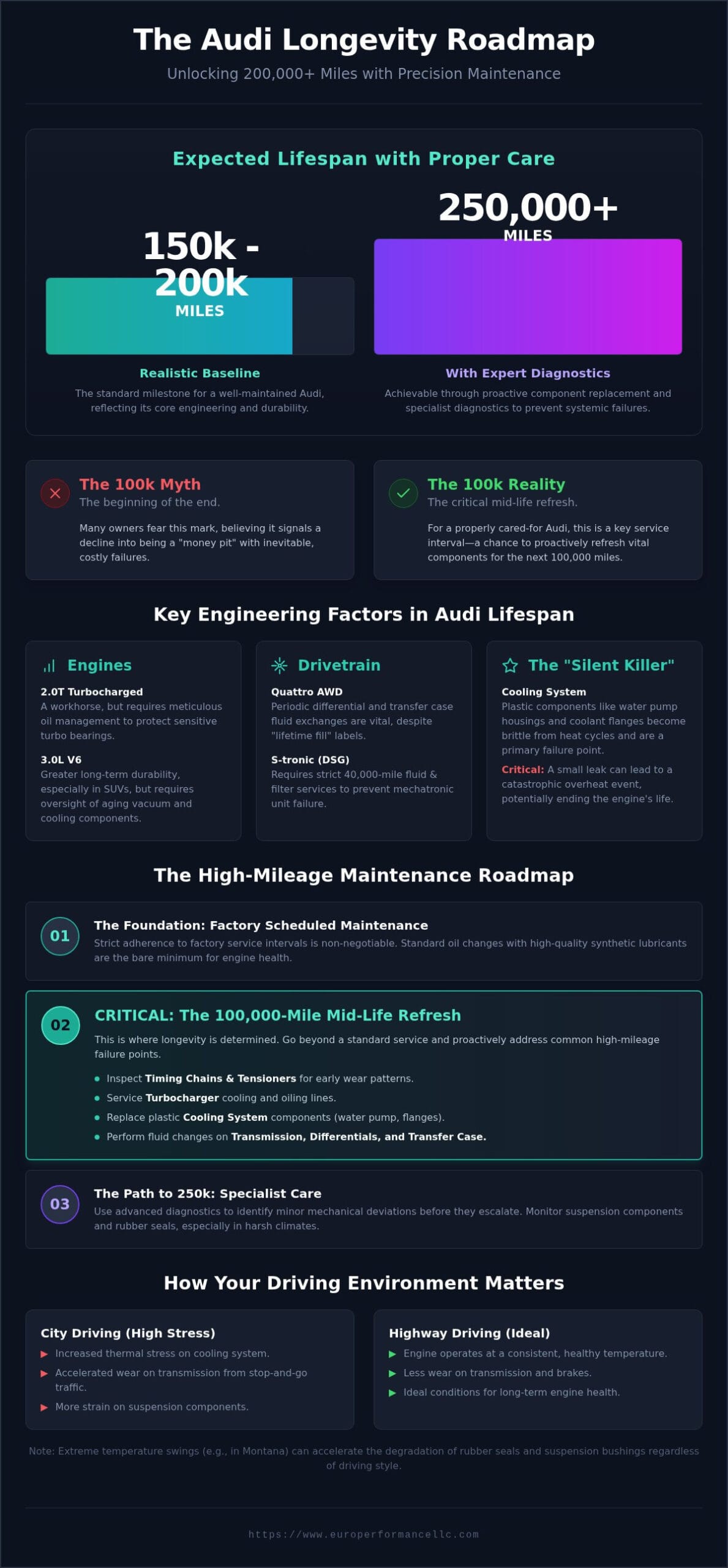
The question of how many miles do audi’s last is rarely answered by a single number. For most owners, the realistic baseline for a modern Audi sits between 150,000 and 200,000 miles. Reaching this range isn’t a matter of luck; it’s a reflection of the precision engineering inherent in the History of the Audi brand. While some vehicles struggle after the first decade, these machines are designed to sustain high performance levels as long as their complex systems are managed with professional expertise.
Longevity in a European vehicle means more than just a running engine. It defines the car’s ability to maintain its structural integrity, cabin refinement, and electronic accuracy over time. Many drivers still believe the 100,000-mile myth, fearing that luxury cars become “money pits” once the six-figure mark appears on the odometer. In reality, with the advent of advanced metallurgy and superior synthetic lubricants, an Audi at 100,000 miles is often just entering its prime years of service.
Your daily driving environment plays a significant role in determining the total odometer potential. Constant city driving in stop-and-go traffic increases thermal stress on the cooling system and accelerates wear on the transmission. Conversely, highway miles allow the engine to operate at a consistent temperature, which is ideal for long-term health. Owners in Belgrade, MT, must also account for extreme temperature swings that can impact rubber seals and suspension components.
The 150k vs. 250k Divide
The difference between an Audi that retires at 150,000 miles and one that powers through to 250,000 miles usually comes down to the quality of diagnostics. Specialized European auto repair involves more than just reacting to a check engine light. It requires using advanced diagnostic equipment to catch early wear patterns in timing chains, turbochargers, and fuel systems. Audi longevity is the direct result of a technician identifying and correcting minor mechanical deviations before they escalate into systemic failures. By using ASE-certified technicians who understand these specific platforms, you ensure that small issues don’t turn into catastrophic engine or transmission failures.
Why Year 2026 Models Are Built Differently
Newer generations of Audi vehicles utilize sophisticated engineering that changes the longevity equation. Modern models benefit from high-strength steel and aluminum alloys that reduce weight without sacrificing durability. Synthetic lubrication technology has also evolved, allowing for better protection of internal components even under the high heat generated by turbochargers. While turbocharging adds complexity and engine stress, current cooling and oiling systems are specifically designed to mitigate these factors. We see strong reliability trends in both the latest SUV models, like the Q5 and Q7, and the classic A4 and A6 sedans, provided they adhere strictly to Factory Scheduled Maintenance protocols.
Engineering Factors That Determine Audi Lifespan
Understanding the mechanical backbone of your vehicle is essential when evaluating how many miles do audi’s last. While Audi reliability ratings provide a statistical overview, the actual lifespan depends on the specific engineering choices under the hood. For instance, the 2.0T turbocharged engine is a workhorse found across the lineup, but it requires meticulous oil management to protect the turbo bearings. In contrast, the 3.0L V6 engine often displays greater long-term durability in heavy SUV applications, though its complex vacuum systems and cooling flanges require professional oversight as they age.
The Quattro all-wheel-drive system is a hallmark of the brand, but it introduces additional driveline components that require attention. Differentials and transfer cases are often labeled as “lifetime fill,” yet we find that periodic fluid exchanges are vital for preventing gear whine and mechanical binding past 150,000 miles. Transmission choice also dictates your long-term maintenance path. The Tiptronic automatic is known for robust longevity; however, the S-tronic Dual-Clutch (DSG) offers lightning-fast shifts but demands strict 40,000-mile fluid and filter services to avoid expensive mechatronic failures.
The cooling system remains the primary silent killer for high-mileage European cars. Plastic water pump housings and coolant flanges can become brittle due to thousands of heat cycles. A small leak often precedes a major overheat event, which can warp cylinder heads and end an engine’s life prematurely. Monitoring these components during Routine Maintenance is the most effective way to ensure your vehicle reaches its full potential. This proactive approach is what truly determines how many miles do audi’s last in real-world conditions.
The Timing Chain and Tensioner Evolution
Early iterations of the 2.0T engine suffered from timing chain tensioner failures that could lead to catastrophic engine damage. Audi has since updated these components with more robust designs, making the current systems much more reliable for the long haul. For older models, verifying the tensioner version is a critical safety step. Beyond the engine, maintaining the chassis is equally important. A specialized alignment shop ensures that your suspension geometry remains precise, preventing uneven tire wear and reducing stress on the Quattro system as the miles accumulate.
Direct Injection and Carbon Buildup
Direct injection technology improves fuel economy but leads to carbon deposits on the intake valves because fuel no longer “washes” them. Over 100,000 miles, this buildup can restrict airflow, causing rough idles and decreased power. Professional carbon cleaning, often performed via walnut blasting, restores engine efficiency and protects the catalytic converters from downstream damage. Using top-tier fuel and specialized OE-spec oil helps slow this process, ensuring the engine breathes clearly well past the 200,000-mile mark.
Comparing Longevity Across Popular Audi Models
Not all Audi models are created equal when it comes to long-term endurance. Determining how many miles do audi’s last often depends on the specific chassis and powertrain configuration you choose. For example, Audi crossovers like the Q7 and Q8 face unique challenges compared to their sedan counterparts. The added weight of a large SUV puts more stress on suspension bushings, tires, and wheel bearings. If you use your Q7 for towing, the transmission and cooling systems work significantly harder; this can shorten the vehicle’s lifespan if fluid service intervals aren’t shortened to compensate for the extra load.
High-performance S and RS models offer incredible power, but they involve a trade-off between performance and longevity. These engines operate at higher internal pressures and temperatures than standard models. While they are engineered with high-strength forged components, the sheer thermal stress can degrade plastic cooling pipes and rubber seals faster than in a standard A4 or A6. Enthusiasts often look back at “Golden Era” models from the early 2000s as the benchmark for 300,000-mile potential. These older vehicles featured simpler electronic architectures, which often makes them more cost-effective to keep on the road as they age.
The Reliability Leaderboard
Historical data suggests the A6 and Q5 remain among the most durable choices in the current lineup. The Q5 is a versatile crossover, but its suspension bushings and control arms tend to wear faster than those on the A4 sedan due to the higher center of gravity. High-mileage enthusiasts specifically seek out the 3.0T “Supercharged” V6 engine. This powerplant is revered for its robust construction and predictable wear patterns, often reaching 200,000 miles with few internal failures. Conversely, used A3 models can be risky if previous owners neglected the Haldex all-wheel-drive service or DSG transmission flushes, which are critical for preventing early driveline issues.
Engine-Specific Lifespans
The 2.0L TFSI engine is the workhorse of the modern Audi era. While it is capable of impressive mileage, it requires strict adherence to the Audi service schedule to prevent oil consumption and carbon buildup. For those seeking the ultimate distance, the TDI diesel engines remain the undisputed mileage kings. These powerplants are frequently seen exceeding 250,000 miles because of their heavy-duty internal components and efficient thermal management. Regardless of the engine type, your choice of oil and the frequency of its replacement remain the most significant factors in how many miles do audi’s last.
- Sedans (A4, A6): Generally lower stress on tires and suspension.
- SUVs (Q5, Q7): Higher weight requires more frequent brake and suspension inspections.
- Performance (S, RS): Requires specialized diagnostics to monitor high-pressure fuel systems and turbos.
- Diesels (TDI): Built for long-distance cruising and maximum odometer potential.
The 100k+ Mile Maintenance Strategy: Proactive Care
Entering the second decade of ownership requires a transition from basic upkeep to a specialized longevity strategy. Standard oil changes are the minimum requirement, but they don’t address the underlying wear on auxiliary systems that often dictates how many miles do audi’s last. To truly influence the lifespan of your vehicle, you must consider a mid-life refresh at the 100,000-mile mark. This involves replacing high-wear components like ignition coils, spark plugs, and the PCV system before they fail and cause secondary damage to the engine or catalytic converters.
Fluid management is the next pillar of high-mileage care. While some manufacturers suggest lifetime fluids for transmissions and differentials, our experience shows these lubricants break down over thousands of heat cycles. Performing a transmission fluid service and flushing the differential and brake systems every 40,000 to 60,000 miles prevents internal friction and corrosion. This methodical approach ensures the driveline remains as quiet and efficient as it was on day one, even as the odometer climbs toward 200,000 miles.
The Power of Factory Scheduled Maintenance
Following factory scheduled maintenance is the most effective way to prevent the cascading failure effect. For example, a worn-out cooling fan might seem minor, but if it fails during a summer climb, it can lead to an overheated engine and warped cylinder heads. Our ASE-certified technicians use advanced diagnostics to identify these subtle wear patterns early. We insist on using top OE manufacturer parts because high-mileage reliability depends on components that meet exact factory tolerances and material standards.
Suspension and Wheel Alignment
The signature Audi driving experience relies heavily on the integrity of the suspension and bushings. As rubber components age, they lose their elasticity, leading to vague steering and increased vibration. Precision wheel alignment preserves the drive shaft and differentials by ensuring the Quattro system isn’t fighting against improper geometry. When replacing suspension components, ADAS calibration is vital to ensure your safety sensors and driver-assist systems remain accurately aligned with the new chassis height. Maintaining these systems is what separates a car that feels old from one that feels timeless.
If you’re approaching the six-figure mark, it’s time to move beyond basic service and invest in a specialized technical evaluation. Schedule a comprehensive maintenance inspection to secure your vehicle’s performance for the next 100,000 miles.
Specialist Care in Belgrade, MT: Extending Your Audi’s Life
Montana’s environment presents unique challenges that directly influence how many miles do audi’s last. In Belgrade and Bozeman, vehicles endure extreme temperature swings that can drop well below zero, causing rubber seals and suspension bushings to become brittle and fail prematurely. Additionally, the heavy use of road salt during our long winters accelerates corrosion on undercarriage components and electrical sensors. At Euro Performance Auto Shop LLC, we’ve developed specific protocols to mitigate these regional factors, ensuring that local Audis aren’t just surviving the climate but thriving within it.
Choosing a specialist shop over a dealership is a strategic decision for long-term ownership. While dealerships are often geared toward the sales and service of newer models under warranty, our focus remains on the entire lifecycle of the vehicle. We believe that specialized repair is significantly more cost-effective than vehicle replacement. Our technicians utilize advanced diagnostics for complex engine functions to pinpoint issues that general shops might overlook. If you’re looking to enter the Audi family with a higher-mileage vehicle, a used car pre purchase inspection is an essential first step to identify potential concerns before they become expensive liabilities.
Local Expertise for European Performance
Our ASE certified team brings decades of combined experience to every service bay. We understand the nuances of high-mileage Audi engines, from the intricacies of the fuel system to the precise requirements of the Quattro drivetrain. By investing in the same high-level diagnostic technology used by the factory, we provide dealership-level accuracy without the associated “dealership premium.” This allows Bozeman and Belgrade owners to maintain their vehicles to the highest professional standards while managing their long-term maintenance budget effectively.
Your Roadmap to 200,000 Miles
We don’t believe in one-size-fits-all maintenance. Instead, we create customized plans based on your specific Audi model, its current mileage, and your driving habits in the Gallatin Valley. As a local european performance specialist, we prioritize the use of top OE manufacturer parts to ensure every repair meets the original engineering standards. This commitment to quality is what ultimately determines how many miles do audi’s last in our demanding Montana environment.
Take the first step toward securing your vehicle’s future on the road. Schedule your high-mileage health check with Euro Performance Auto Shop LLC today and let our master craftsmen provide the technical precision your Audi deserves.
Securing Your Audi’s 200,000-Mile Future
Reaching the double-century mark on your odometer isn’t a matter of chance; it’s the result of technical precision and specialized oversight. We’ve explored how the intersection of engine architecture, fluid management, and climate-specific care dictates the long-term potential of your vehicle. The fundamental answer to how many miles do audi’s last lies in moving beyond reactive repairs and embracing a philosophy of proactive preservation. By replacing high-wear components before they fail and adhering to factory scheduled maintenance, you protect the high-level engineering that makes your car unique.
In the Gallatin Valley, your vehicle requires a partner that understands the specific stresses of mountain driving and winter road conditions. Our ASE Certified Technicians utilize specialized European diagnostic tools and high-quality OE manufacturer parts to ensure every system operates within factory tolerances. Choosing specialized care is an investment in your car’s future that far outweighs the cost of premature replacement.
Schedule Your Audi Longevity Inspection at Euro Performance Auto Shop LLC to secure your path to 200,000 miles and beyond. Let’s ensure your Audi continues to deliver the refinement and performance you expect for the long haul.
Frequently Asked Questions
Is an Audi expensive to maintain after 100,000 miles?
Maintenance costs climb after 100,000 miles because major service items like cooling components and suspension bushings reach the end of their service life. While specialized European repair requires a higher initial investment in OE parts, it remains significantly more affordable than the monthly payments on a new vehicle. Proactive care prevents the catastrophic failures that drive up long-term ownership costs.
What is the most reliable Audi engine for high mileage?
The 3.0T supercharged V6 and the TDI diesel engines are widely considered the most reliable choices for high-mileage endurance. These powerplants feature robust internal components that handle thermal stress better than smaller, highly-strung four-cylinder engines. Owners frequently report these engines reaching 200,000 miles without requiring internal mechanical overhauls, provided they follow strict maintenance protocols.
How often should I change my Audi’s oil to make it last 200,000 miles?
You should change your oil every 5,000 to 7,500 miles using high-quality synthetic lubricants that meet factory specifications to reach 200,000 miles. While the manufacturer might suggest 10,000-mile intervals, shorter windows provide better protection against carbon buildup and timing chain wear. This simple habit is the most effective way to influence how many miles do audi’s last over the long term.
Do Audis have transmission problems at high mileage?
Transmission issues at high mileage are typically the result of neglected fluid services rather than inherent design flaws. The S-tronic dual-clutch transmission requires fluid and filter changes every 40,000 miles to prevent mechatronic failure. If these services are performed on schedule, the transmission should remain smooth and responsive well past the 150,000-mile mark.
Can an Audi last 300,000 miles?
An Audi can certainly reach 300,000 miles, though this requires a commitment to replacing major wear items before they fail. You will likely need to refresh the cooling system, replace timing chain tensioners, and overhaul suspension components at least once during this journey. Meticulous record-keeping and specialized diagnostics are the keys to maintaining a vehicle for three decades or more.
What are the warning signs that my Audi’s engine is reaching its limit?
Warning signs of a failing engine include excessive oil consumption, blue or white exhaust smoke, and persistent metallic rattling during cold starts. A significant drop in fuel economy or a loss of power can also indicate internal wear or compression issues. If you notice metal shavings in your oil during a routine change, it is a critical sign that internal components are degrading.
Is it worth buying a used Audi with 120,000 miles?
Buying a used Audi with 120,000 miles is a viable option if the vehicle has a documented history of Factory Scheduled Maintenance. You should prioritize cars that have already had their mid-life refresh items addressed, such as the water pump and timing components. Always perform a used car pre-purchase inspection to verify the current health of the engine and Quattro system.
If you are broadening your search to include other dependable brands, a reputable dealership like Edwards Chevrolet 280 can be an excellent resource for finding well-maintained vehicles built for the long haul.
Does Montana’s cold weather affect Audi longevity?
Montana’s extreme cold accelerates the degradation of rubber seals and suspension bushings, making them brittle and prone to cracking. Road salt used in Belgrade and Bozeman also increases the risk of corrosion on brake lines and electronic sensors. Using a specialized shop that understands these local impacts is vital for preserving your vehicle’s structural and mechanical integrity.