
Blog

The $4,000 repair bill sitting on your dashboard might actually be the most fiscally responsible decision you make this year. As of May 2026, the cost of used vehicles in the Gallatin Valley remains significantly inflated, making you ask: is it worth fixing an old audi in bozeman? You likely feel the weight of sticker shock from specialized European parts and the anxiety of whether your high-mileage Quattro will reliably start during a sub-zero January morning. We understand that hesitation. It’s often a choice between a known machine and a mystery used car that could inherit even more expensive problems.
If the rising cost of European parts makes you consider a transition to domestic reliability, Pearl Motor Company illustrates how modern Chevrolet and GMC vehicles provide advanced safety and technology with more accessible maintenance schedules.
Our team of ASE certified technicians wants to provide you with a clear mechanical framework to determine if your Audi is a reliable investment or a mounting liability. With Bozeman labor rates averaging $150 per hour and Audi’s national reliability rating holding at 3.0 out of 5.0, you need objective data to make an informed choice. This guide explores the difference between essential safety investments and temporary patches. You’ll learn how to evaluate your car’s winter readiness and decide if keeping your current European vehicle is the safest path for your wallet and your peace of mind.
Key Takeaways
- Learn how to apply the 50% rule and compare one-time repair costs against a year of new car payments to determine your vehicle’s true financial value.
- Use our mechanical and financial framework to answer the question: is it worth fixing an old audi in bozeman when compared to the rising costs of the local used car market?
- Understand the critical difference between routine maintenance milestones and major system failures that could signal it is time to move on.
- Discover a strategic approach to prioritizing safety-critical repairs like steering and brakes to keep your vehicle winter-ready without overspending.
- Identify how utilizing ASE-certified technicians and OE manufacturers’ parts ensures your repairs are long-term investments rather than temporary fixes.
The Repair vs. Replace Framework: Is Your Audi Still an Asset?
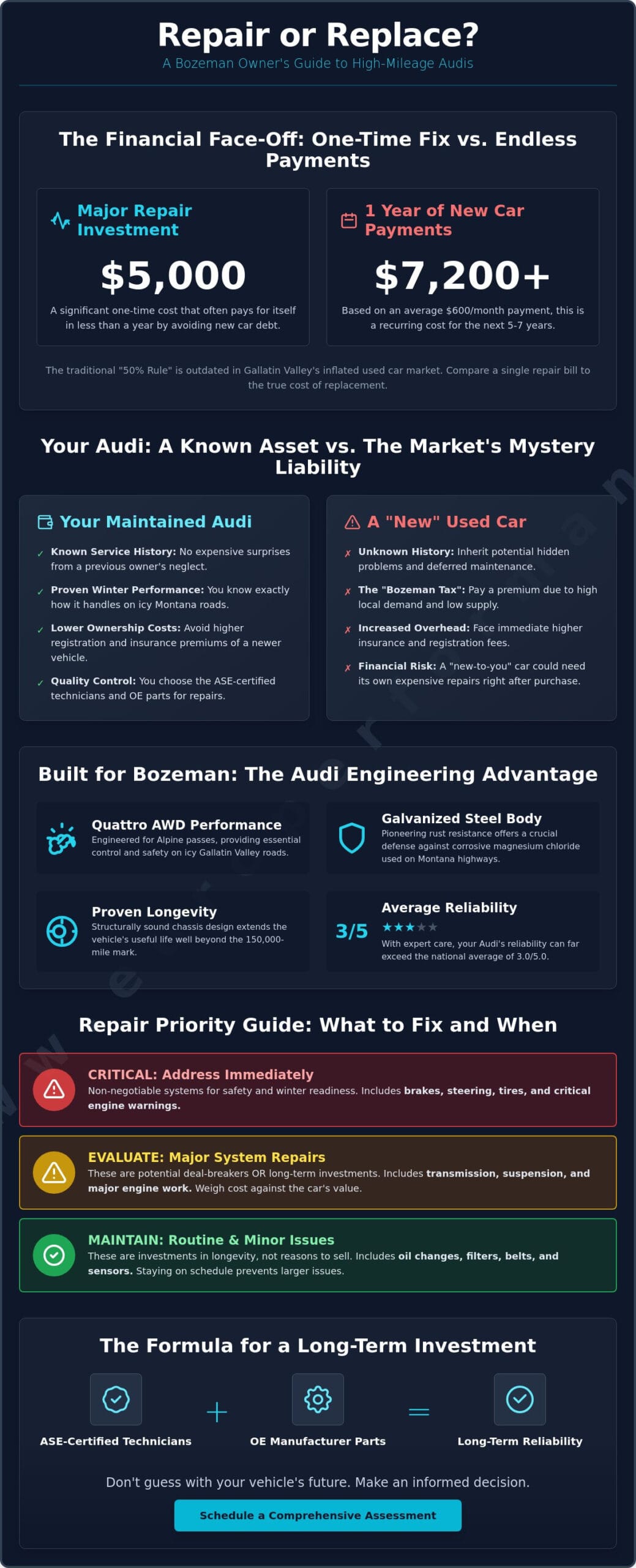
Deciding whether to keep your vehicle often comes down to the 50% rule. This traditional metric suggests that if a single repair estimate exceeds half of the car’s current market value, you should consider a replacement. However, when asking if is it worth fixing an old audi in bozeman, this calculation is more complex in 2026. You must weigh a one-time mechanical investment against the reality of 12 months of new car payments. With average new car payments now frequently exceeding $600 per month, a $5,000 repair often pays for itself in less than a year.
To better understand the financial logic behind keeping a premium German vehicle, watch this helpful video:
Your current Audi is a known entity. You know its service history, its quirks, and exactly how it handles on icy Montana roads. While Audi holds a reliability rating of 3.0 out of 5.0 according to RepairPal data, a car you’ve maintained is always safer than a stranger’s neglected trade-in. Repairing your vehicle allows you to maintain control over the quality of parts and labor. It’s your vehicle, and your right to repair ensures you can choose specialists who understand high-performance engineering.
Calculating the Total Cost of Ownership (TCO)
Newer cars come with hidden expenses that go beyond the monthly payment. Registration fees in Montana for brand-new luxury vehicles often exceed those of older models by hundreds of dollars. Insurance premiums also jump significantly when moving from a paid-off vehicle to one with a lien. You should amortize the total cost of any major mechanical work over the next 24 months to see the true monthly impact on your budget. Investing in expert European auto repair ensures these costs translate into long-term reliability rather than temporary fixes.
The Bozeman Used Car Market Reality
Used car prices in the Gallatin Valley stay higher than national averages because demand consistently outstrips supply. This local inflation makes people wonder: is it worth fixing an old audi in bozeman, or should they risk the “Bozeman tax” on a different vehicle? Buying a used car here often means paying a premium for a “mystery” vehicle with no documented history. Your own maintenance records are your biggest financial leverage; a well-maintained Audi has significantly more life left than a stranger’s neglected trade-in.
The Montana Factor: Why Audis Are Worth the Extra Effort
In the Gallatin Valley, a vehicle is more than a status symbol; it’s a critical tool for navigating eight months of winter. While national reliability rankings offer a broad perspective, they often fail to account for the specific environmental demands of the Northern Rockies. When considering is it worth fixing an old audi in bozeman, you must evaluate the car’s ability to handle extreme cold and corrosive road chemicals. Audis were engineered for the German Autobahn and Alpine passes, making their foundational architecture uniquely suited for Montana’s rugged terrain.
One primary reason these vehicles remain relevant is their resistance to the magnesium chloride used on I-90 and local canyon roads. Audi pioneered the use of fully galvanized steel bodies in the 1980s. This zinc coating provides a chemical barrier that most domestic and many Asian manufacturers didn’t adopt as comprehensively until much later. Even a decade-old Audi chassis often remains structurally sound and free of the terminal frame rot that claims other vehicles in our climate. This longevity helps lower the total cost of ownership by extending the vehicle’s useful life well beyond the 150,000-mile mark.
Quattro Performance in the Gallatin Valley
The Quattro all-wheel-drive system remains a gold standard for safety on the drive to Big Sky or Bridger Bowl. Unlike many modern crossovers that use electronic slip-based systems to “react” to a loss of traction, many Audi models utilize a mechanical center differential. This provides proactive power distribution that feels more stable on packed snow and ice. Maintaining this driveline is essential for safety. Ensuring a precision wheel alignment is particularly vital for winter traction, as even a slight deviation can compromise how the Quattro system translates power to the road surface.
Chassis and Body Longevity
An older Audi’s build quality often surpasses that of a brand-new budget car. The heavy-duty suspension components and thick interior materials are designed to withstand the vibrations of washboard gravel roads and extreme temperature swings. Audi’s paint and trim durability are also exceptional; the clear coats are specifically formulated to resist the high-UV environment found at our 4,793-foot elevation. This physical resilience means that once mechanical repairs are completed, the car still looks and feels like a premium machine. If you’re unsure about your vehicle’s current mechanical state, our ASE certified technicians can perform a comprehensive inspection to identify which components are worth the investment.
Maintaining that premium finish after an accident requires a shop dedicated to factory-standard paint matching and structural repair; for an example of professional collision and glass service standards, click here.
Cold-start reliability is another factor that justifies the “Bozeman tax” on European repairs. When temperatures drop to 20 degrees below zero, an Audi equipped with an OE-standard battery and high-torque starter is more likely to turn over than a vehicle using generic aftermarket parts. This reliability is exactly why well-maintained Audis sell so quickly in the Bozeman market. Buyers here understand that a car capable of handling a Montana winter is worth a premium price, making your repair investment much easier to recoup if you eventually decide to sell.
Common High-Mileage Audi Repairs: ‘Deal-Breakers’ vs. ‘Maintenance’
The 100,000-mile milestone often triggers anxiety for European car owners, but not every repair at this stage is a sign of a dying vehicle. When asking is it worth fixing an old audi in bozeman, you must separate ‘Wear Items’ from ‘System Failures.’ Wear items like brakes, tires, and spark plugs are expected expenses in any vehicle’s lifecycle. System failures, such as a failing turbocharger or a slipping transmission, are the true ‘deal-breakers’ that require a deeper financial analysis. Following a structured Audi service schedule ensures you’re addressing these needs proactively rather than reacting to a breakdown on a remote mountain pass.
According to government data on vehicle costs, maintenance and repairs are a standard part of vehicle ownership, but they shouldn’t be unpredictable. For a high-mileage Audi, certain repairs act as ‘life insurance’ for the engine. Timing belt and water pump replacements are non-negotiable at specific intervals. If these components fail, they often cause catastrophic internal engine damage that far exceeds the car’s value. Conversely, minor oil leaks from valve cover gaskets might be unsightly, but they can often wait until your next major service if they aren’t dripping onto hot exhaust components.
The ‘Big Three’ Audi Repairs
Success with an older Audi depends on three critical systems. First, the timing belt or chain tensioners must be in top condition. Ignoring these leads to bent valves and a dead engine. Second, suspension bushings are vital for maintaining the precision handling these cars are known for. Montana’s frost heaves and gravel roads punish rubber components, and replacing them restores the car’s original safety profile. Third, the cooling system relies on plastic flanges and housings that become brittle over time. We exclusively use parts from OE manufacturers because generic plastic components often fail within a single season of Montana’s extreme temperature swings.
Diagnostic Accuracy: Avoiding ‘Part-Hanging’
Many generic shops fall into the trap of ‘part-hanging,’ which means replacing sensors until the problem disappears. This is an expensive and inefficient way to maintain a European vehicle. Our ASE certified technicians use advanced electronic diagnosis to find the root cause of a fault code the first time. This precision is especially critical for safety systems. For example, ADAS calibration is vital if you’ve recently replaced suspension components or a windshield. Without proper calibration, your Audi’s safety sensors won’t accurately detect hazards, making the car less reliable for winter driving.
How to Prioritize Repairs to Keep Costs Manageable
Facing a comprehensive list of suggested repairs can feel daunting. However, you don’t have to address every single item on the same day to keep your vehicle on the road. When determining if is it worth fixing an old audi in bozeman, the secret lies in strategic prioritization. By categorizing repairs into immediate safety needs and long-term mechanical preservation, you can transform a single large bill into a manageable maintenance roadmap that fits your budget over six to 12 months.
Safety-critical components remain your highest priority. Brakes, steering linkage, and tires are non-negotiable items that directly impact your ability to navigate Bozeman’s challenging winter conditions. Once the vehicle is safe to operate, your focus should shift to core engine health. This includes the cooling system, timing components, and fluid integrity. Addressing these preventatively is the only way to avoid a “dead” car scenario that forces a premature replacement decision during a Montana cold snap.
Many owners find that a professional used car pre-purchase inspection is a valuable tool even for a car they’ve owned for years. This deep-dive evaluation provides an objective baseline of your vehicle’s current health. It allows our ASE certified technicians to identify which issues are urgent and which are merely cosmetic, giving you the clarity needed to decide your next steps without the pressure of a sudden breakdown.
Creating a 12-Month Maintenance Roadmap
Euro Performance Auto Shop LLC helps owners triage their repair lists based on mechanical urgency and budget constraints. We often recommend grouping related repairs to maximize your investment. For instance, replacing the water pump while the timing belt is already removed saves hours of redundant labor. Many Audi models require the “service position,” where the front bumper and radiator support are moved forward; performing multiple repairs during this single procedure is the most efficient way to lower your total service costs by avoiding repeated disassembly fees.
Preventative vs. Reactive Maintenance
Sticking to factory scheduled maintenance is the most effective way to prevent the “cascading failure” effect, where one worn part causes three others to fail. The cost difference is stark. A routine oil change in Bozeman is a fraction of the price of an engine rebuild caused by oil sludge or a failed tensioner. We always advocate for parts from OE manufacturers because they meet the precise engineering standards required for your Audi’s complex systems. If you’re ready to create a long-term plan for your vehicle’s health, schedule a comprehensive digital inspection with our specialized team today.
Euro Performance Auto Shop LLC: Your Partner in Audi Longevity
The decision regarding your vehicle’s future relies on the technical proficiency of your service team. When you ask if is it worth fixing an old audi in bozeman, the answer depends on whether those repairs are executed with surgical precision. Our ASE certified technicians function as specialized master craftsmen for your vehicle. We look beyond basic fault codes to identify the mechanical root causes that generalist shops often overlook. This level of technical proficiency ensures that every dollar you invest translates into measurable reliability on Montana roads.
Quality control is the cornerstone of our service philosophy. We maintain a strict commitment to using components from OE manufacturers. While generic aftermarket parts might offer a lower initial price point, they frequently fail prematurely under the stress of our extreme temperature fluctuations. Using original equipment ensures that your Audi’s complex systems, from the turbocharger to the Quattro driveline, operate exactly as the factory intended. This dedication to quality parts is what allows us to transform a high-mileage vehicle from a source of anxiety into a dependable tool for mountain living.
Transparency is vital to building long-term trust. We utilize a structured three-step process: Schedule, Estimate, and Repair. This sequence demystifies the customer journey and eliminates the “sticker shock” often associated with high-performance car ownership. You’ll receive a detailed digital inspection report that triages your vehicle’s needs. This methodical approach allows you to make financial decisions based on facts rather than guesswork. We help you maximize your vehicle’s lifespan by focusing on the repairs that offer the greatest return on safety and performance.
Expertise You Can Trust in Belgrade
Choosing a specialized shop provides a significant advantage over high-priced dealerships or general repair facilities. We possess the specific diagnostic software and specialized tools required for advanced Audi systems. We stand behind our craftsmanship with a 2-year/24,000-mile warranty on most repairs. Our location in Belgrade makes premium European service accessible to the entire Gallatin Valley. We offer a professional alternative that prioritizes your car’s longevity over high-volume turnover.
Ready to Evaluate Your Audi?
Ultimate peace of mind comes from knowing exactly where your vehicle stands. Whether you’re planning a trip over Bozeman Pass or simply commuting to work in January, you deserve confidence in your car’s mechanical integrity. A comprehensive health check is the first step in determining if your current vehicle is worth the continued investment. Don’t leave your winter safety to chance. Schedule your Audi diagnostic at Euro Performance Auto Shop LLC today! and let our experts provide the clarity you need to stay on the road.
Secure Your Vehicle’s Reliability for the Seasons Ahead
The decision to maintain your high-mileage German vehicle involves more than just a repair bill; it’s about securing a reliable tool for the Montana landscape. We’ve established that in the 2026 Gallatin Valley market, the gap between repair costs and the price of a “mystery” used car has never been wider. By applying the 50% rule and prioritizing safety-critical systems, you can preserve the value of your Quattro’s galvanized chassis and winter-ready engineering. Ultimately, determining if is it worth fixing an old audi in bozeman comes down to having a clear mechanical roadmap provided by experts who understand European performance.
Euro Performance Auto Shop LLC is here to provide that clarity. Our ASE Certified Technicians utilize specialized Audi diagnostic tools and OE manufacturer parts to ensure every service is a long-term investment. Located in Belgrade, we serve the entire Gallatin Valley with the technical proficiency your car deserves. Don’t let mechanical uncertainty affect your safety on I-90 or local canyon roads. Book Your Audi Diagnostic at Euro Performance Auto Shop LLC to receive a professional evaluation and drive with total confidence.
Frequently Asked Questions
Is it worth fixing an Audi with over 150,000 miles?
Determining if is it worth fixing an old audi in bozeman at 150,000 miles depends on the vehicle’s structural integrity and previous maintenance records. If the chassis is free of terminal rust and the engine has received consistent oil changes, a major repair is often more economical than buying a replacement in the current local market. We recommend a comprehensive health check to identify any potential deal-breakers before you invest in high-mileage repairs.
What are the most expensive Audi repairs to watch out for?
The most costly Audi repairs typically involve the transmission, turbochargers, or internal engine components caused by timing chain failure. Replacing a Quattro transmission or a set of twin turbochargers can reach several thousand dollars in parts and labor. These are considered system failures rather than routine maintenance. Our technicians use specialized diagnostic tools to catch early signs of wear in these systems, potentially saving you from a total component replacement.
Can I take my Audi to a regular mechanic in Bozeman?
You can take your vehicle to a generalist, but determining if is it worth fixing an old audi in bozeman often requires the precision of specialized European tools. Generalist shops may lack the advanced electronic diagnosis equipment needed to communicate with Audi’s proprietary software. Our ASE certified technicians focus exclusively on European engineering, ensuring that complex repairs are performed correctly the first time without the added cost of unnecessary part-hanging.
How much should I budget for annual maintenance on an old Audi?
Audi owners should budget approximately $987 per year for maintenance, according to national RepairPal data for 2026. This figure covers routine items like factory scheduled maintenance and brake service. In the Gallatin Valley, you should account for additional costs related to extreme weather. This includes specialized winter fluids and more frequent battery testing to ensure your car remains reliable when temperatures drop well below zero.
Does a flashing check engine light mean my Audi is totaled?
A flashing check engine light does not mean your car is totaled, but it does indicate a critical mechanical emergency. We strongly recommend that you DO NOT DRIVE your vehicle if the light is flashing. This signal signifies a severe engine misfire that can cause immediate, permanent damage to your catalytic converter and internal engine components. Stop the car safely and have it towed to a specialized facility for an immediate electronic diagnosis.
Why are Audi parts more expensive than Ford or Chevy parts?
Audi parts command a premium because of their high-tolerance engineering and the specialized materials used in their construction. European manufacturers often use complex alloys and integrated electronics that aren’t found in domestic economy vehicles. Many of these components are sourced directly from OE manufacturers to ensure they meet the exact performance specifications of your vehicle. This precision engineering is what provides the superior handling and safety Audis are known for.
Should I use aftermarket parts to save money on my Audi repair?
We strongly advise against using generic aftermarket parts for critical engine, cooling, or safety systems. While generic parts may cost less initially, they often lack the precise fit and heat resistance required for European engines. Using components from OE manufacturers ensures that the repair lasts as long as the original part. Choosing low-quality alternatives often leads to premature failure, which doubles your labor costs over the long run.
How do Montana winters affect the lifespan of an Audi?
Montana winters accelerate wear on rubber suspension bushings and lead-acid batteries due to extreme temperature swings. Temperatures reaching 20 degrees below zero can reduce a battery’s cranking power by 50%, while frost heaves on local roads punish your vehicle’s steering components. Regular maintenance helps identify these cold-weather vulnerabilities. Addressing small issues like brittle cooling flanges before winter begins prevents them from becoming catastrophic failures during a blizzard.