
Blog
Your European car’s AC isn’t just a cooling system — it’s a precision climate computer, and treating it like one makes all the difference. If you’ve been sitting in a sweltering BMW or Audi on a dusty Gallatin Valley road, watching the temperature gauge climb while warm air pours from the vents, you already know that something is wrong. What you may not know is that the fix requires far more than a refrigerant top-off from a generic shop.
That frustration is completely valid. Bozeman dealerships are often overbooked and expensive, and most general repair shops simply don’t have the diagnostic software to communicate with the layered sensor networks inside a modern European climate control system. Guesswork isn’t a strategy when you’re dealing with precision German engineering.
This guide covers everything you need to know about European auto AC repair in Belgrade, MT: why these systems fail, what accurate diagnosis actually looks like, and how a specialist approach restores ice-cold, reliable cooling built to handle mountain driving. If you want your car fixed correctly the first time, read on.
Key Takeaways
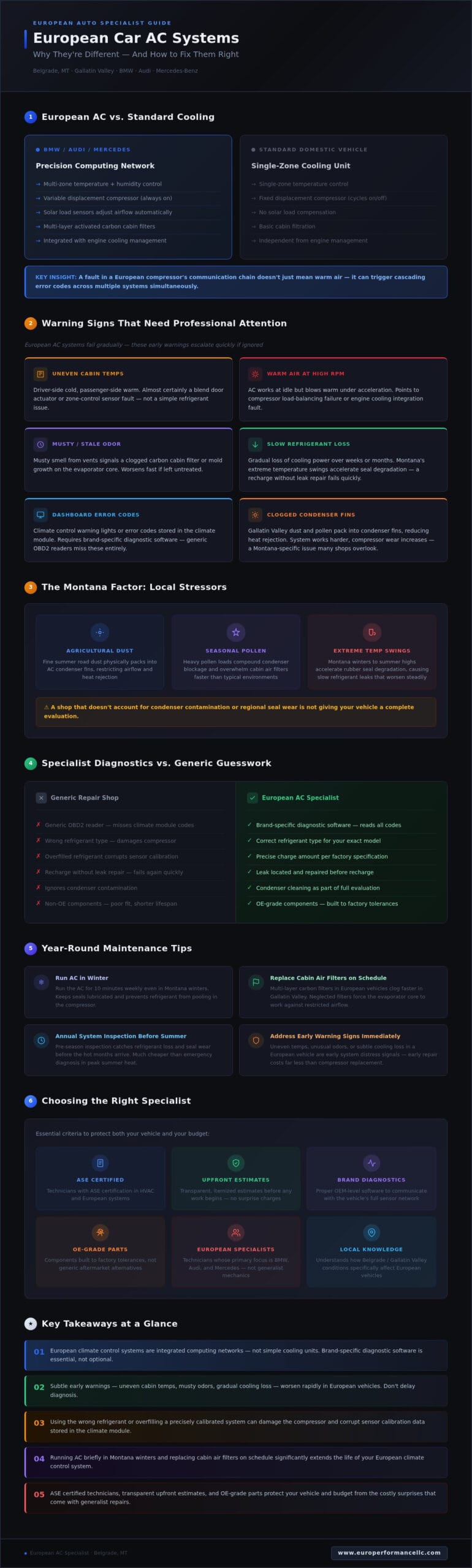
- European climate control systems are integrated computing networks — not simple cooling units — which is why brand-specific diagnostic software is essential for accurate repair rather than guesswork.
- Seeking European auto AC repair in Belgrade, MT from a specialist means access to the correct refrigerant type, OE-grade components, and the advanced tools required to communicate with your vehicle’s layered sensor network.
- Subtle warning signs like uneven cabin temperatures or a musty odor from the vents are early indicators of system failure that worsen quickly if left unaddressed in European vehicles.
- Simple year-round habits — like running your AC during Montana winters and replacing cabin air filters on schedule — can significantly extend the life of your European climate control system.
- Choosing a specialist with ASE certified technicians and transparent, upfront estimates protects both your vehicle and your budget from the costly surprises that come with generalist repairs.
Why European Climate Control Systems Are Different
Open the hood of a BMW 5 Series or an Audi A6 and you’re looking at far more than a compressor and a few refrigerant lines. European climate control systems are fully integrated computing networks. They manage cabin temperature, humidity levels, air quality, and airflow distribution simultaneously, pulling data from multiple sensors to make constant micro-adjustments. That’s a fundamentally different architecture than the single-zone cooling units found in most domestic vehicles, and it demands a fundamentally different approach to diagnosis and repair.
One component that illustrates this gap clearly is the variable displacement compressor, standard across most modern BMW and Audi platforms. Unlike a fixed-displacement unit that cycles on and off, a variable displacement compressor continuously adjusts its output based on real-time cooling demand. The result is smoother performance and better fuel efficiency, but it also means the compressor is in constant communication with the engine control module. A fault in that communication chain doesn’t just mean warm air; it can trigger cascading error codes across multiple systems.
European manufacturers also prioritize cabin air filtration at a level that most domestic counterparts don’t match. Multi-layer activated carbon cabin filters are standard equipment on most Mercedes-Benz, BMW, and Audi models, designed to trap fine particulates, allergens, and volatile organic compounds. These filters serve a dual purpose: protecting passenger health and maintaining clean airflow through the evaporator core. When they’re neglected, the entire system pays the price.
Precision Engineering vs. Standard Cooling
European climate systems integrate solar load sensors, typically mounted on the dashboard, that detect the angle and intensity of sunlight hitting the cabin. The system uses that data to independently adjust driver and passenger-side airflow without any manual input. On high-performance models, the AC system is also integrated with engine cooling management, meaning the compressor load is actively balanced against coolant temperature under hard acceleration. This level of integration is why a generic refrigerant recharge kit from an auto parts store is genuinely risky on these vehicles. Overfilling a system calibrated for a precise refrigerant charge, or using the wrong refrigerant type entirely, can damage the compressor and corrupt sensor calibration data stored in the climate control module.
The Montana Factor: Dust, Pollen, and Condensers
Belgrade and the broader Gallatin Valley present a specific environmental challenge that most AC guides completely overlook. Summer road conditions here mean fine agricultural dust and seasonal pollen loads that physically pack into AC condenser fins, restricting airflow and forcing the system to work harder to reject heat. Older European vehicles with original rubber seals are particularly vulnerable: the dramatic temperature swings between Montana winters and summer highs accelerate seal degradation, leading to slow refrigerant leaks that worsen steadily over time.
For anyone seeking European auto AC repair in Belgrade, MT, understanding these local stressors is the starting point for a proper diagnosis. A shop that doesn’t account for condenser contamination or regional seal wear isn’t giving your vehicle a complete evaluation.
This is exactly where a specialist approach to European auto AC repair in Belgrade, MT separates itself from a generic recharge service. Identifying the specific failure point, whether it’s a clogged condenser, a degraded seal, or a compressor communication fault, requires both the right diagnostic software and an understanding of how Montana’s climate interacts with precision European engineering.
Common Signs Your European AC Needs Professional Repair
Most AC problems announce themselves gradually. A BMW or Audi rarely goes from perfectly cold to completely broken overnight. Instead, the system sends early warnings that are easy to dismiss or misattribute, right up until they become expensive. Knowing what to look for can be the difference between a straightforward repair and a compressor replacement.
Four patterns consistently indicate that your European climate system needs professional attention:
- Inconsistent cabin temperatures: If the driver’s side is blowing cold air while the passenger side stays warm, the problem is almost certainly not a simple refrigerant issue. Dual-zone European systems rely on independent blend door actuators and zone-specific temperature sensors. When one fails, the system can’t distribute conditioned air correctly. This is a diagnostic fault, not a recharge candidate.
- Musty odor from the vents: European evaporator housings are tightly packaged for aerodynamic and packaging reasons, which makes them prone to bacterial and mold accumulation when condensate doesn’t drain properly. That musty smell isn’t just unpleasant; it’s a sign of biological growth inside the HVAC box that will worsen with time.
- Rapid compressor cycling: If you can hear the compressor clicking on and off in short bursts rather than running steadily, the system is likely responding to abnormal pressure readings. Low refrigerant, a failing pressure sensor, or a partially blocked expansion valve can all trigger this behavior. Each cycle adds wear to the compressor clutch.
- Climate control screen glitches: A flickering display or unresponsive climate control panel on a Mercedes-Benz or Audi isn’t a cosmetic problem. These interfaces communicate directly with the HVAC control module, and electronic faults here can prevent the system from executing commands at all.
Decoding Unusual Noises and Smells
Sound is one of the most reliable diagnostic inputs a technician has. A hissing noise near the dashboard or firewall often points to a refrigerant leak at the evaporator core, a repair that requires dashboard disassembly on most European platforms. Grinding or squealing from the engine bay needs to be distinguished carefully: belt-related noise typically changes with engine RPM, while internal compressor failure produces a more consistent grinding that persists regardless of belt load. A damp or “wet carpet” smell, distinct from the musty evaporator odor, usually means a clogged condensate drain line is allowing water to pool in the cabin floor. Left unaddressed, that moisture creates conditions for mold growth and can damage interior electronics.
When the Check Engine Light Affects Your AC
This is a connection that catches many drivers off guard. Modern BMWs are programmed to disable the AC compressor as a protective measure when coolant temperatures rise toward a critical threshold. The logic is straightforward: eliminating compressor load reduces strain on the engine during a thermal event. So if your AC suddenly stops working and the check engine light is on, the AC itself may be functioning perfectly. The real problem could be a failing cooling fan, a stuck thermostat, or a coolant leak that the engine management system is responding to. Reaching for a can of refrigerant in that scenario accomplishes nothing and delays finding the actual fault.
A professional diagnostic scan is always the correct first step. For anyone seeking European auto AC repair in Belgrade, MT, that means connecting to the vehicle’s full module network, not just reading generic OBD-II codes. The ASE certified technicians at Euro Performance LLC use advanced diagnostic technology specifically calibrated for BMW, Audi, and Mercedes-Benz systems, so the root cause gets identified before any parts are ordered.
The Specialist’s Advantage: Diagnostics vs. Guesswork
There’s a meaningful difference between a shop that services AC systems and one that understands European AC systems. That difference lives entirely in the tools, the parts, and the training behind the repair. When a technician connects a generic OBD-II scanner to a BMW or Audi, they’re seeing a fraction of the data the vehicle is actually generating. Brand-specific diagnostic software, the kind calibrated for BMW, Audi, and Mercedes-Benz architectures, communicates directly with the climate control module, the compressor control unit, and the zone sensor network simultaneously. That’s what separates a confirmed diagnosis from an educated guess.
The refrigerant question is equally critical. Older European models use R-134a, but the specification matters beyond just the type: the system charge weight is precise, often to within a few grams, and overfilling causes pressure spikes that damage expansion valves and compressor seals. Using a “universal” refrigerant blend instead of the specified type introduces incompatible lubricant carriers and can contaminate the entire circuit, turning a minor leak repair into a full system flush.
Component quality follows the same logic. European compressors operate at higher internal pressures and tighter tolerances than most domestic counterparts. A low-cost aftermarket compressor that isn’t built to OE specifications will often fail within a season, not because compressors are inherently fragile, but because the replacement wasn’t engineered for the load demands of that specific system. OE-grade parts sourced from the same suppliers the manufacturers use are the only reliable long-term solution.
Leak detection methodology also separates specialist work from generic service. A basic pressure gauge check tells a technician whether the system holds pressure. A proper vacuum leak test, where the system is evacuated and held under vacuum for a measured period, confirms that every seal, fitting, and weld point is airtight before refrigerant is ever introduced. That step isn’t optional on a precision European system; it’s the foundation of a repair that actually lasts.
Why Generic Shops Often Struggle with Euro AC
Two technical details consistently trip up non-specialist shops. First, European compressors often require POE (polyolester) oil rather than the PAG (polyalkylene glycol) oil used in most domestic systems. Mixing them degrades lubrication and accelerates compressor wear. Second, European wiring diagrams are layered and system-specific; a technician without brand-specific training may misread a sensor fault as a compressor fault, replacing the wrong component entirely. ASE certified technicians with European specialization read those diagrams correctly from the start.
R-1234yf: The New Standard for Modern European Vehicles
Newer European models have transitioned to R-1234yf refrigerant, a lower global-warming-potential refrigerant that requires dedicated recovery and recharge equipment. This machinery isn’t interchangeable with R-134a equipment; using the wrong recovery machine cross-contaminates refrigerant supplies and violates EPA handling standards. For anyone seeking European auto AC repair in Belgrade, MT, confirming that your shop has the correct R-1234yf recovery equipment for your model year is a straightforward but essential question. The ASE certified technicians at Euro Performance LLC use advanced diagnostic technology built for the specific demands of BMW, Audi, and Mercedes-Benz systems, ensuring your vehicle is serviced to the standard its engineering requires.
Maintenance Tips to Protect Your European AC System
Prevention is always cheaper than repair. For European vehicles driven in Montana’s climate, a handful of consistent habits can add years to your AC system’s life and keep you out of the shop during the hottest stretch of summer. None of these practices are complicated, but each one targets a specific failure point that’s common to BMW, Audi, and Mercedes-Benz systems in this region.
- Run your AC through the winter: Most drivers shut off the AC the moment temperatures drop. That’s a mistake. Running the system for at least ten minutes each week, even in January, keeps the compressor seals lubricated and prevents the refrigerant oil from settling. Dormant seals dry out and crack, and the resulting leaks are slow enough that you won’t notice until summer when the system can’t hold pressure.
- Replace cabin air filters every 12,000 miles: European HVAC systems use multi-layer activated carbon filters that restrict airflow as they load up with particulates. A clogged filter forces the blower motor to work harder against increased resistance, accelerating motor wear and reducing evaporator efficiency. In the Gallatin Valley, agricultural dust and seasonal pollen can shorten filter life, so check yours at every oil service interval rather than waiting for the mileage marker.
- Keep the condenser clear: The condenser sits at the front of the vehicle and takes the full impact of road debris, insects, and Gallatin Valley mud. Blocked condenser fins reduce heat rejection, which raises system pressure and compressor load. A gentle rinse with a garden hose from the engine side outward, never a pressure washer, removes buildup without bending the delicate aluminum fins.
- Address small leaks immediately: A slow refrigerant leak doesn’t just mean warm air over time. As the charge drops, the compressor runs with insufficient lubrication, generating heat and internal wear. What starts as a minor seal repair can become a compressor replacement if ignored through a full season.
The Importance of Factory Scheduled Maintenance
Your AC system doesn’t operate in isolation. Coolant condition, drive belt tension, and electrical system health all affect how the climate system performs. Integrating AC inspections into your factory scheduled maintenance plan ensures that potential problems are caught during a routine visit rather than discovered during a breakdown. One component worth noting specifically: the receiver-drier is a small canister in the refrigerant circuit that absorbs moisture contamination, and it should be replaced whenever the system is opened to prevent that moisture from damaging the expansion valve or compressor internals.
Protecting Your Interior and ADAS Sensors
Excessive cabin heat isn’t just uncomfortable. Modern European vehicles integrate cameras, radar modules, and forward-facing sensors that can drift out of calibration when subjected to prolonged thermal stress. A properly functioning AC system keeps the interior environment stable, which matters for ADAS calibration integrity. Supplementing your AC with quality window tinting and a reflective sunshade reduces the solar load the system has to overcome, extending compressor run cycles and lowering fuel consumption. From a resale standpoint, a well-documented maintenance history that includes AC service is a concrete differentiator in Montana’s used vehicle market, where buyers know that mountain driving and temperature extremes take a measurable toll.
For drivers seeking reliable European auto AC repair in Belgrade, MT, consistent maintenance is the most effective way to protect that investment. Schedule a preventive inspection with Euro Performance LLC before the cooling season to confirm your system is ready for summer.
Trust Euro Performance LLC for Expert AC Repair in Belgrade
Every technical detail covered in this guide points toward the same conclusion: European climate control systems reward specialist care and suffer under generalist guesswork. Euro Performance LLC was built around that reality. The shop focuses exclusively on BMW, Audi, and Mercedes-Benz vehicles, which means the diagnostic software, the refrigerant handling equipment, the OE-grade components, and the ASE certified technicians are all calibrated for the specific demands of European engineering, not adapted from a domestic service model.
Transparent pricing is a non-negotiable part of that approach. Before any repair begins, you receive a detailed estimate that explains what was found, why it needs attention, and what the repair involves. No surprises after the work is done. That clarity matters when you’re making decisions about a precision vehicle, and it’s a standard that every customer deserves.
Flexible payment plans, available in 3, 6, and 12-month options, make it practical to address essential repairs on schedule rather than deferring them until a minor fault becomes a compressor replacement. Essential maintenance shouldn’t have to wait because of timing.
Our AC Diagnostic and Repair Process
The repair process follows a disciplined, three-step sequence that eliminates guesswork from the first connection to the final recharge:
- Step 1: Comprehensive system scan and performance testing. Brand-specific diagnostic software connects to the climate control module, compressor control unit, and zone sensor network simultaneously. Performance testing under operating conditions confirms actual cooling output against manufacturer specifications, not just whether the system turns on.
- Step 2: Electronic leak detection and dye testing for precision. A pressure gauge check alone doesn’t locate a leak; it only confirms one exists. Electronic detection identifies the specific failure point, and dye testing provides visual confirmation at fittings, seals, and evaporator cores where refrigerant loss is most common on European platforms.
- Step 3: Evacuation and recharge using exact manufacturer weight specifications. The system is evacuated, held under vacuum to verify complete seal integrity, and recharged to the precise charge weight specified for your vehicle’s platform. Whether your model uses R-134a or R-1234yf, the correct refrigerant type and dedicated recovery equipment are used, never a universal substitute.
Schedule Your Appointment on Jetway Drive
The Belgrade location on Jetway Drive is positioned for straightforward access from across the Gallatin Valley, making it a practical choice for Bozeman-area drivers who want specialist service without a dealership appointment. For anyone seeking European auto AC repair in Belgrade, MT, proximity to a shop with the right tools and training is exactly the kind of convenience that matters when summer temperatures climb.
Experience the peace of mind that comes with expert European auto repair in Belgrade, MT from a team that understands your vehicle’s engineering from the ground up. Don’t wait for a warm air complaint to become a compressor failure. Book your AC service at Euro Performance LLC and get your climate system evaluated before the heat of summer demands it.
Keep Your European Vehicle Cool All Summer Long
Your BMW, Audi, or Mercedes-Benz deserves more than a generic refrigerant top-off from a shop that doesn’t understand what’s actually running behind that climate control panel. The core message throughout this guide holds firm: precision European systems require precision European expertise. That means brand-specific diagnostics, the correct refrigerant type and charge weight, OE-grade components, and ASE certified technicians who read European wiring diagrams correctly from the start.
For European auto AC repair Belgrade MT drivers need a specialist, not a generalist. The difference shows up in repairs that last through Montana summers rather than ones that fail before the season ends. Flexible payment plans make it practical to address your system now, before a slow refrigerant leak becomes a compressor replacement.
Don’t wait for warm air to confirm what an early warning sign was already telling you. Schedule your European AC service at Euro Performance LLC today and head into summer with complete confidence in your climate system.
Frequently Asked Questions About European Auto AC Repair in Belgrade, MT
How much does a European AC recharge cost in Belgrade?
Providing a specific price here wouldn’t be accurate or fair to you, because the cost of an AC service depends heavily on what the diagnostic scan reveals. A straightforward recharge on a system with no leaks or component faults is a very different job from one requiring a seal replacement or expansion valve repair. Contact Euro Performance LLC directly for a transparent, upfront estimate based on your specific vehicle and what the initial diagnostic confirms.
Why is my Audi’s AC blowing cold on one side and hot on the other?
This is almost always a failure in the dual-zone climate system, not a refrigerant issue. Audi’s independent climate zones rely on separate blend door actuators and zone-specific temperature sensors for each side of the cabin. When one actuator fails or a sensor sends incorrect data to the climate control module, that zone loses the ability to regulate temperature correctly. A refrigerant recharge won’t fix this; it requires a proper diagnostic scan to identify which component has failed.
Do I really need a specialist for a BMW AC repair?
Yes, and the reason is straightforward. BMW climate systems communicate across multiple control modules simultaneously, including the engine control unit, the HVAC module, and zone sensor networks. A generic OBD-II scanner reads only a fraction of that data. Without brand-specific diagnostic software, a technician is working with incomplete information, which leads to misdiagnosed faults and replaced parts that don’t solve the problem. For European auto AC repair in Belgrade, MT, specialist tools and training aren’t optional extras; they’re the baseline requirement for an accurate repair.
Can I use a DIY AC recharge kit on my Mercedes?
It’s not recommended. Mercedes-Benz systems require a precise refrigerant charge weight, often specified to within a few grams, and most DIY kits have no mechanism for measuring actual system charge. Overfilling raises internal pressure beyond design limits and can damage the expansion valve and compressor seals. If your Mercedes uses R-1234yf refrigerant, standard DIY kits aren’t compatible at all. The risk of turning a minor issue into a costly compressor repair isn’t worth the short-term savings.
How often should I replace the cabin air filter in my European car?
Most European manufacturers recommend replacement every 12,000 to 15,000 miles, but that interval shortens in the Gallatin Valley. Agricultural dust and seasonal pollen loads here are significant enough to saturate a multi-layer activated carbon filter well before the standard mileage marker. A practical habit is checking the filter at every oil service interval. A clogged filter forces the blower motor to work against increased resistance, which accelerates motor wear and reduces the evaporator’s ability to cool air efficiently.
What is R-1234yf refrigerant and does my car use it?
R-1234yf is a newer refrigerant with a lower global warming potential than the older R-134a standard. Most European vehicles manufactured from roughly 2017 onward use it, though the exact changeover year varies by manufacturer and model. The two refrigerants aren’t interchangeable, and the recovery equipment for each type is completely separate. Using the wrong equipment cross-contaminates refrigerant supplies. Check your owner’s manual or the label inside the engine bay near the AC service port to confirm which type your vehicle requires before any service is performed.
Why does my car’s AC smell like old gym socks?
That odor comes from bacterial and mold growth on the evaporator core, which is a common problem in tightly packaged European HVAC systems where condensate drainage can become restricted. When moisture doesn’t drain properly, it creates a warm, damp environment inside the HVAC housing that’s ideal for microbial growth. Running the fan on high with the AC off for the last few minutes of a drive helps dry the evaporator, but if the smell is already established, a professional evaporator treatment and drain line inspection are the correct fix.
Is AC repair covered under my European car’s maintenance schedule?
Routine AC inspections can be integrated into factory scheduled maintenance visits, and that’s genuinely the best time to catch developing issues before they become expensive repairs. However, component failures such as a leaking compressor seal, a failed blend door actuator, or a contaminated refrigerant circuit are repairs, not scheduled maintenance items, and are typically not included in a standard service package. Confirming your vehicle’s specific maintenance intervals with a specialist and adding an AC performance check to those visits is the most cost-effective approach.