
Blog

The hardest part of modern vehicle care isn’t authorizing a routine service; it’s knowing which line items on an estimate actually demand immediate action. Standing at the counter while a service advisor lists worn suspension bushings, aging fluid flushes, and sensor faults can quickly become overwhelming. You want your vehicle running safely, yet nobody wants to feel pressured into paying for elective maintenance they don’t actually need. Learning how to approve or deny auto repair work confidently gives you the upper hand, replacing anxiety with objective mechanical facts.
You’ll learn how to evaluate complex estimates, identify genuine safety hazards versus preventative maintenance, and comfortably decline or defer work without fearing sudden vehicle failure. We also cover how to request visual diagnostic evidence, including digital inspection photos and physical component measurements, before authorizing any repair. Here is the step-by-step framework to evaluate every recommendation with absolute clarity and peace of mind.
Key Takeaways
- Decode any automotive estimate by separating dedicated diagnostic fees, hands-on installation labor, and component classifications before making a commitment.
- Categorize proposed services into an objective urgency matrix that separates immediate safety hazards from elective preventative maintenance.
- Follow a five-step protocol explaining how to approve or deny auto repair work confidently, using targeted questions that eliminate sales pressure.
- Determine when deferring a repair is mechanically safe and when putting it off risks accelerated wear or cascading component failures.
- Rely on digital vehicle inspections featuring high-resolution photos and measurements to verify every recommendation with objective evidence.
Deconstructing an Auto Repair Estimate: Parts, Labor, and Diagnostics
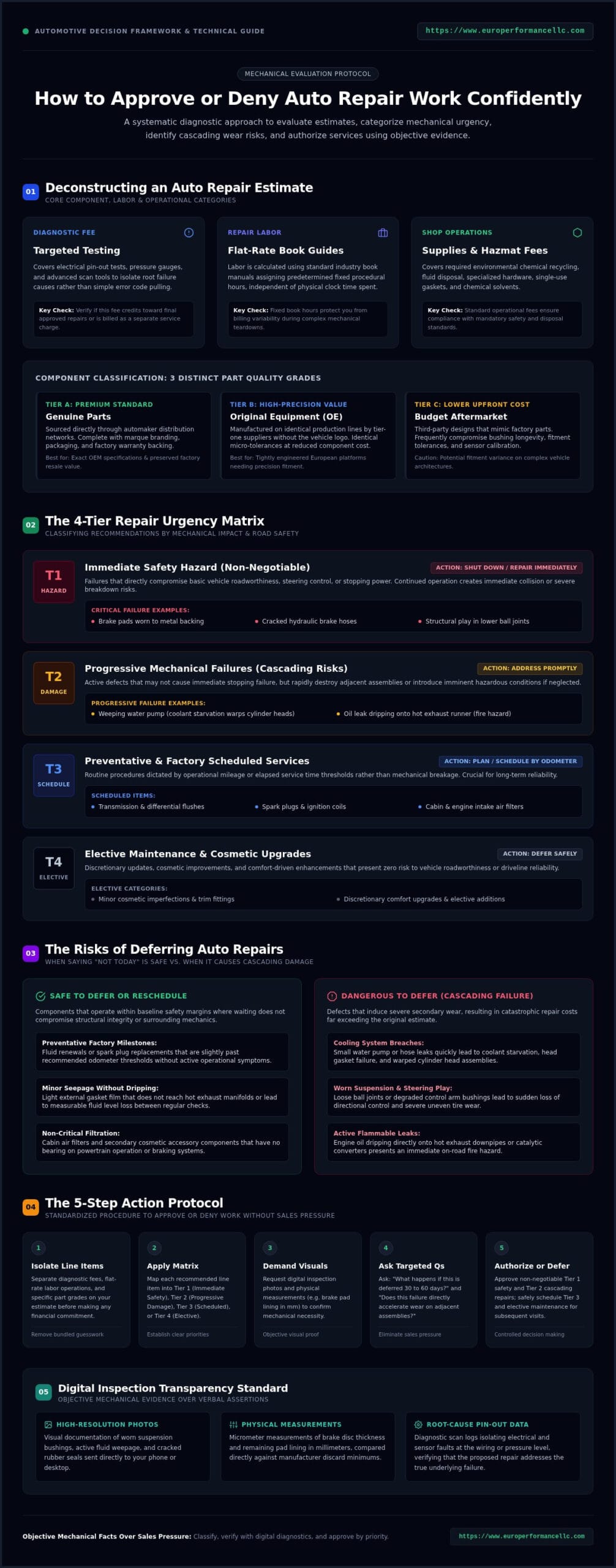
Every formal automotive estimate breaks down into distinct operational categories. Knowing what each line item represents is the foundation of how to approve or deny auto repair work confidently. Beyond mechanical components and wrench time, modern repair estimates account for technical diagnostic procedures, environmental compliance fees, and shop supplies such as specialty fasteners, single-use gaskets, or chemical solvents required to complete a job correctly.
Understanding Diagnostic Charges vs. Repair Labor
A dedicated diagnostic fee covers targeted mechanical and electrical testing, not physical component replacement. Certified technicians use advanced diagnostic scan tools, wiring pin-out tests, and pressure gauges to isolate the root failure rather than merely pulling basic error codes. In contrast, repair labor relies on standardized flat-rate book guides. These industry-standard manuals assign fixed labor times to specific mechanical procedures regardless of actual clock time. Reputable facilities clearly state whether that initial diagnostic charge credits toward your final authorized repair balance or stands as a separate service fee.
Deciphering Part Quality Tiers
Component selection directly affects vehicle longevity, particularly across tightly engineered European platforms where micro-millimeter tolerances matter. Estimates generally reflect three distinct grades:
- Genuine Parts: Sourced directly through vehicle manufacturer distribution networks, carrying automaker branding and original packaging.
- Original Equipment (OE) Parts: Built on identical manufacturing lines by tier-one suppliers without the vehicle marque emblem. They deliver factory-level precision and metallurgical standards at a lower component cost.
- Budget Aftermarket Parts: Third-party alternatives designed to mimic original designs. While inexpensive upfront, they frequently compromise fitment tolerances, bushing durability, and sensor calibration on complex vehicle systems.
Finally, review the miscellaneous shop supply and hazardous waste charges itemized on the quote. These standard fees support required fluid recycling, chemical disposal, and shop safety protocols. Understanding these operational line items helps you determine how to approve or deny auto repair work confidently, ensuring you authorize only necessary services backed by transparent mechanical rationale.
The 4-Tier Repair Urgency Matrix: How to Categorize Recommendations
Receiving an extensive list of proposed repairs often feels overwhelming, but you don’t have to treat an estimate as an all-or-nothing proposition. Categorizing recommendations through a mechanical urgency matrix is the most reliable way to learn how to approve or deny auto repair work confidently. By evaluating parts based on immediate safety risks and cascading component wear, you can easily separate non-negotiable fixes from items that can wait.
Tier 1 and Tier 2: Non-Negotiable Safety and Progressive Damage
Tier 1 focuses strictly on immediate safety hazards that compromise vehicle roadworthiness. Friction material worn down to the brake pad backing plate, cracked hydraulic hoses, or structural play in a lower ball joint severely impair stopping and steering control. These failures require immediate vehicle shutdown until resolved.
Tier 2 includes progressive mechanical failures that directly threaten adjacent assemblies. A weeping water pump will eventually starve cooling channels and warp a cylinder head, while an active engine oil leak dripping directly onto a hot exhaust runner presents an immediate fire hazard. Addressing these secondary damage risks matches the rigorous diagnostic baseline established during an expert European auto repair inspection.
Tier 3 and Tier 4: Preventative Schedules and Discretionary Upgrades
Tier 3 covers predictable factory services dictated by elapsed time or operational mileage rather than active mechanical breakage:
- Transmission fluid flushes, differential services, and drive belt renewals.
- Spark plug and ignition coil replacements based on odometer thresholds.
- Cabin microfilter and engine intake air filter servicing.
Always cross-reference Tier 3 suggestions against your vehicle’s published factory scheduled maintenance intervals before agreeing to work.
Tier 4 consists of elective cosmetic repairs and non-critical convenience features. Minor valve cover sweating without active pooling, torn aesthetic engine covers, or light cosmetic scraping on an aerodynamic belly pan pose no functional threat to your drivetrain. If a shop attempts to bundle Tier 4 cosmetic touches alongside urgent mechanical items, you can defer them without anxiety. For drivers seeking honest technical guidance and transparent repair prioritization, consulting a dedicated European automotive specialist ensures you make objective decisions backed by engineering facts.
How to Approve or Deny Auto Repair Work: A 5-Step Action Protocol
Navigating service recommendations requires an objective procedure rather than an emotional reaction. A structured framework removes sales pressure, allowing you to examine mechanical facts clearly. Follow this 5-step protocol to master how to approve or deny auto repair work confidently every time your vehicle enters a service bay:
- Demand Visual Verification: Request a comprehensive digital inspection report complete with high-resolution photos, measurement readouts, and fluid test strips.
- Interrogate the Recommendation: Pose targeted technical questions to establish whether an issue represents active failure or normal wear.
- Isolate Line Items: Separate the quote into immediate approvals, deferred maintenance, and declined recommendations rather than signing a blanket agreement.
- Communicate Decisions Assertively: Deliver precise instructions using industry-standard terms so your advisor understands your choices without ambiguity.
- Require a Revised Work Order: Never authorize work until you hold an updated written document displaying only approved line items.
The Four Critical Questions to Ask Your Service Advisor
Before authorizing any estimate, ask these four questions:
- “What direct physical measurement or visual defect caused this part to fail inspection?” Demand exact figures, such as remaining brake pad lining in millimeters or suspension play in degrees, rather than subjective terms like “worn.”
- “What happens if this repair is deferred for 60 days?” A skilled advisor can articulate whether the component will cause secondary system damage or simply remain stable.
- “Does this line item resolve the root cause or merely treat a symptom?” Ensure the technician isn’t swapping an oxygen sensor when an intake vacuum leak caused the fault code.
- “How would your shop rank these items from highest to lowest mechanical risk?” This forces the shop to align recommendations by mechanical necessity.
Scripts for Approving, Deferring, and Declining Work
Eliminate conversational friction by using concise, professional phrasing at the service counter:
- To Approve: “I authorize lines one and two for the front brake rotors and pads; please proceed with parts procurement and keep me updated.”
- To Defer: “Please document line three on my permanent vehicle history as a deferred item; we will re-inspect it during my next routine maintenance interval.”
- To Decline: “I decline line four today. Please assemble the vehicle according to manufacturer safety standards and finalize billing for the approved items.”
When evaluating older vehicles, reviewing the detailed records from a comprehensive used car pre-purchase inspection helps you verify baseline conditions, spot recurring faults, and determine how to approve or deny auto repair work confidently based on established maintenance history.
The Risks of Deferring Auto Repairs: When Saying ‘Not Today’ Is Safe vs. Dangerous
Mechanical components don’t all age at the same rate. Understanding the difference between stable, gradual friction wear and rapid mechanical fatigue is essential to how to approve or deny auto repair work confidently. While certain parts can safely operate for months before requiring attention, postponing others triggers cascading failures that multiply maintenance costs across interrelated vehicle systems.
Safe Deferrals: Items That Allow Reasonable Delays
A safe deferral involves isolated wear that poses no threat to adjacent assemblies. You can comfortably postpone:
- Brake Friction Above Discard Limits: Brake pads measuring four to five millimeters still retain workable lining above the standard two to three millimeter replacement threshold.
- Filtration Elements: Cabin dust filters and engine air filters nearing routine intervals can wait if airflow remains unrestricted.
- Early Belt Aging: Serpentine drive belts displaying light surface micro-cracking without rib separation, missing material, or belt squeal remain temporarily functional.
Dangerous Deferrals: Cascading Mechanical Failures
Dangerous deferrals occur when one neglected part actively destroys connected components. Postponing cracked control arm or thrust arm bushings, for instance, allows excessive suspension deflection. This movement causes severe uneven tire wear and destabilizes your wheel alignment geometry, turning a single bushing replacement into an expensive multi-component overhaul.
Fluid leaks present similar secondary risks. On many European platforms, oil filter housing gasket leaks drip oil directly onto underlying radiator and heater hoses. Engine oil softens the synthetic rubber, eventually causing the hose to rupture under hydraulic cooling pressure and leading to catastrophic engine overheating. Similarly, ignoring manufacturer timing belt replacement schedules on an interference engine invites belt snapping, which causes pistons to strike open valves and destroys the cylinder head assembly.
When you decline a critical Tier 1 safety item, such as a loose ball joint nearing separation, reputable shops will require you to sign a liability waiver. This document formally records that you were advised of an active road hazard before leaving the premises.
Evaluating mechanical interdependencies removes guesswork, giving you the clarity needed to decide how to approve or deny auto repair work confidently. When faced with an uncertain estimate, schedule an inspection with Euro Performance Auto Shop LLC to receive an objective, evidence-based assessment of your vehicle’s mechanical health.
Partnering with the Right Auto Repair Facility: Digital Transparency as the Standard
Selecting an automotive service center committed to open communication changes the dynamic between technician and customer. Basic licensing registries confirm that an enterprise meets statutory operating thresholds, but they reveal nothing about operational honesty or communication clarity. A modern, customer-focused facility removes doubt by putting measurable technical evidence ahead of any sales pitch, giving you the clarity needed to master how to approve or deny auto repair work confidently.
The Power of Digital Vehicle Inspections (DVI)
Paper checklists and hurried phone calls are quickly becoming obsolete. Progressive repair centers send interactive digital vehicle inspections directly to your smartphone. These reports present high-resolution photography and video footage showing exact wear indicators: micrometers measuring rotor thickness, test strips showing degraded brake fluid, and clear visual evidence of leaking seals. According to an August 2026 report by Business Research Insights, roughly 76% of independent repair facilities now use digital inspection platforms. This software lets you review documented faults at your own pace, giving you full control to approve, defer, or deny each item individually.
Why European Specialization Demands Rigorous Standards
Precision-engineered European platforms require specialized technical standards that generic service chains cannot support. Modern German vehicles operate intricate controller area networks (CAN-bus), sophisticated multi-link suspensions, and sensitive Advanced Driver Assistance Systems (ADAS) that interact directly with chassis geometry. Accurate diagnosis requires:
- Dedicated diagnostic interfaces capable of reading proprietary manufacturer control modules.
- Technicians who complete rigorous ASE certification programs to master platform-specific mechanical systems.
- Original Equipment parts that preserve exact factory clearances and material specifications.
- Calibrated alignment and sensor setups that maintain active safety system functions.
When technicians pair platform-specific diagnostic tools with open digital reporting, you receive objective assessments without pressure or sales tactics. This transparent workflow creates mutual accountability, protecting your vehicle’s mechanical health while ensuring you retain complete authority over every line item. For drivers seeking this standard of technical precision, turn to Euro Performance Auto Shop LLC for specialized European vehicle care, factory scheduled maintenance, and transparent diagnostics in Belgrade, Montana. Knowing you have a dedicated specialist in your corner is the ultimate foundation for understanding how to approve or deny auto repair work confidently on every visit.
Drive Forward with Diagnostic Clarity and Complete Control
Evaluating an auto repair estimate doesn’t have to feel like an exercise in high-pressure guesswork. With an objective urgency matrix and targeted diagnostic questions at your disposal, you can isolate critical safety fixes, defer routine upkeep responsibly, and decline unnecessary add-ons without anxiety. Mastering how to approve or deny auto repair work confidently ensures you always make informed decisions grounded in verifiable mechanical data.
When your vehicle requires service, choose a team that values open communication and engineering excellence. At Euro Performance Auto Shop LLC, our ASE certified technicians specialize in complex European platforms, pairing advanced digital inspections and visual photo evidence with strict adherence to Original Equipment (OE) parts standards. You deserve complete clarity before authorizing a single wrench turn. Schedule a transparent diagnostic inspection with Euro Performance Auto Shop LLC today and take command of your automotive care.
Frequently Asked Questions
Can a mechanic legally refuse to release my vehicle if I decline safety repairs?
No. A repair facility cannot legally impound your car simply because you decline recommended safety fixes, provided you have settled the bill for authorized diagnostic time or completed work. The shop may ask you to sign a liability waiver acknowledging that you were advised of an unsafe condition. If a vehicle is mechanically undriveable, reputable technicians will advise arranging a flatbed tow rather than driving it away.
What should I do if an auto shop performs unauthorized repair work?
Request to see your signed estimate and authorization records immediately. In most jurisdictions, facilities cannot bill for services performed without prior written or documented verbal consent. Review your original work order, dispute unauthorized charges directly with shop management, and pay only for pre-approved labor and parts. If the business refuses to release your keys, contact your state automotive repair bureau or consumer protection agency.
How do I know if an auto repair estimate is genuinely fair and accurate?
Look for clear line-item transparency that separates labor book hours, diagnostic testing, and part tiers. Learning how to approve or deny auto repair work confidently relies on evaluating whether proposed labor aligns with industry flat-rate guides. Quality facilities distinguish Original Equipment parts from aftermarket alternatives, avoid vague lump-sum quotes, and back up each recommended fix with digital photos or physical measurement readouts.
Is it rude or unacceptable to ask for a second mechanical opinion?
No, requesting a second opinion is standard practice and completely acceptable. Reputable repair facilities welcome scrutiny and will gladly share digital inspection findings, fault codes, and diagnostic photos so you can consult another specialist. Defensiveness or hesitation from a service advisor when you ask for your vehicle’s diagnostic records is a reliable warning sign that you should seek service elsewhere.
What is a Digital Vehicle Inspection (DVI) and how does it help me?
A Digital Vehicle Inspection is an electronic health assessment sent directly to your phone or computer. Instead of relying on handwritten notes, it includes high-resolution photos, video clips, fluid test strips, and micrometer measurements showing component wear. This visual documentation bridges the gap between technical jargon and physical proof, helping you understand how to approve or deny auto repair work confidently on your own terms.
Can declining scheduled maintenance void my manufacturer or aftermarket warranty?
It can if the neglected service directly causes a subsequent mechanical failure. Under federal law, manufacturers cannot void an entire vehicle warranty simply because you deferred non-essential maintenance or visited an independent specialty shop. However, if an internal engine component fails due to a lack of documented oil changes or required timing belt renewals, warranty providers will routinely deny claims for that specific damage.