
Blog
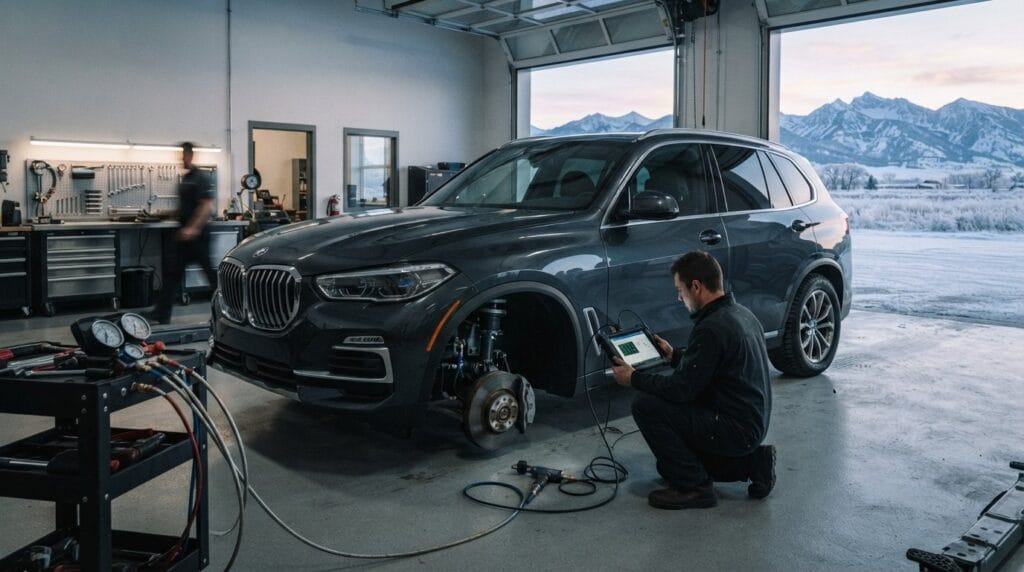
You step into your garage on a sub-zero morning to find your Cayenne dropped completely onto its bump stops, chassis resting inches above the concrete. Dealing with Porsche Cayenne air suspension problems Montana drivers face is an all-too-common reality when extreme cold turns flexible rubber bladders brittle and strains your entire pneumatic setup.
Few experiences are more frustrating than hearing a compressor run continuously until a chassis system failure warning appears on the instrument cluster. It leaves you dreading steep dealership bills or wondering if a coil conversion is your only dependable option. You don’t have to sacrifice performance to survive the season. You’ll learn why sub-zero temperatures accelerate pneumatic leaks and how targeted diagnostics isolate the exact failure point to restore factory Porsche Active Suspension Management (PASM) stability.
We’ll examine early warning symptoms, explore proper suspension calibration requirements, and outline proven repair solutions engineered to keep your Cayenne composed across demanding mountain passes.
Key Takeaways
- Understand why sub-zero winter temperatures trigger Porsche Cayenne air suspension problems Montana drivers experience, from stiffened rubber seals to frozen valve blocks.
- Identify early mechanical warnings, such as corner sagging and extended compressor cycles, before complete pneumatic failure damages related chassis components.
- Evaluate the practical trade-offs between preserving factory PASM electronic dampening versus converting to an aftermarket coil spring setup.
- Discover the multi-step diagnostic process technicians use to isolate microscopic leaks, electrical faults, and pressure-decay issues with precision.
- Learn why restoring Cayenne suspension integrity demands post-repair wheel alignment and ADAS calibration to maintain active safety systems.
Recognizing Porsche Cayenne Air Suspension Problems in Montana Winter Conditions
When temperatures drop below zero across the Gallatin Valley, Porsche Cayenne air suspension problems Montana owners face become immediately obvious. Cold ambient air drops internal pneumatic pressure, accelerating leaks at aged strut seals. Modern air suspension setups rely on flexible elastomers and precise valve controls, but freezing weather challenges both. You might notice the vehicle struggling to transition between Terrain, Normal, and Low aerodynamic modes, accompanied by a compressor running continuously on initial startup.
The Cold Morning Sag: Why One Corner Drops Overnight
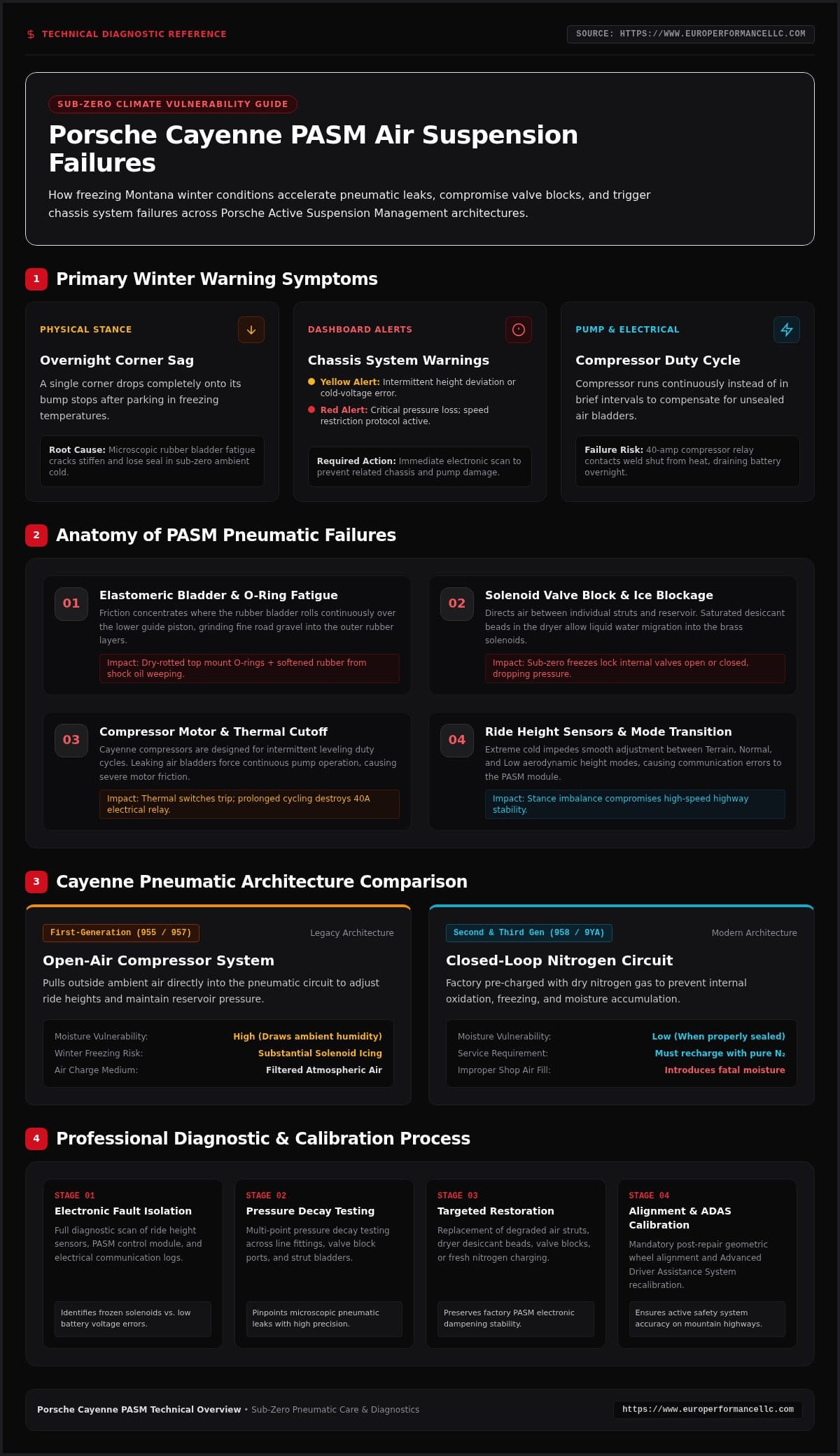
Parked overnight in freezing Belgrade weather, an aging air strut often loses its seal. Rubber air bladders develop microscopic fatigue cracks that stay pliable in warm weather but stiffen and contract in sub-zero cold. Simultaneously, residual pressure retaining valves can stick open when condensation inside the pneumatic lines turns to ice. This causes a single corner to drop onto its bump stops, creating an uneven stance that compromises handling stability along Highway 191 or I-90.
Chassis System Warning Indicators and What They Mean
Your multi-function instrument cluster will signal pneumatic distress through specific warnings. A yellow alert typically indicates an intermittent height deviation or an electrical communication error caused by cold-induced low battery voltage. A red “Chassis System Failure” warning indicates critical pressure loss, triggering vehicle speed restriction protocols to prevent suspension damage. These warnings require prompt electronic scans to isolate whether the root cause is a frozen solenoid, a damaged ride height sensor, or an active pneumatic leak.
Compressor Overheating and Pump Burnout Symptoms
Cayenne air compressors operate on intermittent duty cycles designed for occasional leveling, not continuous running to compensate for leaks. When an unsealed bladder demands constant pressure, the pump motor generates intense friction until thermal cutoff switches intervene to halt operation. Prolonged cycling also degrades the 40-amp compressor relay. If the relay contacts weld shut from electrical heat, the compressor will run continuously after the engine shuts off, draining the battery overnight.
Root Causes of Cayenne PASM Failures: From Leaking Bags to Frozen Valves
Porsche Active Suspension Management (PASM) pairs adaptive dampers with pneumatic air springs to continuously adjust ride height and chassis firmness. While this architecture provides remarkable high-speed control, the mechanical and electronic assemblies remain susceptible to regional wear. Investigating Porsche Cayenne air suspension problems Montana drivers experience requires looking past basic air leaks to inspect the electromechanical network that governs pressure distribution.
Air Strut Bladder Wear and Seal Deterioration
Air springs face mechanical stress with every wheel articulation. Friction concentrates where the elastomeric bladder continuously rolls over the lower guide piston, grinding fine Montana road gravel directly into the outer rubber layers. At the same time, top mount O-rings dry out after thousands of heating cycles. If internal adaptive shock absorbers weep hydraulic fluid, that oil pools inside the pneumatic chamber, softening the internal rubber until it tears under standard load pressures.
Valve Block Malfunctions and Moisture Contamination
The pneumatic solenoid valve block directs air volume between individual struts and the main reservoir tank. In cold climates, internal failure often traces back to saturated desiccant beads inside the air dryer assembly. Once this filter can no longer trap condensation, liquid water migrates straight into the brass solenoids. Sub-zero valley freezes turn that residual moisture to ice, locking valves open or closed and triggering immediate pressure drops across the line fittings.
Closed-Loop Nitrogen Systems vs. Open-Air Architectures
Pneumatic architecture varies significantly across Cayenne generations, demanding distinct service protocols:
- First-Generation (955/957): These early chassis rely on open-air compressors drawing outside ambient air, making them highly vulnerable to moisture accumulation.
- Second & Third Generations (958/9YA): Porsche shifted to closed-loop circuits pre-charged with dry nitrogen gas to prevent corrosion and internal freezing.
Improper maintenance that vents factory nitrogen and refills the system with shop air introduces ambient moisture directly into critical circuits. Following proper guidelines for safe winter care helps protect these components, but when severe freezes seize valve blocks, scheduling a professional evaluation with Euro Performance Auto Shop LLC ensures technicians utilize genuine diagnostic equipment to restore factory nitrogen parameters without damaging sensitive electronics.
Air Suspension Repair vs. Coil Spring Conversion for Montana Drivers
Facing recurring pneumatic errors often tempts owners to consider ditching the system entirely. When resolving the persistent Porsche Cayenne air suspension problems Montana winters expose, aftermarket suppliers frequently market steel coil conversion kits as a permanent fix. While deleting the pneumatic setup removes future leak concerns, it fundamentally changes how your vehicle drives, tows, and handles severe mountain topography.
Preserving Porsche Handling and Off-Road Versatility
Porsche engineered the Cayenne chassis to balance track-capable cornering with genuine off-road capability. Converting to static steel springs compromises both ends of that spectrum. The original pneumatic arrangement provides continuous benefits that static hardware cannot match:
- Adaptive Ground Clearance: Factory air springs elevate the body to deliver up to 10.7 inches of clearance, essential for navigating unplowed Gallatin County roads and deep ruts.
- Dynamic Load Leveling: Hitching a horse trailer or snowmobile hauler triggers immediate automatic leveling, keeping the chassis flat and maintaining proper headlight aim.
- High-Speed Stability: At interstate speeds, the chassis lowers aerodynamically to reduce drag and manage body roll through mountain curves.
Evaluating the Real Costs of Coil Conversion Kits
Steel conversions carry hidden drawbacks that national marketing campaigns rarely mention. Removing factory air springs permanently disables the PASM center console controls. Most aftermarket conversion packages include electronic bypass modules designed to trick the vehicle network, but these resistors regularly fail in extreme temperatures. That leaves persistent check-chassis warning messages glowing on your dash. Beyond electronic headaches, deleting the factory-engineered air suspension drastically diminishes trade-in and private resale values among discerning European automotive buyers.
Targeted OE-Quality Component Replacement
A failed strut does not mandate discarding an exceptional suspension platform. Full system failure rarely happens at once; pinpointing a single worn air bladder, dry-rotted O-ring, or malfunctioning valve block resolves the fault for a fraction of full-system replacement costs. Sourcing components from top European OE manufacturers matches original equipment durability while preserving factory ride dynamics. Consulting specialists at an expert European auto repair in Belgrade, MT facility allows you to isolate exact component failures and protect your vehicle’s long-term utility.
Professional Diagnostic Steps and Safe Winter Care for Cayenne Suspensions
Accurately identifying Porsche Cayenne air suspension problems Montana drivers experience demands systematic technical evaluation rather than guesswork. Simply replacing visible components without verifying pneumatic integrity wastes money and leaves root causes unaddressed. Certified technicians follow a rigorous five-step diagnostic protocol:
- Control Module Interrogation: Technicians connect Porsche-specific diagnostic scanning platforms to read live CAN-bus data streams, fault memory, and individual corner sensor voltages.
- Acoustic and Pressure-Decay Testing: Pneumatic lines and individual strut chambers are isolated under pressure to track decay rates over several hours.
- Compressor and Desiccant Evaluation: The compressor’s maximum output bar pressure is tested, alongside a physical inspection of the air dryer’s desiccant saturation.
- Closed-Loop Nitrogen Charging: Specialized manifold gauges evacuate atmospheric air and refill the circuit with pure, moisture-free dry nitrogen.
- Electronic Ride-Height Calibration: The vehicle is placed on an alignment rack to perform wheel-arch-to-hub calibrations, re-zeroing the PASM control unit.
Why Generic OBD-II Scanners Fail to Identify Air Leaks
Handheld code readers cannot communicate with proprietary Porsche chassis management networks. Standard OBD-II tools only read generic powertrain codes, leaving valve block actuation, accumulator pressures, and compressor duty cycle logs completely invisible. Dedicated diagnostic software allows technicians to manually command individual corner valves open and shut. This isolates whether a fault stems from an internal electrical solenoid failure or a physical breach in the rubber bladder.
Nitrogen Charging Requirements for Modern Cayenne Models
Second-generation 958 and third-generation 9YA Cayenne models rely on factory-sealed nitrogen systems to eliminate condensation. Standard tire inflators or shop air lines inject ambient moisture directly into closed reservoirs. When temperatures tumble below freezing, that moisture turns to ice crystals inside the valve block. Certified technicians use specialized nitrogen charging stations to repressurize the system to exact factory bar specifications, preventing cold-weather freeze-ups.
Preventative Winter Care Habits for Montana Owners
Montana roads present harsh conditions that accelerate chassis wear. Frequent undercarriage washes prevent de-icing chemicals and crushed volcanic rock from embedding in the lower rubber folds of the air springs. Avoid leaving your vehicle parked for weeks in high snowdrifts, where packed snow can distort exposed height sensor linkages. If your vehicle drops overnight, address the leak immediately. Postponing service forces the compressor to overwork until mechanical failure occurs.
If your instrument cluster displays active chassis warnings, schedule specialized European auto repair to isolate leaks before thermal stress damages the compressor assembly.
Restoring Precision: Alignment, ADAS, and Expert European Repair in Belgrade
Replacing an air spring, valve block, or compressor cures pneumatic leaks, but it only completes half the repair. Resolving the Porsche Cayenne air suspension problems Montana terrain provokes requires restoring the entire chassis network to factory tolerances. Anytime a strut or control arm is unbolted, suspension geometry shifts out of alignment. Thorough repair protocols mandate evaluating surrounding control arm bushings, ball joints, and stabilizer bar links for stress fractures before locking in final adjustments.
The Critical Need for Precision Wheel Alignment
Even minor variations in ride height pull camber, caster, and toe settings outside factory specifications. Misaligned wheels cause rapid inside tire scrub, prematurely wearing aggressive winter treads. Precision four-wheel alignment restores razor-sharp Porsche steering feedback, stabilizes high-speed tracking, and ensures balanced braking response across snowy highways. Selecting a certified alignment shop equipped with European-specific targets prevents uneven tire wear and protects your investment.
Recalibrating Advanced Driver Assistance Systems (ADAS)
Modern Cayenne platforms integrate chassis ride height with electronic driver-assist safety systems. Windshield cameras, forward-facing radar sensors, and blind spot arrays rely on a level platform to calculate distances accurately. A height deviation of mere millimeters tilts these sensor trajectories, causing lane-keeping assist to pull unevenly or adaptive cruise control to misjudge following distances. Professional ADAS calibration performed on an optical target board aligns vehicle cameras and radar units with the newly calibrated chassis height.
Specialized Porsche Service Near Bozeman at Euro Performance Auto Shop LLC
Gallatin Valley drivers no longer need to haul disabled vehicles hundreds of miles to distant metro dealerships for chassis repairs. The Belgrade facility of Euro Performance Auto Shop LLC delivers specialized European repair directly to owners throughout Bozeman, Big Sky, and surrounding communities. ASE-certified technicians utilize advanced OE-grade diagnostic tools, high-grade parts sourced from top OE European manufacturers, and in-house alignment and ADAS equipment to address complex Porsche Cayenne air suspension problems Montana winters present. Our methodical service approach ensures your Cayenne retains its authentic PASM driving dynamics and winter capability.
Keep Your Porsche Cayenne Winter-Ready on Montana Roads
Sub-zero weather tests every seal and valve in your chassis, but pneumatic errors don’t require abandoning factory engineering. Methodical diagnostics isolate leaking air bladders, corroded sensors, or stuck valves without the drawbacks of aftermarket steel springs. When paired with four-wheel geometry alignment and dynamic ADAS recalibration, targeted component repairs fully restore the handling precision, towing stability, and ride comfort engineered into your PASM setup.
Overcoming the Porsche Cayenne air suspension problems Montana winters deliver is straightforward with dedicated regional expertise. At Euro Performance Auto Shop LLC in Belgrade, our ASE-certified technicians specialize in complex European platforms. We combine factory-grade diagnostic tools with advanced in-house wheel alignment and ADAS calibration equipment, installing high-grade parts sourced from top OE European manufacturers to protect your vehicle’s long-term integrity. You don’t have to navigate snowy highways with a compromised chassis. Schedule your Porsche suspension diagnostic at Euro Performance Auto Shop LLC today to restore confident handling across every mountain pass.
Frequently Asked Questions
Why does my Porsche Cayenne only sag on cold mornings in Montana?
Sub-zero overnight temperatures cause the rubber air spring bladders and internal O-ring seals to contract and stiffen. This physical shrinkage temporarily widens microscopic stress cracks that remain sealed during warmer daytime driving. Resolving the Porsche Cayenne air suspension problems Montana winters expose often begins with recognizing these temperature-sensitive leaks before the elastomeric material splits completely.
Can I continue driving my Cayenne with a “Chassis System Failure” warning light?
You shouldn’t drive if a red chassis system warning appears on your dash. A red alert indicates severe pressure loss, meaning the vehicle is likely riding directly on its rubber bump stops. Continuing to drive without air cushioning transmits severe road shocks into control arms, tie rods, and wheels. It also forces the compressor to run continuously, which will burn out the motor.
Is it better to replace air suspension components or convert to coil springs?
Replacing individual failed air components is generally the superior choice for preserving your Cayenne’s engineering integrity. Steel coil conversions eliminate pneumatic maintenance, but they permanently disable Porsche Active Suspension Management (PASM), variable ground clearance, and automatic load leveling. Targeted repairs using OE-grade components restore factory ride control, protect trailer towing capabilities, and preserve long-term vehicle resale value.
How much does it cost to fix a Porsche Cayenne air suspension leak?
Total repair expenses depend entirely on which component within the pneumatic circuit has failed. Resolving a minor leak at an air line fitting or valve block requires substantially fewer parts than replacing a complete adaptive air strut assembly or burned-out compressor. Comprehensive diagnostic testing pinpoints the exact mechanical or electronic failure, preventing you from replacing fully functional components unnecessarily.
How long do Porsche Cayenne air suspension struts usually last?
Factory air struts typically last between 80,000 and 120,000 miles under normal conditions. In northern climates, severe cold, de-icing chemicals, and abrasive gravel road dust collect in the lower rubber folds, which can accelerate seal degradation. Routine undercarriage washing and addressing early height drops promptly help extend strut longevity well past the ten-year mark.
Why does my Cayenne suspension compressor run constantly in freezing weather?
The compressor runs constantly because it cannot build adequate reservoir pressure to reach the commanded ride height. This typically stems from an active air bladder leak, a cracked line fitting, or an internal solenoid valve frozen open by trapped condensation. Investigating Porsche Cayenne air suspension problems Montana cold triggers prevents prolonged duty cycles that weld relay contacts and overheat the pump motor.
Do newer Porsche Cayenne models use regular air or nitrogen in their suspension?
Second-generation (958) and third-generation (9YA) Cayenne platforms utilize closed-loop pneumatic circuits charged with dry nitrogen gas. Unlike older open-air compressors that draw outside air, factory nitrogen systems eliminate internal humidity. Servicing these modern platforms requires dedicated charging equipment to evacuate atmospheric moisture and restore precise nitrogen pressure levels specified by factory engineering manuals.