The Porsche PDK transmission service interval isn’t always the same in factory schedules and specialist recommendations. For street-driven cars, some service advice calls for a fluid change every 30,000 to 40,000 miles or three years, whichever comes first, while factory guidance can allow a longer interval on certain models and years.
It’s reasonable to expect a PDK service to involve more than draining and refilling fluid. The work may include filter replacement, and the exact procedure depends on the transmission and vehicle. Porsche’s “lifetime fill” wording can also make it difficult to know whether time, mileage, or driving conditions should guide your decision.
This article explains what PDK maintenance typically includes, why recommended intervals differ, and what “lifetime fill” means in practice. You’ll also learn why model year and vehicle use matter, including track driving, so you can make a more informed maintenance decision for your Porsche.
Key Takeaways
- A PDK service can involve fluid and filter replacement; the required work depends on the transmission design and model-specific service information.
- Factory and specialist interval advice can differ, so model year and driving conditions may help determine which schedule applies.
- A “lifetime fill” label should be understood in the context of Porsche’s service information for the specific vehicle; it does not, by itself, establish that the fluid lasts forever.
- Track use and repeated hard launches may affect service needs, but the appropriate maintenance depends on the vehicle and Porsche’s guidance.
What Does PDK Maintenance Actually Include?
A PDK service addresses the fluid and filter, with procedures varying by transmission and model year. Correct fluid level and condition matter because the transmission’s two wet clutches operate within the system.
Fluid and Filter Service Intervals
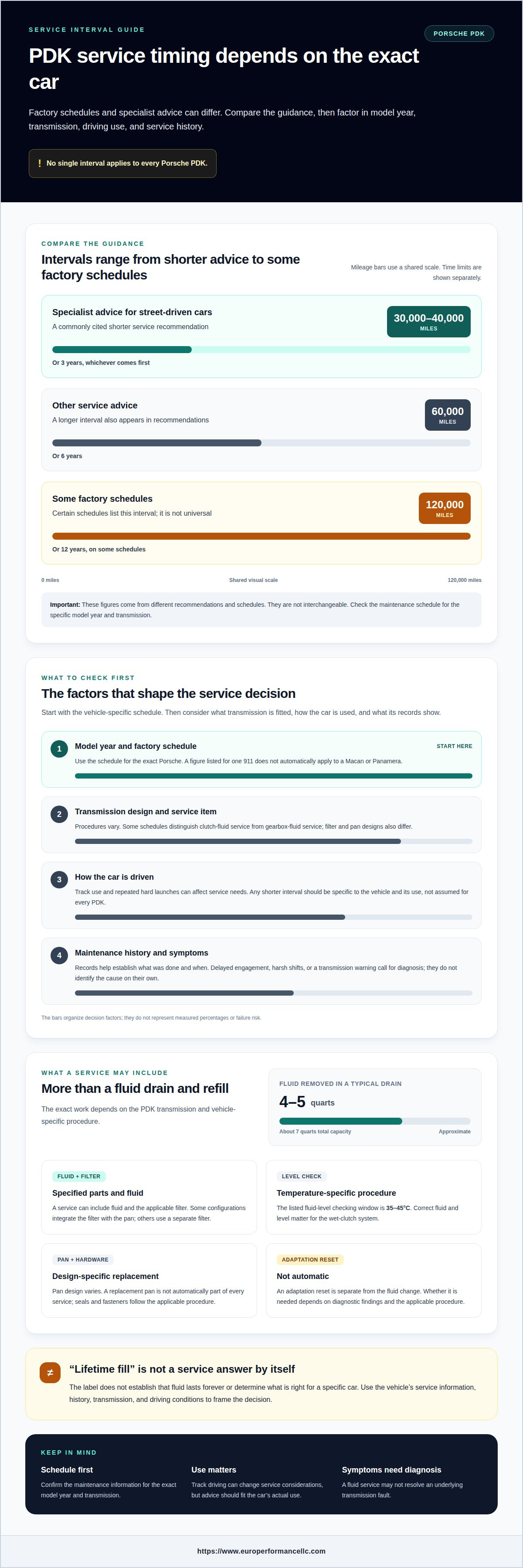
For street-driven PDK cars, specialist recommendations commonly range from 30,000 to 40,000 miles or three years, whichever comes first. Other advice uses 60,000 miles or six years. These differences make the vehicle’s model year and service schedule important when planning a fluid change.
For 911, Boxster, Cayman, Macan, and Panamera models, there isn’t one interval that applies to every year and transmission. Some Macan schedules separate clutch-fluid service from gearbox-fluid service, so the model-specific maintenance schedule matters.
Symptoms such as delayed engagement, harsh shifts, or a transmission warning may warrant professional diagnosis. They don’t identify the cause on their own, and a fluid service may not resolve an underlying fault.
A dated maintenance record should identify the work performed and the fluid used. Warranty coverage depends on the applicable terms and circumstances; a service record helps document completed maintenance.
Filter, Pan, and Hardware Replacement
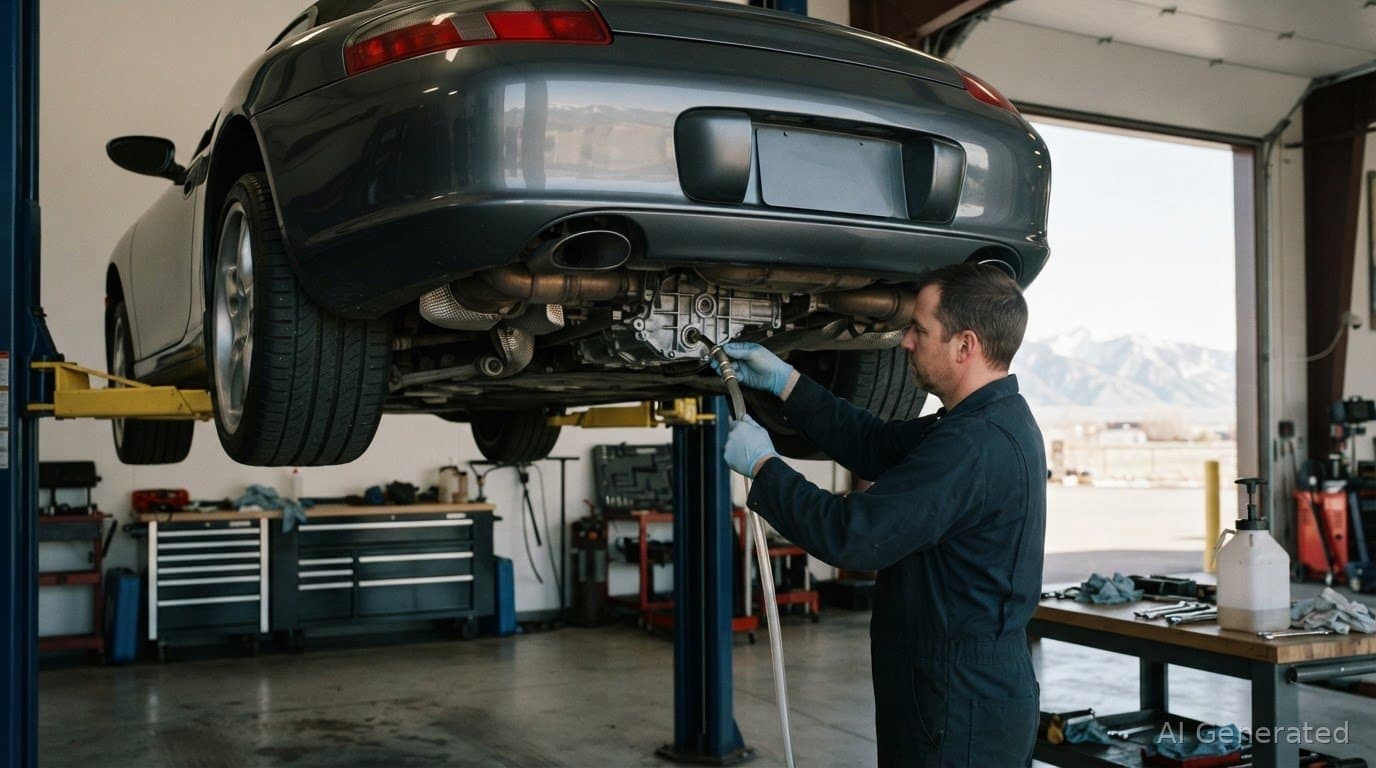
A PDK fluid and filter service replaces specified transmission fluid and the applicable filter. On most models, a drain removes about 4-5 quarts from an approximately 7-quart total capacity. The filter and pan design vary, so a replacement pan isn’t automatically part of every service.
Pan fasteners, seals, and other hardware are handled according to the transmission design and service procedure. Replacing the filter at the fluid interval is common specialist advice. Some configurations integrate the filter with the pan, while others use a separate filter.
A professional service identifies the transmission, drains and refills it with the correct fluid, and sets the level at the specified temperature. The listed checking window is 35-45 degrees Celsius. An adaptation reset is separate from the fluid change; its need depends on the diagnostic findings and applicable procedure.
Differences between factory and specialist interval recommendations
Factory schedules and specialist recommendations may set different PDK service intervals. Model year, transmission configuration, and driving conditions help explain the difference.
Factory Maintenance Schedule
The factory maintenance schedule sets service requirements for a specific Porsche model and year. This matters because one mileage figure cannot apply to every PDK.
Schedule information varies across models. Some schedules may list PDK fluid and clutch-fluid service at 120,000 miles or 12 years, but these figures should not be treated as applying to every vehicle. The maintenance schedule for the exact model and year is the relevant reference.
For example, a listed 911 maintenance-book interval may not apply to a Macan or Panamera. The transmission, model year, and service item can change the specified interval. Some schedules distinguish clutch oil from gearbox oil, so the recommendation may cover one fluid before the other.
The factory interval is a baseline for the specified vehicle and use conditions. Following it also helps owners keep maintenance records consistent with the schedule for their car.
Specialist Interval Recommendations
Some specialists may recommend shorter intervals than the factory schedule for a Porsche used on track. Any such recommendation should be specific to the vehicle and its use, rather than assumed to apply to every PDK.
Recommendations such as service every 30,000 miles or three years for track-driven cars, or roughly half an interval after repeated track use or launch control, are not universal manufacturer requirements. Confirm the appropriate schedule for the specific vehicle with a qualified specialist.
A reported dealer recommendation for a car tracked 10-12 days per year, with an oil change every three years and a full service every six years, cannot be verified here and should not be treated as general guidance. “Service” can also describe different work.
Earlier fluid service is preventive maintenance, not proof that the factory schedule is incorrect. Delayed engagement or harsh shifts call for diagnosis rather than an automatic fluid change. Compare any recommendation with the exact model-year schedule and the car’s actual use.
Meaning of Porsche's lifetime-fill designation
“Lifetime fill” is a term used for Porsche PDK fluid, but it should not be taken to mean the fluid lasts forever or that every Porsche owner should disregard fluid condition and service history. The term alone does not establish what maintenance is appropriate for a specific car.
For owners, the phrase is not a physical property of transmission fluid. Heat, workload, and driving conditions affect fluid over time. A car used mainly for ordinary street driving may face different demands from one driven repeatedly on a track. These differences help explain why specialists may recommend service based on the specific vehicle and its use.
An inspection can help assess the PDK’s condition, but it doesn’t replace the maintenance schedule for the specific car. Service records show whether fluid was replaced and when. If records are incomplete, model year, transmission, and vehicle use help frame the maintenance decision. A technician can also investigate symptoms rather than treating every shift concern as proof of degraded fluid.
PDK, short for Porsche Doppelkupplung, is used across Porsche models including the 911, Boxster, Cayman, Macan, and Panamera. Availability varies by model and year, including among 997.2-generation 911s.
“Lifetime” needs context: the term alone does not specify how long fluid will remain suitable for use or establish a service interval for every vehicle. An older Porsche with limited mileage, for example, still calls for consideration of age and service history alongside the odometer reading.
For a specific Porsche, match its model year and transmission to the applicable maintenance schedule, then consider how it has been driven. Keep dated records of fluid service and inspection findings. This gives future maintenance decisions a clearer basis than the phrase “lifetime fill” alone.
What is the Porsche PDK transmission fluid service interval by model and year?
There isn’t one service interval for every Porsche PDK. Model year, transmission configuration, and driving conditions can change the schedule, so match the recommendation to the specific vehicle rather than relying on its model name alone.
Figures of 40,000 miles or four years, whichever comes first, and 120,000 miles or 12 years are cited for some Porsche maintenance schedules. Without the applicable model-year schedule, however, these figures cannot be confirmed as guidance for a particular vehicle or service item. They should not be treated as universal PDK intervals.
The transmission’s introduction also varies by model. Porsche introduced PDK on the 997.2-generation 911. That milestone does not provide a complete introduction timeline for the Boxster, Cayman, Macan, or Panamera. For those models, use the vehicle’s generation and year to identify the applicable schedule, rather than assuming they received PDK at the same time as the 911.
Service schedules can also distinguish between fluids. A reported Macan example separates clutch-oil service at 40,000 miles from gearbox-oil service at 120,000 miles, but those figures need to be checked against the schedule for the specific model year. A maintenance entry should identify the fluid and service performed; a single “PDK service” label may not describe every scheduled item.
For high-performance models such as the GT3, GT4, and Turbo S, a 40,000-mile or four-year interval is sometimes cited as a specialist recommendation. That figure, and any shorter recommendation for track use or track-modified use, should be confirmed for the specific vehicle. It is not a substitute for the factory schedule tied to its model year.
For a low-mileage Porsche, the time limit still matters alongside mileage when the applicable schedule specifies one. A car with 9,000 miles at six years old illustrates why the odometer alone doesn’t establish whether service is due. Match the model year, transmission, and service history to the applicable maintenance schedule before applying an interval from another Porsche.
European Auto Repair in Belgrade, MT | Euro Performance
Euro Performance helps Porsche owners make informed maintenance decisions through specialized European auto repair and factory scheduled maintenance. When your PDK schedule differs from general interval advice, consider the model year, maintenance records, and driving conditions together.
Bring the vehicle’s service history and model information when discussing maintenance. This context helps clarify which schedule applies and whether the car’s use supports additional preventive service. If you’ve noticed changes in shifting or engagement, describe when they occur so the concern can be assessed alongside the vehicle’s maintenance needs.
For help reviewing your Porsche’s maintenance needs, contact Euro Performance.
Plan Your Next PDK Maintenance Decision
Use the service history to prepare for your next maintenance decision. Records of completed work can help clarify what remains due and give a technician useful context. If the history is incomplete, note the vehicle’s model year and how it is driven.
The Porsche PDK transmission service interval is a planning reference, not a substitute for evaluating the specific vehicle. If shifting changes, note when the concern occurs and the driving conditions. Those details can help distinguish a maintenance question from an issue that needs diagnosis.
Keep maintenance records with the vehicle and update them after each service. A clear history makes future decisions easier and helps the next technician understand what work has already been done.
Frequently Asked Questions
What Happens If You Skip PDK Maintenance?
Skipping PDK maintenance means scheduled work may not be completed or recorded. The immediate effect may not be obvious during normal driving, and the absence of a warning light doesn’t establish that maintenance is current. If records are missing, include that gap when planning service, along with any changes in engagement or shifting behavior.
Does Porsche recommend PDK fluid changes by mileage, time, or both?
Depending on the model year and service item, Porsche schedules may use mileage, elapsed time, or both. If the schedule lists a mileage limit and a time limit, follow whichever comes first. Low annual mileage doesn’t eliminate a listed time requirement. Refer to the schedule for the exact vehicle, since guidance for one Porsche model or generation may not apply to another.
What is included in a Porsche PDK transmission service?
The work record should identify the specific PDK service performed, not just say “transmission service.” It should list the fluid service and any filter or pan work completed, along with the service date and mileage. Diagnostic repairs or adaptation work are separate items unless included in the documented scope. Clear records help distinguish completed maintenance from future recommendations.
What are the risks of delaying PDK fluid and filter service?
The potential effects of delaying PDK fluid and filter service depend on the vehicle, its maintenance schedule, and operating conditions. Delayed service may mean the transmission operates beyond its scheduled maintenance point, but the risk of additional wear varies. If shifting behavior changes, note the conditions in which symptoms occur and arrange a professional assessment. Don’t assume a fluid change alone will correct a shifting concern.