A VANOS fault does not automatically mean the solenoid has failed. To tell if a BMW VANOS solenoid is bad, watch for rough idling, sluggish acceleration, misfires, or a check-engine light, then confirm the cause with diagnostic testing. These signs can also result from other engine or oil-related problems.
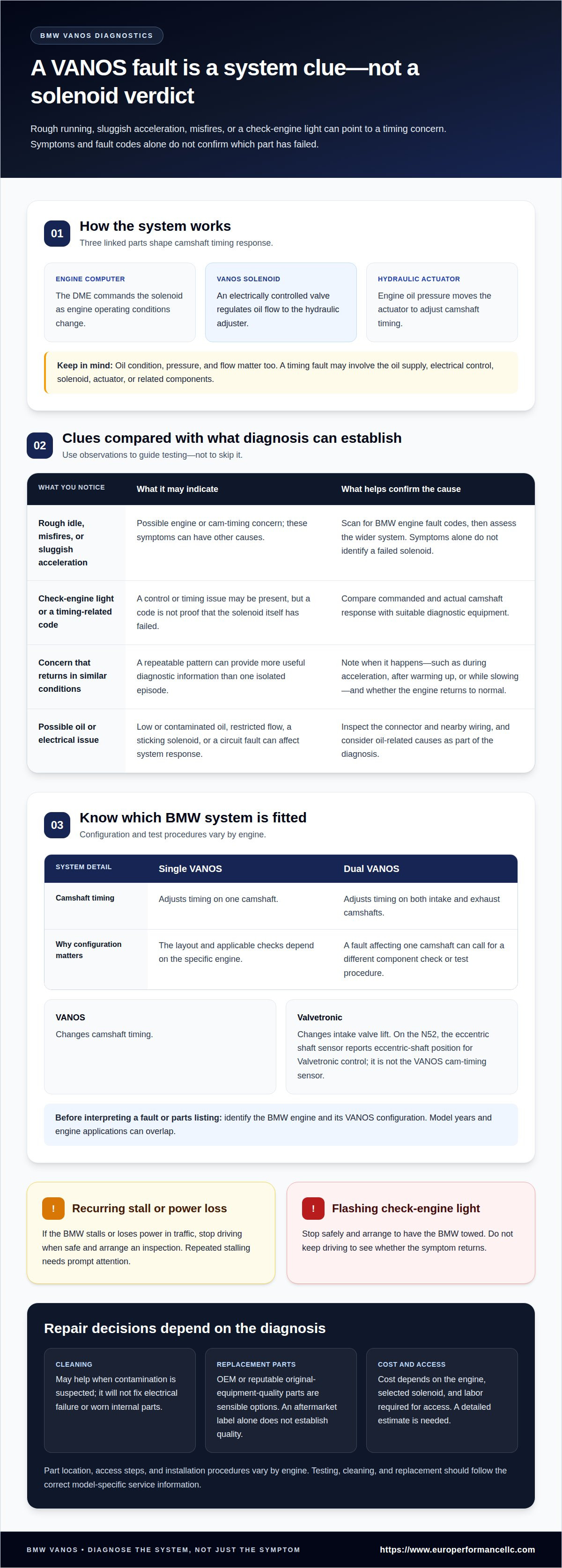
VANOS uses engine oil pressure to adjust camshaft timing, while its solenoids control the oil flow that moves the hydraulic actuator. If a solenoid sticks or its electrical circuit has a fault, cam timing may not respond as intended. Oil condition and pressure matter too, so replacing a solenoid based on symptoms alone can miss the underlying problem.
This guide explains what VANOS does, how oil pressure and solenoids work together, and which warning signs need attention. It also explains why scanning fault codes and inspecting the wider system can help distinguish a failing solenoid from other possible causes.
Key Takeaways
- Understand how oil pressure and the VANOS solenoid work together to adjust camshaft timing.
- Recognize possible warning signs, while keeping in mind that symptoms alone can’t identify the failed part.
- See why fault-code diagnosis and checking related oil and electrical causes can help avoid replacing the wrong component.
- Learn why VANOS configuration differs among BMW engines and why the specific engine matters when diagnosing a fault.
How oil pressure and solenoids control camshaft position
BMW VANOS uses engine oil pressure to adjust camshaft timing as engine speed and load change. The solenoids regulate oil flow, so a timing problem may involve the oil supply, electrical control, or the solenoid itself.
Oil Pressure and Camshaft Timing
VANOS is BMW’s hydraulic system for changing camshaft position while the engine runs. The DME commands a solenoid, which directs pressurized oil to move the VANOS actuator and adjust valve timing. This helps the engine respond to changing operating conditions. Low or contaminated oil, restricted flow, or a sticking solenoid can prevent the actuator from moving as commanded. A timing fault alone does not prove the solenoid has failed.
VANOS Solenoid Testing
A basic check can start with scanning for BMW engine fault codes, followed by a visual inspection of the solenoid connector and nearby wiring. Codes and symptoms can point to a control or timing issue, but they do not confirm the solenoid is at fault. Proper testing compares commanded and actual camshaft response using suitable diagnostic equipment. Do not apply battery power directly or remove parts without the model-specific service procedure.
Aftermarket VANOS solenoid reliability depends on the manufacturer and the specific BMW application. OEM or reputable original-equipment-quality parts are sensible options, but an aftermarket label alone does not establish quality.
Replacement cost depends on the engine, solenoid selected, and labor required to access it. The total varies by the repair, so a detailed estimate is needed.
VANOS solenoids are generally mounted at the cylinder head, but their exact position and accessibility vary by BMW engine. The engine family and model year determine the layout.
A solenoid may be cleaned if contamination is suspected, but cleaning will not fix an electrical failure or worn internal parts. Have a qualified technician assess and clean it using the correct procedure for the BMW engine, avoiding damage to the solenoid, screen, or seals.
Solenoid replacement should be performed by a qualified technician using model-specific service information. The correct part, access steps, and installation procedure vary by engine.
Symptoms of a failing VANOS solenoid
A single rough-running episode can have several explanations. A recurring pattern, especially one that changes with driving conditions, offers more useful diagnostic information than one isolated event.
Signs of Solenoid and System Failure
To tell if a BMW VANOS solenoid is bad, note whether the same operating conditions repeatedly trigger a change. Record whether it happens during acceleration, after the engine warms up, or as you slow to a stop. Also note whether the engine returns to normal afterward. These observations help describe the concern without treating one symptom as a diagnosis.
A BMW that repeatedly stalls while slowing needs prompt attention. Stalling can leave the driver without normal engine response at an intersection or in traffic, so do not dismiss a recurring event as an occasional idle fluctuation.
Driving with a Faulty Solenoid
Whether it is suitable to drive depends on the warning signs and how consistently the engine runs. If it stalls or loses power in traffic, stop driving when safe and arrange an inspection. If the check-engine light is flashing, stop safely and arrange for the BMW to be towed.
For an intermittent concern, note the driving situation and any dashboard warning before your visit. Avoid repeated trips just to see if the symptom returns, particularly if the BMW has already stalled. This brief record gives the technician a clearer starting point and helps address an unpredictable engine issue as a road-safety concern.
BMW VANOS system and variable valve timing
BMW introduced VANOS in the early 1990s to adjust camshaft timing as engine conditions change. The system changes when intake or exhaust valves open, helping the engine adapt its operation. Knowing which VANOS design a BMW uses matters because solenoid layout and control strategy vary by engine.
Single VANOS adjusts timing on one camshaft, while Dual VANOS adjusts both the intake and exhaust camshafts. These names describe different system configurations, not interchangeable parts. On a Dual VANOS engine, a fault affecting one camshaft may call for a different component check or test procedure than a problem on a Single VANOS engine.
Examples from BMW engines show how the technology changed across generations:
- Some BMW engines used Single VANOS, while others used Dual VANOS.
- Engine configurations can vary, so verify the specific application before relying on a parts listing.
- VANOS and Valvetronic configurations vary by engine.
These examples are not a complete fitment guide. BMW model years and engine applications can overlap, so identify the engine before using a parts diagram or interpreting a fault. For example, the N52 combines Dual VANOS and Valvetronic, but the systems perform different jobs. VANOS changes camshaft timing; Valvetronic changes intake valve lift.
That distinction matters during diagnosis. On the N52, the eccentric shaft sensor reports eccentric-shaft position to the DME for Valvetronic control. It is not the VANOS cam-timing sensor. A code or symptom involving one system should therefore be traced to the relevant components, rather than prompting a parts swap based only on the engine family. Confirming the BMW engine and its VANOS configuration gives testing a clear starting point.
VANOS solenoid role
The VANOS solenoid is an electrically controlled valve between the BMW engine computer and the hydraulic camshaft adjuster. It converts the DME’s command into controlled oil flow, allowing the actuator to change camshaft timing. Its role is specific: the solenoid manages the hydraulic circuit, while the actuator moves the camshaft. A timing-related fault can therefore originate in either component or elsewhere in the control circuit.
During operation, the DME uses engine conditions to determine the desired camshaft position. It then commands the solenoid to direct oil through the appropriate passage. The actuator responds, changing the camshaft position. If the valve sticks or responds slowly, actual timing may not follow the requested position. This can affect engine operation, but it does not identify which part has failed.
Contamination, electrical faults, and wear can interfere with solenoid operation. Debris may restrict valve movement, while a damaged connector or wiring fault can disrupt its electrical command. Oil condition and flow matter too, because the solenoid controls a hydraulic system. Filters and check valves in the VANOS circuit may also warrant inspection, rather than assuming the solenoid explains every timing issue.
Diagnosis should connect the DME’s fault information with the engine’s response. A scan can identify a VANOS-related problem, while further testing helps distinguish a nonresponsive solenoid from restricted oil flow, actuator trouble, or another control fault. On a Dual VANOS engine, intake and exhaust circuits may be controlled separately, so the affected side and engine configuration matter. Replacing parts before locating the fault can leave the original problem unresolved.
The practical takeaway: treat the solenoid as a control valve, not as the entire VANOS system. Accurate diagnosis traces the command, electrical circuit, oil path, and actuator response on the specific BMW engine. For help assessing a BMW timing-control concern, schedule professional European auto repair.
European Auto Repair in Belgrade, MT | Euro Performance
Euro Performance LLC in Belgrade, MT, helps BMW owners address engine concerns through specialized European auto repair. If symptoms or a warning light suggest a VANOS issue, accurate diagnosis can help distinguish a solenoid fault from related oil, electrical, or timing problems before repair decisions are made.
Share when the symptoms occur, such as during a cold start, at idle, or while accelerating. Those details help guide diagnosis alongside the BMW’s engine information and fault data. Factory scheduled maintenance can help keep service aligned with the vehicle’s requirements, but it does not replace diagnosis of an active problem.
Make the Next Diagnostic Step Count
If you are still considering how to tell if a BMW VANOS solenoid is bad, focus on what evidence can distinguish a solenoid fault from another cause. A clear diagnosis helps guide repair decisions and avoid replacing a part that is not responsible. Note changes in how the BMW runs and share them during an inspection, along with any warning signs you have noticed.
VANOS symptoms can have more than one cause, so an inspection should consider the BMW’s symptoms and engine configuration rather than rely on one warning sign. A diagnostic evaluation can help determine whether the solenoid is responsible and guide the appropriate next step.
Contact Euro Performance in Belgrade, MT to discuss your BMW’s symptoms and arrange an evaluation.
Frequently Asked Questions
What is VANOS BMW?
VANOS is BMW’s variable camshaft timing system, which adjusts camshaft position as engine conditions change. The name refers to the system, not a single replacement part. Depending on its engine, a BMW may use Single VANOS or Dual VANOS. Dual VANOS controls intake and exhaust camshaft timing, while the engine’s DME manages system operation.
What are the common symptoms of a failing BMW VANOS solenoid?
Common signs include uneven idling, hesitation during acceleration, misfires, reduced fuel economy, or a check-engine light. Note when the change happens. For instance, hesitation mainly during acceleration gives a technician useful context that a warning light alone cannot provide. These symptoms can also result from other engine faults, so they do not confirm a bad solenoid without diagnostic evidence.
Which BMW fault codes point to a bad VANOS solenoid?
No single fault code confirms a failed VANOS solenoid across every BMW engine. A scan may show a VANOS control or camshaft timing fault, but the code describes the detected issue, not necessarily the failed part. The engine, code details, and test results all matter. A technician uses this information to distinguish solenoid trouble from wiring, oil-flow, or mechanical timing problems.
How do you distinguish a bad VANOS solenoid from a timing chain or sensor problem?
Scan BMW fault codes and compare commanded with actual camshaft response using suitable diagnostic equipment. Inspect the solenoid connector, wiring, oil flow, and actuator; on the N52, the eccentric shaft sensor serves Valvetronic, not VANOS cam timing.
Where are the VANOS solenoids located on different BMW engines?
VANOS solenoids are generally mounted at the cylinder head, but their exact position and accessibility vary by engine. Identify the BMW engine and model year to determine the layout.