
The risks of using cheap aftermarket parts on an Audi include poor fit, inconsistent performance, and premature failure that can lead to repeat repairs. For an Audi 2.0T, ignition coil quality can vary by brand and tier, so a lower price alone doesn't show whether a part is a sound choice. Aftermarket parts aren't automatically poor quality, but the specific part and its fit for the vehicle matter.
It makes sense to look for savings on a repair, especially when parts that appear similar have different prices. The key is weighing that upfront difference against reliability and the possibility of paying for diagnosis and installation again if a replacement doesn't perform as expected. This article explains what OE, OEM, and aftermarket labels mean, how to assess brand tiers on an estimate, and why ignition coils are a useful example. You'll learn which questions matter when comparing options for an Audi and when part quality may affect more than the repair bill.
Key Takeaways
- Compare a replacement part’s fit and configuration with the Audi application, not just its appearance or low price.
- Learn how OE, OEM, quality aftermarket, and counterfeit labels differ, and why the label alone may not tell the whole story.
- Weigh the upfront savings against the possibility of premature failure and repeat repair work.
- For 2.0T ignition coils, consider the manufacturer and part tier alongside the symptoms and diagnostic findings.
Can Aftermarket Car Parts Be Dangerous?
Risk depends on the part’s fit, materials, and compatibility with the specific Audi. Comparing the replacement with the installed component can reveal problems a brand label alone won’t show.
Comparing Aftermarket and Fitted Parts
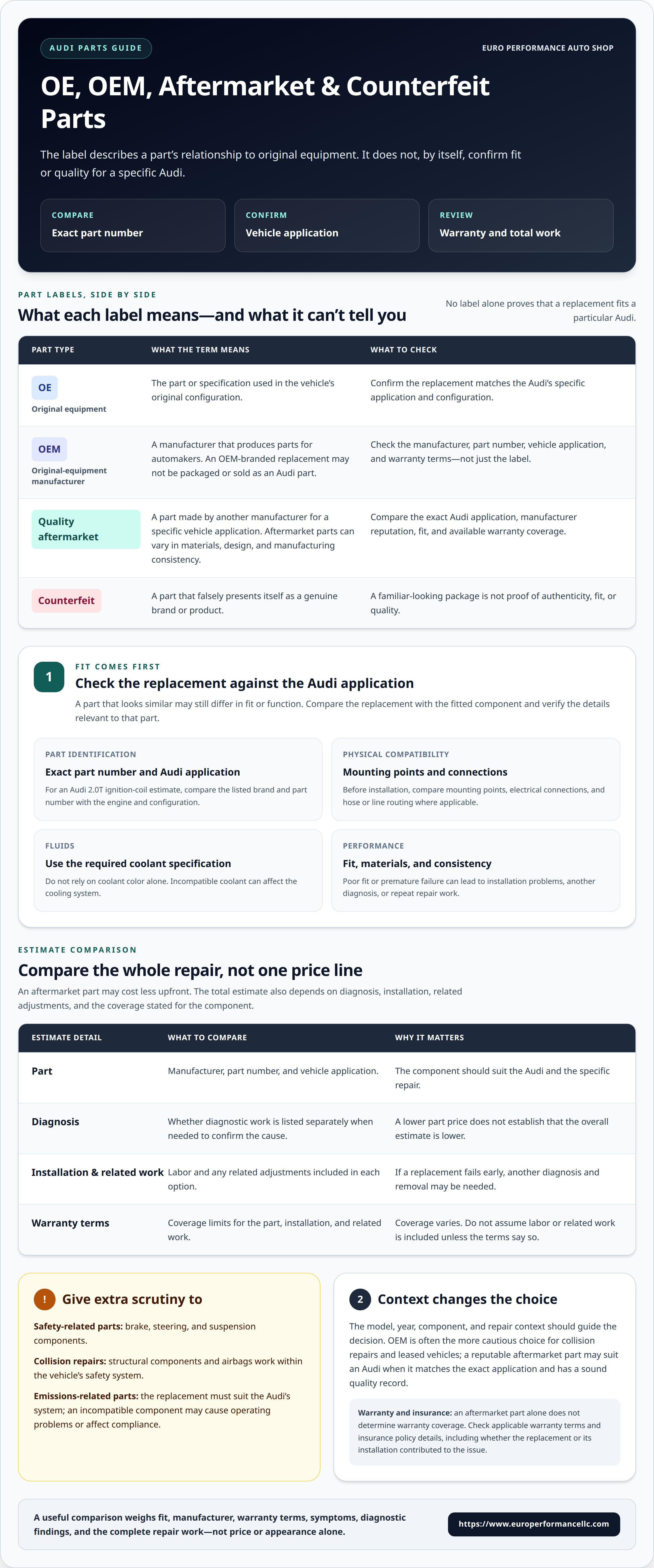
A replacement should match the Audi’s application and connect correctly with the components already fitted. Before installation, compare mounting points, electrical connections, and hose or line routing. For coolant, check the required specification rather than relying on color. Incompatible coolant can affect the cooling system. A part that looks similar may still differ in fit or function, causing installation problems or further repairs.
Comparing Aftermarket Brands
Aftermarket brands can vary in design, materials, and consistency, so a familiar-looking package doesn’t establish equal quality. Compare the exact part number and Audi application, then consider the manufacturer’s reputation and available warranty terms. As a hypothetical example, two of four low-cost aftermarket ignition coils on an Audi A4 might fail within a month. This illustrates why price and brand tier deserve attention, not that every aftermarket coil will fail.
Warranty, Insurance, and Emissions Considerations
An aftermarket part alone does not determine whether an Audi warranty claim is covered. Check the applicable warranty terms and whether the replacement part or its installation contributed to the failure. Insurance coverage depends on the policy and claim circumstances, including any relevant modification. For emissions compliance, the replacement must suit the Audi’s system. An incompatible emissions-related component may cause operating problems or affect compliance.
Reliability and Safety Risks
Cheap parts may use materials or tolerances that contribute to early wear, poor fit, or repeat repairs. The consequences depend on the component: a failed ignition coil can disrupt engine operation, while a poorly fitting safety-related part may not function as intended. Appearance alone cannot establish quality. If new symptoms appear after a replacement, prompt diagnosis can help determine whether the part, installation, or another fault is responsible.
What does OE, OEM, quality aftermarket, and counterfeit actually mean on an Audi?
These labels describe how a replacement relates to Audi’s original design, but none guarantees identical quality. A poor fit or early failure can mean another diagnosis and repair, so the distinction matters.
OE means original equipment: the part or specification used in the vehicle’s original configuration. OEM refers to an original-equipment manufacturer that produces parts for automakers. An OEM-branded replacement may not be packaged or sold as an Audi part. A quality aftermarket part is made by another manufacturer for a specific vehicle application. A counterfeit part falsely presents itself as a genuine brand or product. No label alone proves that a part fits a particular Audi.
Aftermarket parts can vary in materials, dimensions, and manufacturing consistency, which may affect fit or performance. A replacement that does not seat correctly or match mounting points can cause installation problems or affect alignment. If it fails early, the owner may need another diagnosis and repair, including labor to remove and replace it.
Safety-related components, including brake, steering, and suspension parts, deserve particular scrutiny. Collision repairs also call for careful parts selection because structural components and airbags work within the vehicle’s safety system. A reputable aftermarket part may suit an Audi if it matches the exact application and has a sound quality record. OEM is often the more cautious choice for collision repairs and leased vehicles. The model, year, component, and repair context should guide the decision.
Aftermarket versus original-equipment pricing
An aftermarket part may cost less upfront than an original-equipment replacement, but the total estimate matters more than one line item. Compare the part charge, diagnostic work, installation, and related adjustments. The risks of using cheap aftermarket parts on an Audi are easier to assess when the estimate identifies the specific component and explains how its selection affects the work.
For an Audi 2.0T ignition-coil estimate, compare the listed brand and part number with the vehicle’s engine and configuration. Then review what the estimate includes beyond the coil itself. If diagnosis is needed to confirm the cause of an engine symptom, that work should be clear as a separate part of the repair. A lower component price doesn’t automatically mean the overall estimate is lower.
Warranty terms can also change how two estimates compare. Coverage varies by manufacturer and part, and some aftermarket parts have no warranty or guarantee. Read the terms for the replacement component, including any coverage limits. Do not assume the warranty covers installation or related work unless the terms say so. Clear information makes it easier to judge each option’s value.
Ask for an estimate that separates the part choice from labor and diagnosis. If it lists two options, compare their exact applications, coverage, and total work instead of choosing by price alone. The best value depends on the Audi, the component, and the repair requirements. A clear estimate helps you understand what you are approving and why the selected part suits the repair.
Evaluating parts brands and tiers on repair estimates
A useful Audi estimate identifies more than a part category and price. It should name the manufacturer, part number, vehicle application, and warranty terms. These details help you compare fit and support instead of treating all aftermarket components as equivalent. Installation labor matters too, since a failed replacement may require another diagnosis and removal.
For ignition coils, the engine code and Audi application help narrow the right choice. Bosch and NGK are examples of established ignition brands recommended for Audi EA888 and EA839 applications, where coil quality and durability can vary. That doesn’t mean every Bosch or NGK part fits every Audi. The exact part number still needs to match the vehicle’s engine and configuration.
To assess fit and reputation, compare the estimate’s part number with the manufacturer’s application information for the Audi’s model, year, and engine. If a supplier claims certification, identify the issuing organization and what the certification covers. A label alone does not prove compatibility with a specific vehicle. Brand reputation matters, but it cannot replace correct application data or clear warranty terms.
- Confirm the estimate identifies the brand and exact part number.
- Match the listed application to the Audi’s engine and configuration.
- Review the written warranty coverage and its limits.
- Ask whether the estimate specifies OE, OEM, or aftermarket components.
Some aftermarket parts have no warranty or guarantee, so compare written coverage before approving a repair. A strong estimate clearly identifies the parts and explains why the selection suits the Audi.
European Auto Repair in Belgrade, MT | Euro Performance
Euro Performance in Belgrade, MT, helps Audi owners weigh parts choices through European auto repair and vehicle inspections. If a replacement causes new symptoms, fits poorly, or fails early, a professional inspection can help distinguish a part issue from another fault. That distinction guides the next repair decision and helps avoid unnecessary part replacement.
For Audi owners in Belgrade, Bozeman, and the surrounding Gallatin Valley, ask Euro Performance about maintenance services. If a replacement affects wheel position or handling, an inspection can help determine whether wheel alignment is needed. The right service depends on the repair and the vehicle’s condition.
Contact European Auto Repair in Belgrade, MT | Euro Performance to discuss an Audi parts or repair concern.
Make the Next Repair Decision With Confidence
The risks of using cheap aftermarket parts on an Audi are best managed by treating each repair as a vehicle-specific decision, not simply a choice between low and high prices. Before approving work, make sure the estimate identifies the replacement and its intended Audi application. If symptoms began after a recent repair, explain when they appeared and what changed. Those details can help focus diagnosis rather than prompt unnecessary parts replacement.
Keep the estimate and repair records together. They give you a clear reference if the same component needs attention later or you’re reviewing the vehicle’s service history. For Audi maintenance, repairs, or questions about a parts recommendation, contact European Auto Repair in Belgrade, MT | Euro Performance. A careful discussion can help you choose a practical next step for your vehicle.
Frequently Asked Questions
Are aftermarket ignition coils really that different on an Audi 2.0T?
They can differ in construction, consistency, and fit, but the brand name alone doesn’t determine how a coil will perform. On an Audi 2.0T, a misfire doesn’t prove the coil is faulty; spark plugs, wiring, or another engine issue may cause similar symptoms. Diagnosis should identify the cause before parts are replaced. Match any replacement to the specific engine and vehicle application.
How do you ask a shop the right question on an Audi parts estimate?
Ask which manufacturer and exact part number the estimate includes, and whether the part is OE, OEM, or aftermarket. Then ask how it matches your Audi’s model year and engine, what warranty applies, and whether labor is covered if it fails. An estimate listing only “ignition coil,” for example, leaves important details unclear. A specific part description makes options easier to compare.
Is There REALLY a Difference Between OEM and Generic Parts?
Yes. The terms describe different sourcing, but neither label alone proves a part’s quality. OEM identifies a manufacturer associated with original-equipment production; “generic” can describe a replacement sold without that branding. A generic part is not automatically counterfeit, and an OEM label does not establish correct fit for every Audi. Check the application and manufacturer details for the specific component before choosing.
When does the cheaper Audi part actually cost you more?
A lower-priced part can cost more overall if it fails early, fits incorrectly, or requires another repair visit. Replacing a component that takes substantial access work, for example, may mean repeating some labor if the replacement fails. A recurring symptom may also need diagnosis before another part is installed. Compare the full estimate, including diagnosis, installation, and applicable warranty coverage.
What are common signs that an aftermarket Audi part is low quality or counterfeit?
Warning signs can include inconsistent branding on the packaging, missing manufacturer identification, a part number that does not match the Audi application, or poor fit and finish. These clues are not proof on their own, since legitimate parts can come in different packaging. Keep the box and paperwork, and compare the installed component’s markings with the estimate if its fit or operation raises concerns.
How much do OEM versus aftermarket Audi parts cost for brakes, suspension, and engine components?
There isn’t one reliable price for every Audi: the model, year, component, selected brand, and repair labor all affect the estimate. Brake, suspension, and engine parts also differ in scope and installation requirements. Ask for a vehicle-specific estimate that identifies the parts and labor separately. The final amount depends on the case and is provided after a quote request.